Fulcra connects AI agents across platforms with shared context
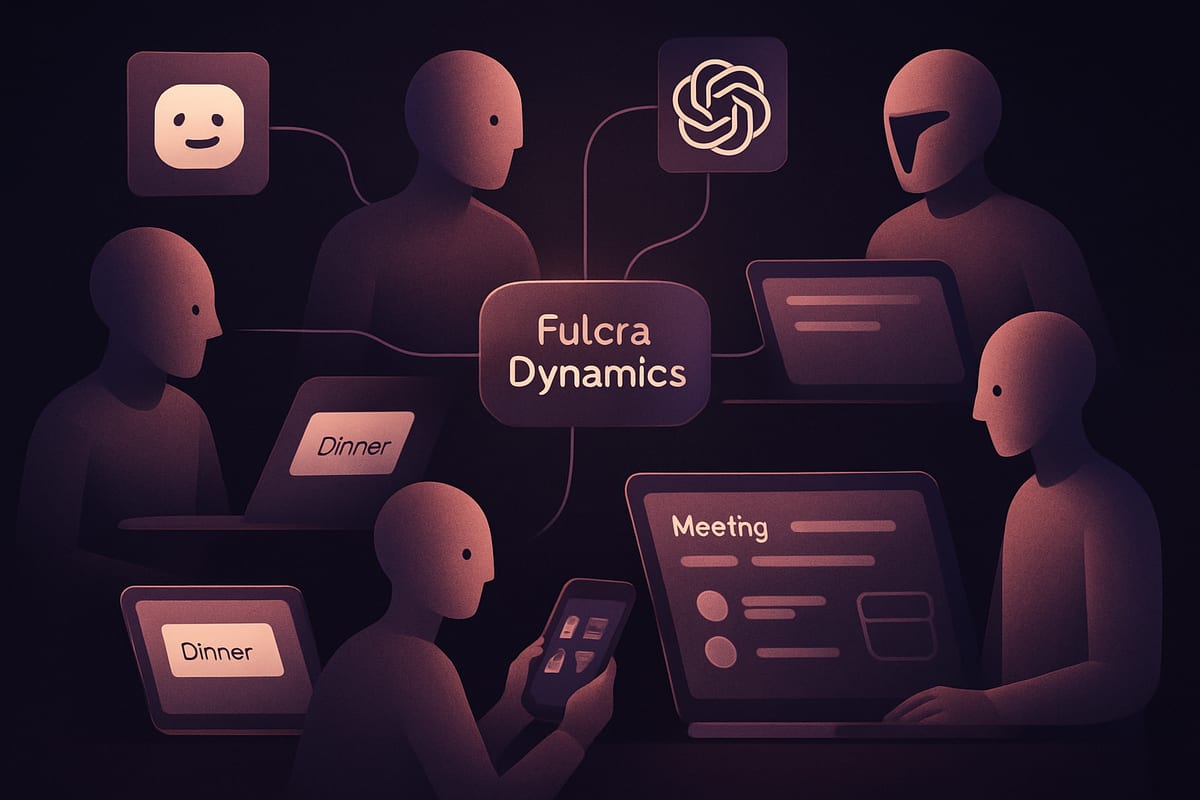
Fulcra Dynamics launches a multiplayer mode that allows heterogeneous AI agents to collaborate without changing tools. The company links this interoperability to a context layer that the user owns and controls, aiming for an alternative to the lock-in observed with Instinct.
The context belongs to the user and follows when changing agents
Fulcra presents the portability of context as a central principle. The context belongs to the user, who decides which agents can access it and what others can see. Access can be revoked, the agent changed, and the context carried over. When replacing an agent, past interactions remain accessible, allowing planning, coordination, and conversations to continue seamlessly. Transitioning from Instinct to a platform deemed more secure is possible by first connecting the Instinct agent to Fulcra, which can then capture secure conversations, and then pointing the new agent to the Fulcra account to instantly reactivate ongoing work. In a described example, David changes agents while retaining preferences and work, continuing to plan with Sarah without any action on his part. Michael Tiffany also calls on designers of alternatives to Instinct to build with Fulcra so that their agents can cooperate with those that users' friends appreciate, seeing it as a superior opportunity to separate networks.
Interoperability rather than lock-in: Fulcra's stance
The multiplayer interaction between agents became known through the Instinct application, where agents of the same type communicate. Fulcra criticizes this logic, arguing that it locks users in, limits their choices, and raises security and trust issues. The publisher has therefore designed a system that allows everyone to use the compatible agent of their choice, including Hermes, Claude, or OpenClaw, and to choose an appropriate level of security with tools that align with their usage. Fulcra describes the requirement to change agents to communicate as monopolistic and presents interoperability as a vector for personal autonomy. Michael Tiffany praises Instinct's demonstration of the value of exchanges between agents while deeming the lock-in untenable in light of the need for interoperability. He advocates for the freedom to choose agents and their ability to communicate, a goal that guided this feature. Brandon Creighton emphasizes the rapid evolution of the market, noting that the current agent may not remain the best choice, and advocates for interchangeable agents and extensible use cases, while preserving the context held by the user.
A "shared space" to coordinate heterogeneous agents
The multiplayer mode presents itself as a shared and authorized space within which agents communicate and coordinate, without imposing a new chat account or agent identity. Each agent only accesses the context and actions that its owner has explicitly permitted. Announced in Boston on September 18, 2026, the capability aims at concrete scenarios where agents from different harnesses, such as Claude, ChatGPT, Hermes, or OpenClaw, are connected to manage interpersonal tasks. The instant connection of one's agent to that of a third party should cover cases such as planning dinners, meetings, or projects.
Le brief IA que les pros lisent chaque soir
Les 7 actus IA du jour, décryptées en 5 min. Gratuit.
Inclus dès l'inscription : notre sélection des meilleurs guides & comparatifs IA.
Choisissez votre rythme
Gratuit · Pas de spam · Désabonnement en 1 clic
Context sharing: data timeline and shared awareness
Beyond messaging between agents, Fulcra adds a context layer that stores, normalizes, and inscribes data on a timeline. The platform highlights a standard and native schema for interpreting data and its changes. Agents query this layer to identify developments and, guided by instructions, use it to perform tasks in human-agent or agent-agent flows. According to the publisher, this architecture enhances communication between agents that share situational awareness. Agents can consult an ongoing plan, detect changes from the shared context, while respecting boundaries: a member can communicate a scheduling constraint without revealing their reasons, and belonging to a group does not grant access to all knowledge held by each agent.
Expanded groups without changing tools, invitations, and preferences
Exchanges between agents extend to groups without each member needing to create an account on a specific platform. Fulcra argues that this requirement poses security and trust risks for some, and discomfort for others. Groups can grow without changing harnesses, with inter-group context sharing set to enhance the experience over time. In the described scenarios, an invitation allows a person not yet using an agent to discover the sender, the plan, and the interest of an agent, activate one, and join the ongoing preparation. Their agent requests useful information, such as the suitability of a date or dietary preferences; the user can respond and enrich the context later. Subsequent invitations build on the experience, and with permission, agents remember favored locations and preferences. They can also identify new opportunities and suggest plans. In another example, a trip to New York triggers a dinner proposal, adjusted by the agents in light of constraints such as an early return or a delayed appointment, with plans submitted for approval.
Starting and expanding use cases, from personal life to work
To test the service, the user directs their agent to the provided URL, then assigns it the task of organizing a dinner with a specific group and sending invitations to their friends. Each invitation allows the recipient either to join the organization via their own agent or to create one, with coordination continuing autonomously between agents. Fulcra specifies that it will be possible to pick up exactly where one left off later, with more information available. The announced use cases cover organizing children's birthday parties, professional events, retreats, or trips, as well as work-related activities around meetings. Coordination of dates, budgets, preferences, and itineraries among travelers, synchronization of tasks and documents in projects, management of bills and responsibilities within a household, client-company dialogue via agents, or interviewing stakeholders before a product launch are also envisioned. Fulcra indicates that development took four years and was carried out by a team from VeraCode and Human, which designed solutions protecting over 30% of internet traffic from bots. On the product side, the publisher highlights a centralized context API owned by the user, providing shared access to each authorized agent, as well as a feature called "The Context Lake."
Brief IA — L'actualité IA en français
L'essentiel de l'actualité de l'intelligence artificielle, décrypté et expliqué chaque jour.