Gemini Flash Analyzes Videos by Agents, at No Extra Cost
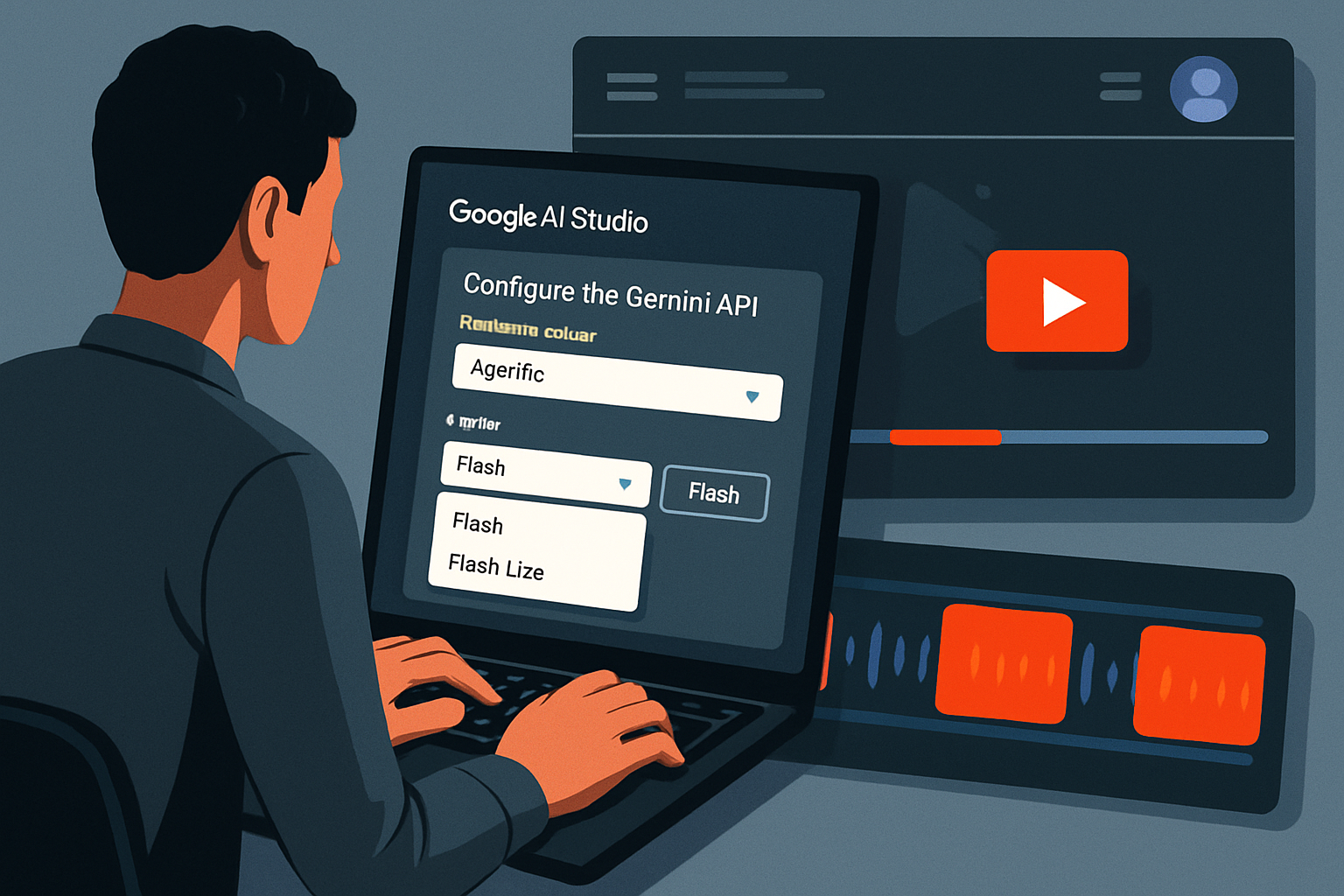
Google activates an agentic video analysis in several Gemini Flash models. The company claims substantial savings in tokens and costs, with immediate availability via the API and deployment announced in its products.
Access via API, Supported Scope, and Unchanged Pricing
The new video analysis can be used for uploaded files and YouTube videos through the Gemini API, in Google AI Studio, and on the Gemini Enterprise Agent Platform. It is particularly useful for finding specific scenes in long videos. Developers enable an agentic processing mode in the configuration. This option incurs no additional fees: billing follows the standard rates of the Gemini API. A developer guide details the implementation.
Token and Cost Savings Claimed by Google
Google claims up to 88% savings in tokens and a 66% reduction in costs, while also mentioning increased accuracy. In its own evaluations, including LongVideoBench, the company attributes the best overall quality and the best trade-off between accuracy and cost-effectiveness to Gemini 3.7 Flash in agentic mode. In its 1H-VideoQA evaluation, the same variant achieves, according to Google, the highest accuracy for the lowest cost per query.
What the Agentic Approach Changes in Video Processing
The analysis shifts from a fixed-frame image-by-image scan to a model-driven approach that connects its reasoning to native video tools. The model selects the passages, the review speed, and the modalities used, whether they are images, audio, or transcripts, and retrieves only the necessary signals. For this, Gemini relies on an internal tool capable of extracting only the relevant portion of the file. Where developers could once cobble together a similar selection, the model now autonomously manages this targeted retrieval loop.
Le brief IA que les pros lisent chaque soir
Les 7 actus IA du jour, décryptées en 5 min. Gratuit.
Inclus dès l'inscription : notre sélection des meilleurs guides & comparatifs IA.
Choisissez votre rythme
Gratuit · Pas de spam · Désabonnement en 1 clic
New Capabilities and Limitations of the Old Pipeline
The 3.7 Flash, 3.6 Flash, and 3.5 Flash-Lite versions detect moments shorter than a second, including state changes or hard-to-see cuts at a rate of one frame per second. They locate scenes within hours of video without using millions of tokens, resample at a higher rate suspicious windows, and accurately count repeated movements and objects over time. In contrast, the old pipeline by default used static sampling of one frame per second, a setting that could be modified via the API. Since 2025, Gemini has been transcribing the audio track and analyzing images every second.
Origin of the Method and Product Expansion Timeline
This approach is part of the agentic vision introduced for Gemini 3 Flash in January, where the model could write and execute Python to zoom, crop, and annotate images, with a reflection-action-observation loop to validate results. At launch, this functionality was not automatic in all cases. During the presentation of Gemini 3 Flash in December, the upcoming arrival of visual and spatial reasoning applied to video was mentioned. The efficiency benefits mainly manifest in long-duration videos, ranging from 10-minute tutorials to 90-minute lectures, and even multi-hour recordings. Regarding the roadmap, future integration into the Gemini app and YouTube is announced, with deployment planned for all users on Flash and Flash Lite devices, as well as upcoming support for Ask YouTube directly on the playback page.
Brief IA — L'actualité IA en français
L'essentiel de l'actualité de l'intelligence artificielle, décrypté et expliqué chaque jour.