General Intuition: €2.3 Billion Bet on AI and Video Games
Le brief IA que les pros lisent chaque soir
Les 7 actus IA du jour, décryptées en 5 min. Gratuit.
Inclus dès l'inscription : notre sélection des meilleurs guides & comparatifs IA.
Choisis ton rythme
Gratuit · Pas de spam · Désabonnement en 1 clic
An Immersion in General Intuition's Innovation
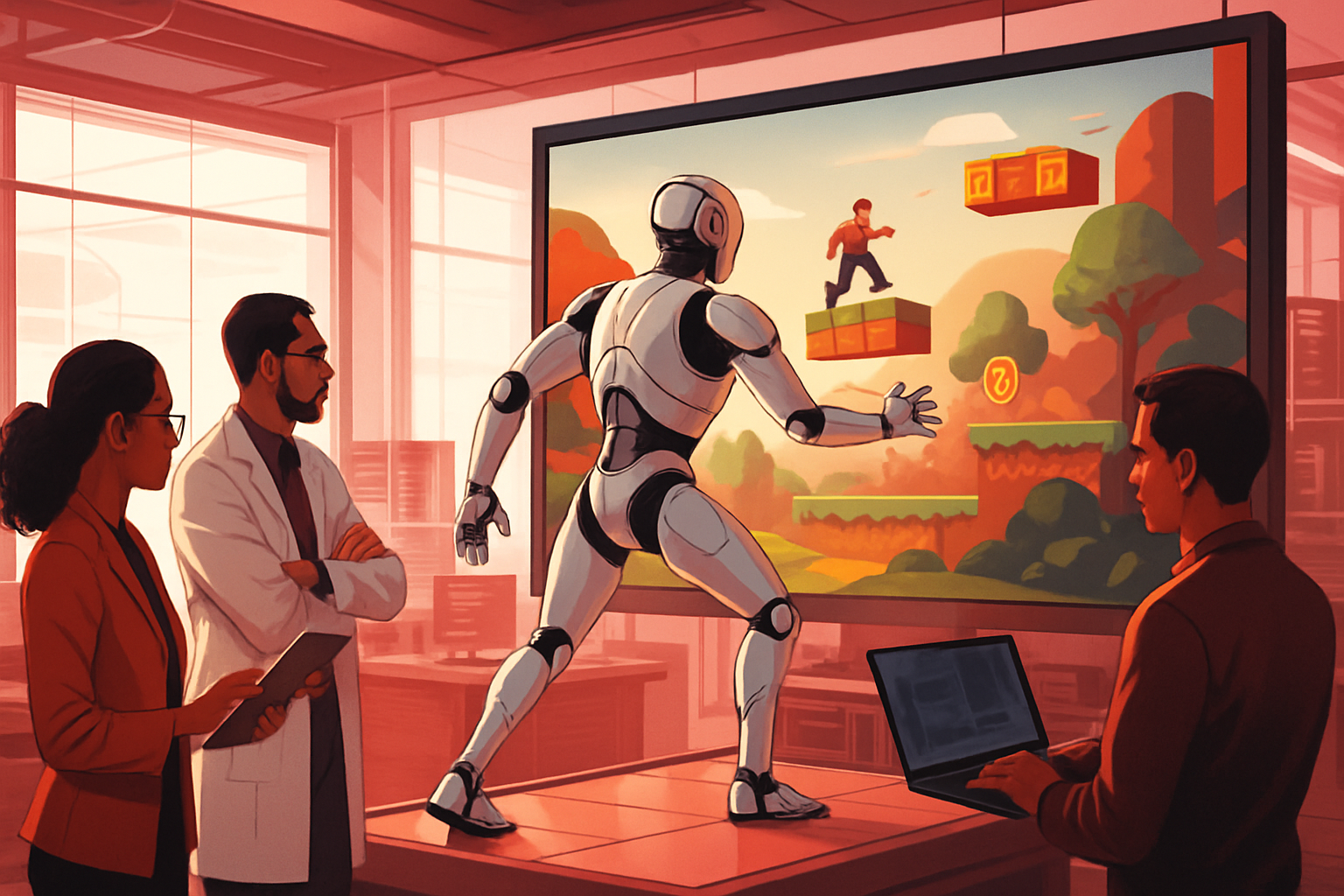
Entering the research and development center of General Intuition in New York, one is immediately immersed in a universe where technology and video games meet in innovative ways. Pim de Witte, the 31-year-old co-founder and CEO of the company, welcomes me and directs me to a screen where an artificial intelligence agent appears to be playing a game reminiscent of Fortnite. What is impressive is that this agent has played uninterrupted for 100 hours, according to Kent Rollins, the company's product director.
As I prepare to observe the AI in action, a quadruped robot approaches, its electronic footsteps echoing in the room. Pim de Witte explains that the same algorithm controlling the agent in the game also animates this robot. Josh Duplantis, a data analyst, shows a live feed from the robot's camera, highlighting that its default mode is exploration. The robot, equipped with a single camera, navigates the space, occasionally bumping into objects like a child learning to walk. Interestingly, it took only eight minutes of real robotics data to refine this AI model for the quadruped. This data was collected on the street, not inside the office where the bot was currently navigating.
Promising Technology Backed by Major Investments
General Intuition recently announced a funding round of $320 million, bringing its valuation to $2.3 billion. This announcement confirms reports from TechCrunch and raises the total funds raised by the startup to $454 million since its inception. The company was created from Medal, a platform that allows players to upload and share video game clips. The hundreds of millions of hours of gameplay uploaded provided the initial dataset to train General Intuition's model.
At the heart of this technology lies the use of action labels embedded in gameplay clips, which accurately record players' actions. Unlike other companies that merely analyze videos, General Intuition uses this data to develop a model capable of understanding and interacting with the real world.
A Unique and Ambitious Training Model
Pim de Witte allowed me to test General Intuition's global model, a simulated environment where agents learn to interact with their surroundings. Unlike other simulations, this model has integrated millions of hours of gameplay, enabling it to understand concepts such as wall solidity or the use of ladders.
For General Intuition, this environment is merely a training tool. The ultimate goal is to sell the agentic model, which, thanks to the action data from games, can distinguish the "self" from the "environment" and understand causality more deeply.
A Bet on the Future of AI and Robotics
While General Intuition's technology is impressive, it is not unique in its quest to create models capable of functioning in the physical world. However, the startup firmly believes that using video games as a training base is an effective and scalable approach.
Investors share this vision, with figures such as Jeff Bezos and Eric Schmidt backing the project. The latest funding round was led by Khosla Ventures, with participation from General Catalyst, Jeff Bezos, Eric Schmidt, Nico Rosberg, and researchers from Google DeepMind and MIT. This funding will primarily be dedicated to increasing computing capacity and improving the company's API. General Intuition has an agreement with CoreWeave to enhance this computing capacity. Part of the funding has also been reserved to make General Intuition's API more widely available by the end of summer.
Vinod Khosla stated that human action data and reaction data in games are key to the emergence of intuition in AI.
A Company Guided by Ethical Values
General Intuition also stands out for its ethical commitment. Pim de Witte, having worked in the humanitarian field, insists that the company's technology will never be used for offensive military purposes. The company aims to focus on beneficial applications, such as search and rescue missions.
De Witte, originally from the Netherlands, has recruited a largely European team, thereby influencing the company's culture. He also launched Nerve, a platform that allows players to earn money by participating in tasks like data labeling, thus providing opportunities for those who might be affected by automation.
Towards an Innovation Ecosystem
General Intuition aspires to become an ecosystem facilitator, similar to Anthropic or OpenAI, by providing models on which other companies can build. Currently, the startup collaborates with clients in the gaming, simulation, and robotics sectors.
The company is already testing its models in various contexts, ranging from quadruped robots to drones, and plans to expand its scope. By carefully selecting its partners, General Intuition hopes to continue collecting unique data that will strengthen its models and advance AI research.
Vinod Khosla, a key investor, emphasizes that General Intuition's proprietary data is essential to its future success. While challenges remain regarding the large-scale application of these models in the real world, the company remains optimistic about its ability to overcome these obstacles.
The Vision of a Generational Company
General Intuition relies on data from Medal's video clips. Brianna Martin, the startup's chief of staff, stated that the company was born, in part, after Medal turned down an acquisition offer from a large lab. Other offers have also been made since.
De Witte and his co-founders, Eloi Alonso, Adam Jelley, and Vincent Micheli, are not interested in an acquisition, and the startup's investors are not yet seeking an exit. The quantity and quality of the proprietary data that General Intuition possesses through Medal is one of the reasons Khosla is convinced that the startup is a generational bet, rather than a merger-and-acquisition target; that it could become the backbone for generalized agents and global models in simulation and the real world.
“At this stage, it would be a data acquisition, which is a bit uninteresting,” Khosla said.
Part of this bet also involves trusting de Witte's values.
The entrepreneur spent three years working in the humanitarian field, including with Médecins Sans Frontières. As such, he has drawn a clear line regarding how General Intuition's technology will be used: no agent will be employed to harm humans.
“We don’t want to be a part of the escalatory system,” de Witte said. “Let’s say I were to announce: ‘We are doing lethal autonomy.’ What do you think would happen in other countries?”
This limitation on military use cases comes as Silicon Valley becomes increasingly optimistic about war, although de Witte expresses happiness that his models are being used for search and rescue missions.
De Witte was born in the Netherlands, and much of his team is European, shaping the company's identity. He stated that he recruited Martin partly due to her decision to publicly leave Palantir because of its work with the U.S. Immigration and Customs Enforcement.
“I don’t know why Silicon Valley does what it does,” he said. “There’s a reason I’m not there.”
De Witte's ethics not only limit what the models will not do. As a player who earned $1.5 million by building and hosting a private RuneScape server in his youth, de Witte also thinks about what happens to those left behind by what AI models can do.
General Intuition recently launched a platform called Nerve, a job marketplace that allows players to earn money using their existing setups. Those who sign up start with data labeling and can eventually move on to teleoperating robots and other tasks. The Medal user base, de Witte noted, is precisely the generation most exposed to displacement by AI, and he wants them to have a stake in what comes next.
De Witte wants General Intuition to be an ecosystem facilitator, like Anthropic or OpenAI — a provider of models that enables others to build on its technology. Today, the startup has a few clients in the fields of gaming, simulation, and robotics.
“We are not going to build a self-driving car company,” de Witte said. “We are going to make it ten times easier for the next person to build a self-driving car company.”
The company claims that once it puts its API in the hands of more clients, it will be able to test its value with a variety of use cases — such as testing a robot in a digital twin of a manufacturing floor, powering a humanoid bot in a gaming studio, or sending a quadruped to navigate hazardous environments.
Although a quadruped is the first physical incarnation that General Intuition has tried in the real world, it has also tested drones and other devices, including the model in driving games.
“It works on anything you can control with a game controller or a keyboard-mouse,” de Witte said.
The ability to build a data cycle is one of the goals.
“We are going to choose clients where we can diversify the incarnations that this generalized foundational model serves as a backbone,” de Witte said. “We will therefore prioritize client selection based on their ability to provide real data that will be interesting and useful for advancing research. And if they have an agile internal team where we can be true integrated partners and learn from each other.”
Khosla stated that General Intuition's proprietary data is what has brought it this far, and its ability to continue collecting data that no one else has will be essential. Especially because, despite impressive demonstrations, the question of whether the transfer from simulation to the real world can hold at scale remains open and has not yet been fully answered.
Brief IA — L'actualité IA en français
L'essentiel de l'actualité de l'intelligence artificielle, décrypté et expliqué chaque jour.