Goldman Sachs Aims to Pass on Its "Tribal Knowledge" to Its AIs
Le brief IA que les pros lisent chaque soir
Les 7 actus IA du jour, décryptées en 5 min. Gratuit.
Inclus dès l'inscription : notre sélection des meilleurs guides & comparatifs IA.
Choisis ton rythme
Gratuit · Pas de spam · Désabonnement en 1 clic
At Goldman Sachs, the challenge is no longer just about deploying AI agents, but about integrating the firm's standards and practices. According to CIO Marco Argenti, over 12,000 developers are already using them, and the effort is focused on tools tailored for the bank, from cloud migration to security. The firm invested approximately $6 billion in AI last year, in a sector that demands concrete evidence of return.
Engineers Pilot Agents and Juniors Coach Veterans
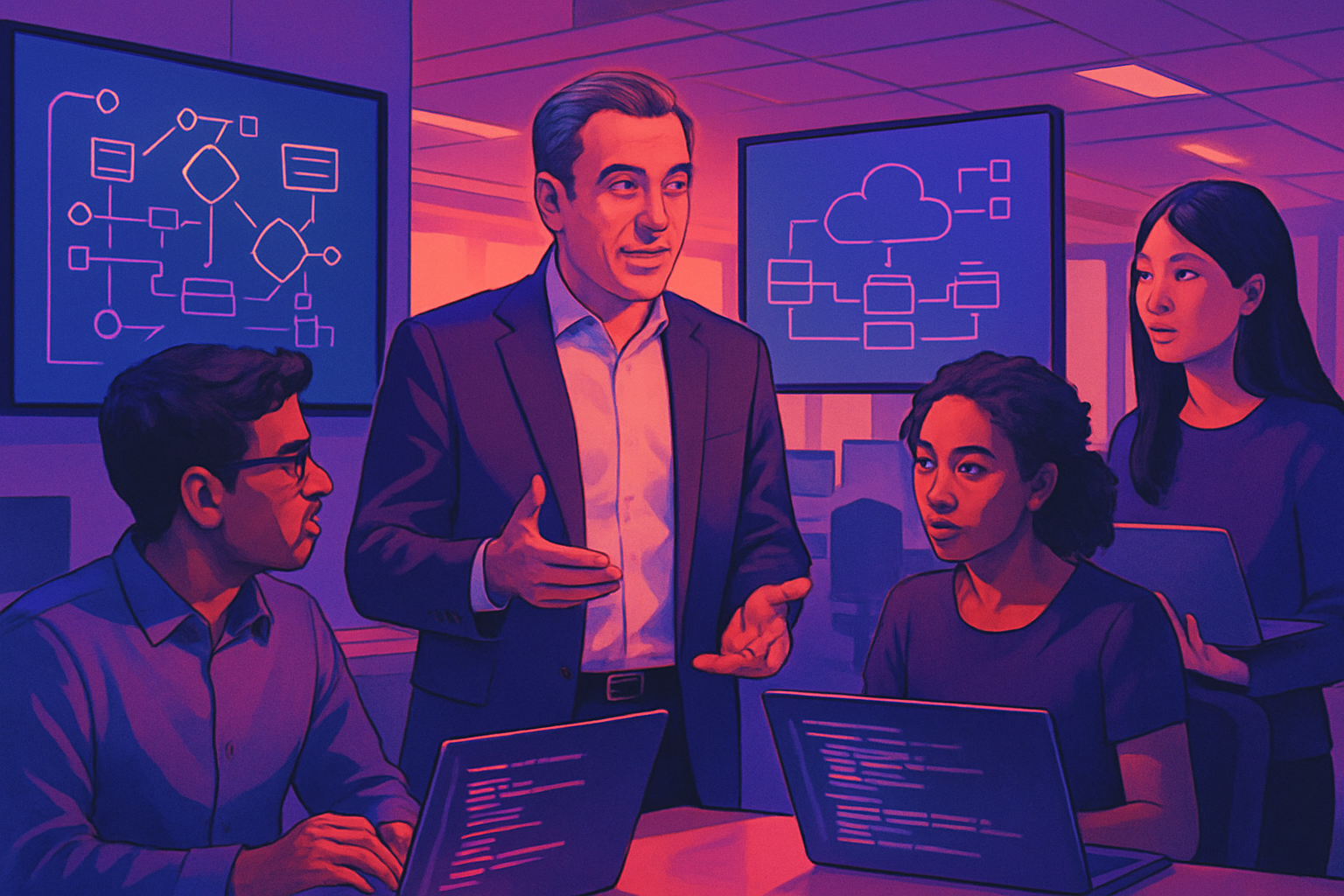
At the current stage of deployment, engineers are spending less time writing code and more time ensuring that their agents adhere to the company's standards, Marco Argenti notes. He describes this shift as profound and believes it will become relevant for other business lines. AI is also changing mentorship relationships among humans: junior employees are now guiding veterans in the use of these tools, in both structured and informal formats. Other groups are also experimenting; at Citi, thousands of employees have volunteered to act as "AI accelerators" for their colleagues.
Goldman Formalizes "Skills" to Encode Its Implicit Rules
To capture the practices unique to Goldman, the bank has designed "skills"—sets of reusable instructions to accomplish specific tasks—that encapsulate design principles, data models, and internal environments. One of these, "cloud fast track," teaches AI what constitutes a good cloud migration in the context of Goldman, making the tools more useful to those managing these migrations. Marco Argenti emphasizes that unwritten rules are the hardest to formalize, which is why they chose to systematize them through assessments. He adds that developers must teach agents "tricks and tribal knowledge" that technology cannot deduce on its own.
12,000 Developers and Agents Like Claude and Devin
Marco Argenti faces a central question: how to convey the subtleties of Goldman Sachs' engineering culture to a bot. More than 12,000 developers at the bank use AI, and all have access to updated agent technology, including Claude and Devin, Cognition's coding assistant. Teams must now determine how to "mentor" these agents, much like a newcomer who is not yet familiar with the company's standards. An agent familiar with Goldman’s data standards or security protocols can produce better work that is quicker for engineers to review. "Transferring institutional knowledge into AI is the biggest question," summarizes the CIO, who also asks: what does an experienced GS AI look like compared to a naive AI? For him, the main challenge for AI engineers has evolved: it is about transferring knowledge to tools that are now specific to Goldman.
$6 Billion Invested and Principles to Translate into AI
Goldman has dedicated approximately $6 billion to AI last year and, like its peers, is under increasing pressure to demonstrate the returns on these investments. Jamie Dimon, CEO of JPMorgan, states that spending on AI has become a prerequisite for remaining competitive. In this context, Goldman highlights its "engineering principles" published on its website, such as "innovate incrementally" and "look around corners," guidelines that are more subjective and therefore harder to grasp for tools than repetitive instructions. Marco Argenti also notes that, in banks, developers often rank among the most seasoned users of AI.
Brief IA — L'actualité IA en français
L'essentiel de l'actualité de l'intelligence artificielle, décrypté et expliqué chaque jour.