Google Ads Expands Conversion Lift to Search
Google indicates that Conversion Lift per user now covers search and Performance Max, with at least 1,000 observed conversions and a minimum study budget of $5,000. Access remains limited to certain accounts. These tests aim to measure additional conversions, distinct from those attributed to campaigns.
Google provides the tools but also counts conversions
Google Ads gathers a vast amount of data almost instantly, but Google sells the clicks for which it then measures conversions. The expanded coverage of Conversion Lift is included in its updated guidelines from early October. Another version of the tool establishes its control groups and test groups by region, also accepting offline data.
Google also offers Meridian GeoX, an open-source library dedicated to geographic experiments, generally available since September 10. On this occasion, the company announced the integration of brand signals into Meridian's marketing mix models, including the volume of brand searches on Google. This indicator is collected from its own services and feeds into a model used to decide, among other things, the spending that will be allocated to it.
Out-of-home advertising is preparing for a change in audience measurement. On March 31, 2026, Geopath and the OAAA selected Ipsos for a pilot scheduled for the second half of the year, aimed at providing continuous forecasts comparable to other channels. Chris Grosso, CEO of Intersection, considers this a major evolution: in his view, the current method assigns unchanged value to impressions regardless of the seasons. Intersection notes that its leader sits on the boards of both organizations.
Intersection distinguishes between purchasing speed and business results
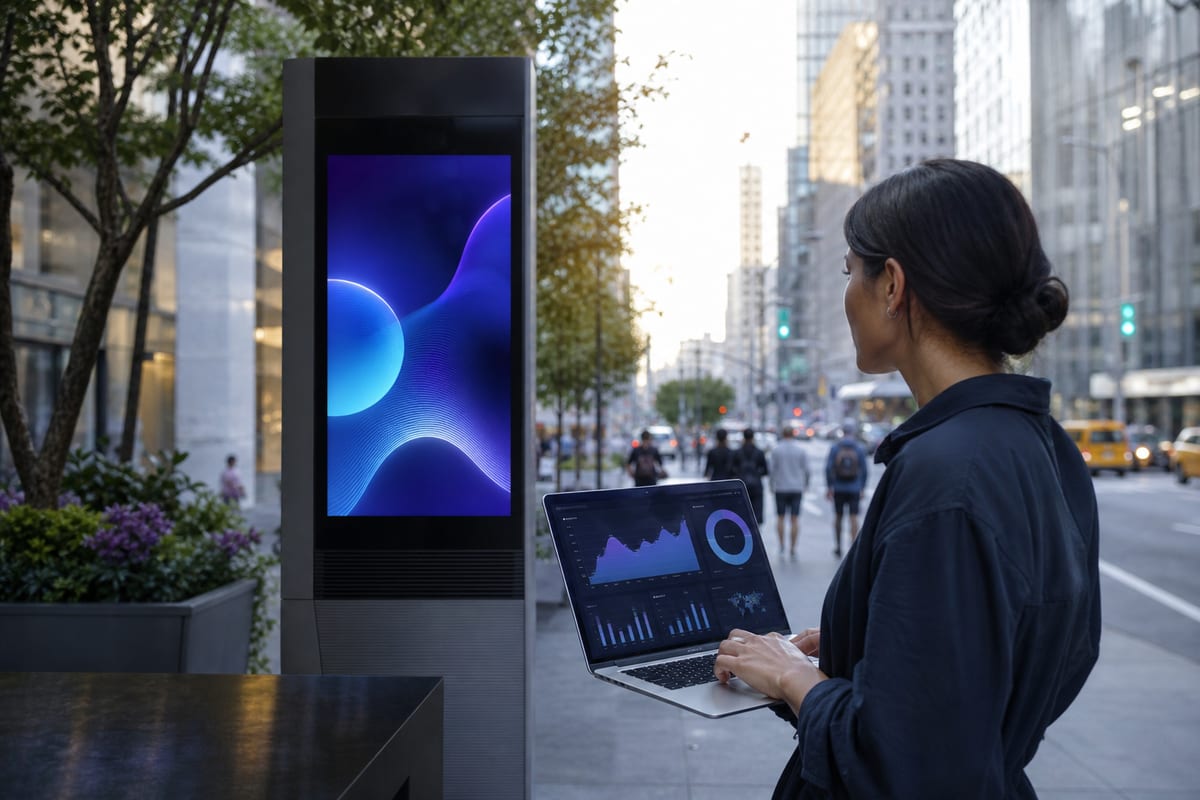
For Chris Grosso, the contribution of AI primarily lies in simplifying operations, not in demonstrated commercial efficiency. Intersection, the out-of-home media company behind LinkNYC, sells ads on street kiosks and operates in a market it describes as highly fragmented. The CEO claims that AI accelerates purchases and allows for more to be made, without asserting that it improves campaign results.
In Google Ads, Performance Max and AI Max group campaigns, generate content, and identify queries that an operator had not added. The time saved is distinct from an increase in additional sales achieved at the same spending level compared to the previous setup. The performance reported by Google for its AI campaigns is calculated by Google itself. Smart Bidding leverages recorded conversions to adjust bids, but attribution does not specify which buyers would have come without an ad.
The time saved and cost per acquisition can thus be tracked separately from additional conversions per dollar, or incremental return on ad spend, known as iROAS, measured by an experiment. An improvement limited to early indicators does not demonstrate additional growth. Grosso also warns that the speed of obtaining results does not guarantee the quality or representativeness of the data. He recommends that marketing departments focus on sustainably tracked indicators: a narrow financial reading risks neglecting brand and long-term growth.
The AI brief the pros read every evening
The 7 best AI stories, the essentials in 5 min. Free.
Included when you join: our pick of the best AI guides & comparisons.
Choose your rhythm
Free · No spam · Unsubscribe in 1 click
How Intersection measures campaigns without clicks
Without clicks to account for, out-of-home advertising relies on control groups, pedestrian movements, and brand indicators. Grosso explains that Intersection compares the results of people exposed to a campaign with those of people not exposed. A subsequent search in a search engine or AI assistant does not alter this distribution; when a pixel detects a digital event, it can be linked to the exposed group. For commercial signs, the comparison focuses on the likelihood that exposed devices enter a geographic area.
Grosso distinguishes several levels of tracking: channel coverage and frequency, including their additional contribution to the overall media plan; signs of interest such as website or store visits; and actual transactions. However, he notes that it is difficult to demonstrate a causal link between a search ad and a click, as the latter can also result from years of brand communication.
According to the CEO, a product integrated with ChatGPT and Gemini, developed by a partner of Intersection specializing in brand surveys, collects 2.35 million unique AI conversations per 30-day period. During the launch of a meal at a major fast-food chain, such a device could analyze the searches of people exposed to that meal in assistants, as well as their visits. Grosso specifies that this additional visibility on the journey does not resolve last-click attribution.
Comparing campaigns across regions
To examine a brand search campaign before a budget increase, Conversion Lift per user is an option when the account is eligible. A geographic comparison can otherwise rely on pausing ads in comparable regions for two to four weeks, against regions where they remain active. The measurement then covers all brand conversions, both organic and paid, with a constant budget, creative, and bidding strategy. Google recommends a minimum of two weeks for its lift studies.
The contribution of an offline campaign can also be examined based on airing dates and market areas, or DMAs, of out-of-home, television, or radio advertising. Brand search impressions, share of impressions, and cost per click are then compared between exposed and non-exposed markets. A geographic experiment or GeoX can then be used to estimate the share of brand searches generated by these media.
Intersection makes its screens accessible to assistants
In May, Intersection opened the management of its orders to AI assistants: the company announces that brands and agencies can prepare and book campaigns on over 7,000 digital screens from Claude or ChatGPT. The connection relies on Model Context Protocol and OpenDirect 2.0, an IAB Tech Lab specification.
According to Grosso, programmatic purchases now represent more than 10% of Intersection's business, a proportion he says is rapidly increasing. He claims that buying platforms optimize their campaigns using AI and believes that out-of-home advertising is reclaiming demand that was previously directed toward the open web, which AI would undermine. Intersection has a direct commercial interest in this reading of budget shifts.
AI companies themselves are among the advertisers. In its S-1 filing submitted on October 26, Anthropic reports advertising expenses of $33 million in 2024, and $147 million in 2025. The company attributes this increase to greater media and public relations investments surrounding its launches.
Brief AI — AI news in French
The essentials of artificial intelligence news, decoded and explained every day.