Google aims to unify professional work with the Gemini agent
Le brief IA que les pros lisent chaque soir
Les 7 actus IA du jour, décryptées en 5 min. Gratuit.
Inclus dès l'inscription : notre sélection des meilleurs guides & comparatifs IA.
Choisis ton rythme
Gratuit · Pas de spam · Désabonnement en 1 clic
Google Cloud introduces an agent designed as a gateway to enterprise work, capable of leveraging multiple models and operating end-to-end. The offering emphasizes security and budget control, but does not specify pricing or a timeline. Sector-specific variants and deep integration with Workspace are announced.
Controlled Costs and Uncertainties Regarding Pricing and Availability
Google states that the price per token has dropped by 98% since 2024, while noting that increasing volumes are driving up AI bills. Automatic routing between models is presented as a way to reserve the most expensive ones for tasks that justify their use. Regarding budget control, administrators can set a spending cap per project in the Google Cloud billing console, and the agent pauses when this threshold is reached, until manually restarted. Despite these safeguards, Google has not communicated any pricing or availability timeline for the Gemini agent. The company continues to use the term Gemini Enterprise for client deployments, without clarifying the agent's role in this offering or in the Workspace packages. In terms of governance, every action is logged under its name, and all traffic passes through Agent Gateway, a dedicated network firewall that enforces company rules.
The Gemini Agent Organizes Work Execution in Enterprises
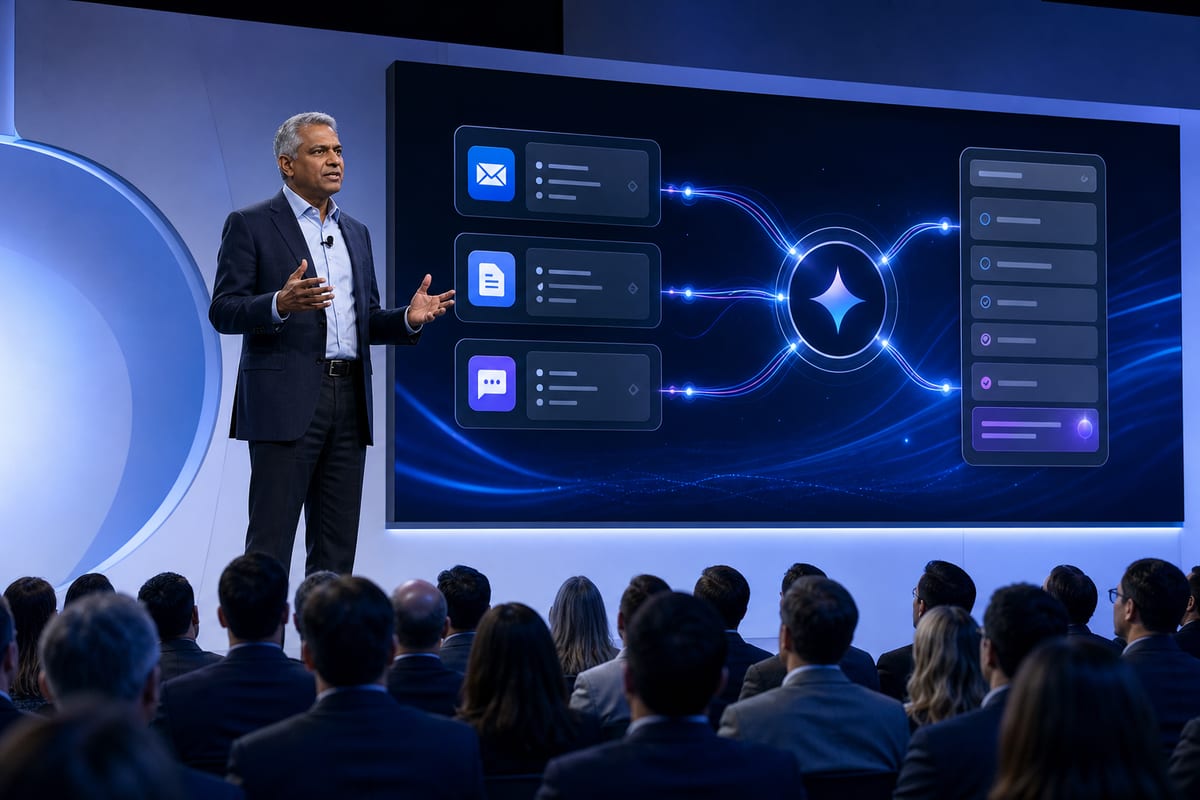
The Gemini agent takes on a goal set by the user and organizes the execution of work. It selects its skills and tools, connects to existing software or MCP servers, operates in the cloud, and maintains a coherent memory across channels, from Microsoft 365 to Slack. Multi-day tasks can continue after the computer is shut down, and temporary sub-agents are created for intermediate steps with their own identity. The agent is not tied to a single model and can direct a task to either Gemini or Claude from Anthropic, with other proprietary and open-source models announced. The entire system is presented through a unique interface and API, with the stated ambition that work begins in the prompt window.
Sector-Specific Variants and Direct Presence in Workspace
Google plans sector-specific versions of the agent equipped with dedicated skills and connectors. Variants for finance and legal are in preview, while public sector, healthcare, and retail are announced without a date. In Workspace, the agent interacts within emails and documents and can suggest tasks to delegate, such as creating a presentation with one click. Teams can create a colleague agent by describing the expected role; it receives a Workspace account with an address in the format @agents.enterprise.com, a calendar, a Drive, and a listing in the directory. It can be mentioned in Chat or comments, its modifications are tracked under its name, and it only accesses content shared with it.
A Trajectory Launched in 2025 and Already Widespread Use
The agent strategy is a continuation of Gemini Enterprise, launched in October 2025 and having integrated Agentspace. This platform functions as a catalog where companies create no-code agents via Agent Designer or select agents offered by Google and its partners. On the consumer side, Gemini Agent was introduced in November 2025 as an experimental feature of the Gemini app for American AI Ultra subscribers. Google claims that today nearly 80% of Google Cloud customers use its AI products and that nearly 90% of Fortune 100 companies utilize Gemini Enterprise, suggesting that organizations are moving beyond the experimentation stage. The promotion of the Gemini agent was highlighted during the Gemini at Work 2026 keynote by Thomas Kurian.
Brief IA — L'actualité IA en français
L'essentiel de l'actualité de l'intelligence artificielle, décrypté et expliqué chaque jour.