Google and Kaggle Offer Free Course on AI Agents
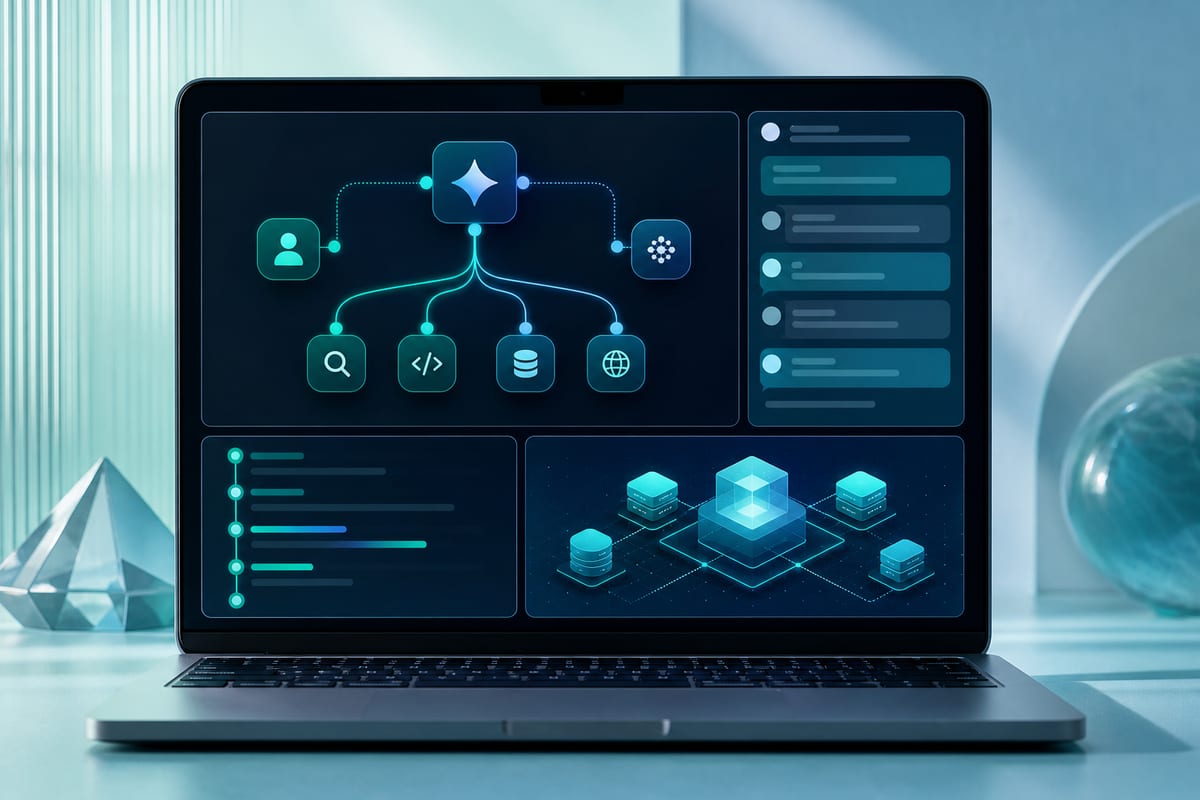
Google and Kaggle are offering a free 5-day training program for AI agents on Kaggle, which can be completed independently. It initially took place live from November 10 to 14, 2025. The program covers everything from building an agent to deploying it, focusing on tools, memory, and evaluation.
Evaluating an Agent's Path and Response
An agent can provide a correct response while unnecessarily multiplying its tool calls. In one example from the training, it invokes the correct tool three times when a single invocation would have sufficed: the result remains the same, but the cost is three times higher. Therefore, the evaluation also considers the operations performed, the tools selected, and their order of use.
With the same input, the steps taken can vary between executions. For this reason, the program addresses quality from the design phase rather than relying on a final verification. Observability is based on execution logs, traces, and metrics; the traces detail the path taken to allow for diagnosing an incorrect response. Repeated evaluations help quickly detect regressions.
Enabling Communication and Deployment of Agents
Facilitating communication between agents developed by different teams, using distinct languages or software frameworks, requires a shared mechanism. Agent2Agent meets this need: the protocol allows an agent to be exposed as a service, while an agent card enables others to identify its capabilities. This aspect is covered on the final day, dedicated to moving beyond the demonstration stage.
The execution itself depends on an executor. An in-memory version is suitable for experimentation, but real-world use requires a persistent executor. The training deploys an agent on Vertex AI Agent Engine, a managed execution environment.
The program also introduces CI/CD and AgentOps practices aimed at maintaining agents post-launch. The SDK is not limited to Python: it is also available for Go and Java.
Descriptions Guide Tool Selection
The operation of an agent relies on a cycle: the model selects an action, uses a tool, examines the returned result, and then determines the next steps. These tools extend its capabilities beyond text. For a functional tool, the model relies solely on its description when deciding how to invoke it.
The program distinguishes four families. Integrated tools accompany the model, like Google Search, while functional tools provide access to the developer's Python functions. Another category delegates a sub-task to an agent while maintaining control of the conversation. Finally, MCP is the protocol used to connect to external services without writing a specific client for each.
Le brief IA que les pros lisent chaque soir
Les 7 actus IA du jour, décryptées en 5 min. Gratuit.
Inclus dès l'inscription : notre sélection des meilleurs guides & comparatifs IA.
Choisissez votre rythme
Gratuit · Pas de spam · Désabonnement en 1 clic
A notebook dedicates exercises to code documentation chains, type annotations, and structured results. More explicit descriptions reduce erroneous calls. For certain lengthy operations, the program also presents human validation: the agent pauses and only resumes after confirmation.
Memory Imposes Cost Choices
The model does not remember anything from one call to the next: it must be provided with the history again, along with the associated token consumption. The SDK distinguishes this history, kept short-term by the session service, from durable information stored outside the session. A memory service makes the latter accessible during subsequent conversations.
Search is conducted by keywords in the in-memory version, while managed services can search based on meaning. As exchanges accumulate, compacting the context and using caching helps manage size and cost. Selecting the information presented to the model at each turn constitutes the context engineering work.
Access to durable memories follows two modalities. In proactive mode, the system initiates a search before each exchange and transmits relevant elements without waiting for a request from the agent. In reactive mode, the agent chooses to consult its memory: the systematic search cost is avoided, but the relevance of the trigger depends on its decision.
Prerequisites and Studied Architectures
The program does not require any prior experience with agents but assumes familiarity with Python and previous experience using a large language model API. The resources available for self-paced learning include research articles, workshops, podcasts, and recorded live sessions. Each day pairs a research article with two notebooks based on Gemini and the SDK, Google’s open-source development framework.
The choice to use an agent is one of the topics taught. On the first day, the notebook From Prompt to Action accompanies an initial construction, followed by Agent Architectures, which addresses cooperative systems. In the SDK, an agent comprises a name, a model, instructions, a description accessible to other agents, and the tools at its disposal.
When an agent receives too many tasks, these can be distributed. Several organizations are presented: a parent selecting its sub-agents, a chain where each passes its result to the next, simultaneous branches, or a loop continued until a condition is satisfied. An optional project then allows participants to design an agent using the studied components. The training guide, SDK documentation, and Agent2Agent resources complement the program.
Brief IA — L'actualité IA en français
L'essentiel de l'actualité de l'intelligence artificielle, décrypté et expliqué chaque jour.