Google Cloud Combines HPC and AI Agents with Skills
At SC26, Google Cloud detailed an agentic approach to high-performance computing that combines ready-to-use capabilities, an AlphaEvolve optimization loop on Batch, and a unified HPC/AI foundation. The stated goal is to frame agents with operational guardrails while providing them access to supercomputing and storage resources designed for hybrid workloads.
A Unified, Quantified HPC/AI Foundation, from CPUs to TPUs
Google Cloud highlights sub-millisecond latency parallel storage with Managed Lustre, announced to deliver up to 10 TB/s in read speeds, GPUDirect Storage via RDMA, and a Dynamic Tier of 80 PB with Cloud Storage Mirroring, which can be supported by a local SSD cache using Cloud Storage FUSE. On the computing side, H4D instances featuring AMD EPYC 5th generation processors and Cloud RDMA, including profiles with 3 TB of memory, target MPI simulations and large engineering models, while Arm-based C4A instances powered by Google Axion seek a better performance-to-consumption ratio. For GPU acceleration, A4 and A4X instances rely on NVIDIA Blackwell B200 and GB200 NVL72, and new A5X bare metal instances built on the NVIDIA Vera Rubin NVL72 platform aim for intensive AI training and reasoning, while G4 instances with NVIDIA RTX PRO 6000 Blackwell GPUs target CAE, CFD, and 3D visualization. The 8th generation TPUs are distinguished between TPU 8t for pre-training, RL, and ModSim, and TPU 8i for high-throughput reasoning and agentic inference; Batch also announces the execution of tasks on single-host TPU slices. The entire setup is orchestrated within a unified hardware and software fabric managed by Cluster Director for workloads that mix solvers, domain background models, and large-scale training.
Integrated Guardrails for Operating Agents in Production
The presented system frames the actions of agents through IAM limits, Kueue quotas, and budget ceilings. Each operation benefits from complete traceability in Cloud Logging, and structured troubleshooting capabilities, including gke-kueue-debugging, are designed to automatically correct blocked queues or node drains. Google emphasizes that the robustness of these autonomous flows directly depends on the infrastructure that supports them.
Le brief IA que les pros lisent chaque soir
Les 7 actus IA du jour, décryptées en 5 min. Gratuit.
Inclus dès l'inscription : notre sélection des meilleurs guides & comparatifs IA.
Choisissez votre rythme
Gratuit · Pas de spam · Désabonnement en 1 clic
Reusable Capabilities Backed by Cluster Toolkit
HPC deployments rely on Cluster Toolkit and declarative YAML plans, which Google now associates with composable and end-to-end tested agent capabilities, distributed via Google Skills and DeepMind Science Skills. Before any deployment, a capability conducts audits of compute and storage quotas, checks regional capacity, ties the workload to a validated Cluster Toolkit plan, and collects human approval before launching gcluster deploy. Once the cluster is ready, domain capabilities guide the configuration of OpenFOAM and Siemens STAR-CCM+ for CFD, the tuning of GROMACS and AlphaFold 3 pipelines, or the launching of subsurface simulations with Devito and OPM, with 3D visualization directly in the browser.
AlphaEvolve on Batch to Evaluate Hundreds of Variants
Developed by Google DeepMind, AlphaEvolve leverages Gemini to iteratively evolve code and 3D parameters according to target metrics. The Cloud Batch variant aims to transition from a local prototype to massive experimentation campaigns: a single gcluster plan installs the controller environment, and Batch evaluates hundreds of candidates in parallel, on single VMs or in multi-node MPI task groups. Researchers drive these cycles from hosted Python notebooks or integrate them into their CLI workloads and agent-driven tools. Google highlights that evaluation on instances with Cloud RDMA and Managed Lustre, combining Spot VMs or DWS to balance costs and timelines, allows for the identification of algorithms suited to supercomputing fabrics and sustainably reduces the cost of future executions.
Why Frame Agents: Limitations of Unguided Approaches
While R&D teams already leverage agents to absorb literature, suggest optimizations, and drive simulations, Google believes that a reliable agentic system in production requires more than a generalist model. Unguided agents can mismate storage and compute, ignore placement rules, or fail to diagnose multi-node MPI incidents. The described initiative aims to formalize HPC engineering into reusable capabilities and combine Gemini, Cluster Toolkit capabilities, optimization on Batch, and dedicated hardware to refocus teams on scientific exploration.
SC26 in Chicago: Demonstrations and Practical Resources
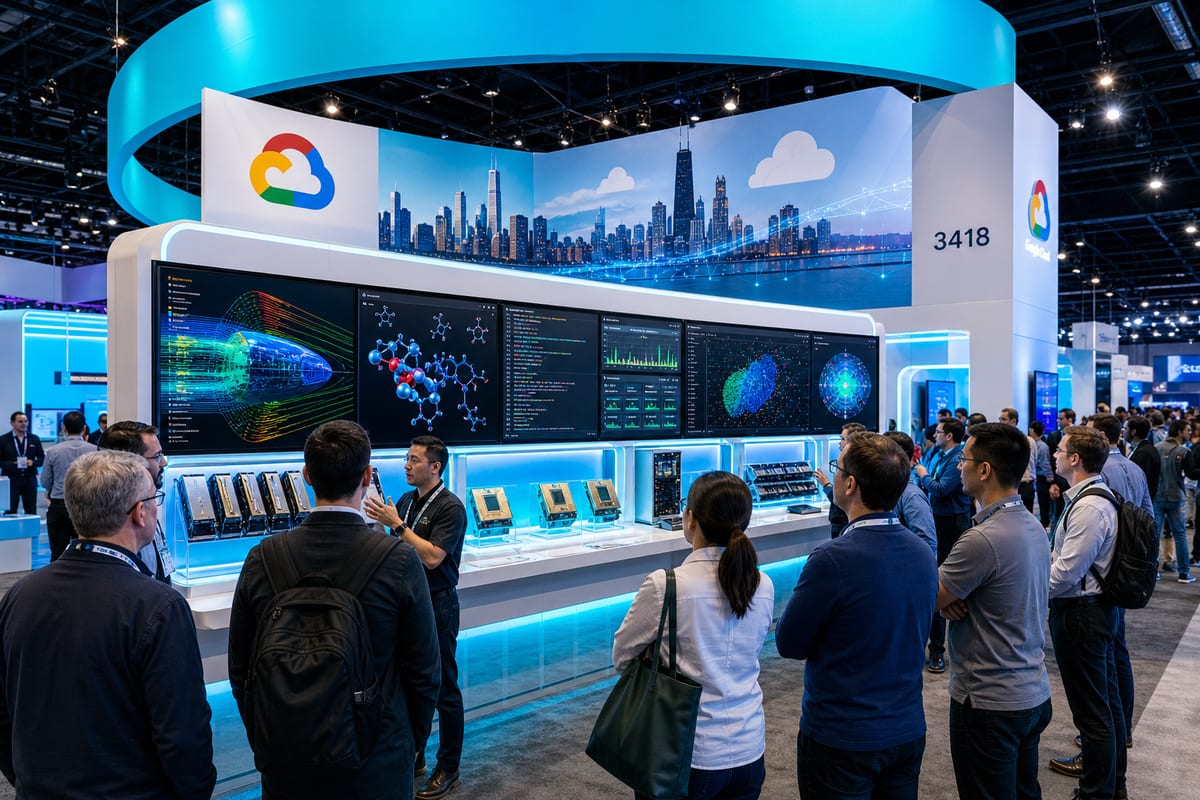
The announcements are presented at SC26, at McCormick Place West in Chicago, from November 15 to 20, at booth 3418. Demonstrations cover Antigravity for HPC, the HPC Prompt Playground, and AlphaEvolve for HPC, along with a community workshop on advanced computing and a session titled Agentic and Hybrid HPC Birds of a Feather. Google provides Cluster Toolkit and Google Cloud HPC solutions, as well as validated templates available for download from the Google Skills and DeepMind Science Skills repositories.
Brief IA — L'actualité IA en français
L'essentiel de l'actualité de l'intelligence artificielle, décrypté et expliqué chaque jour.