Google DeepMind Explores General AI in EVE Online with Fenris Creations
Le brief IA que les pros lisent chaque soir
Les 7 actus IA du jour, décryptées en 5 min. Gratuit.
Inclus dès l'inscription : notre sélection des meilleurs guides & comparatifs IA.
Choisis ton rythme
Gratuit · Pas de spam · Désabonnement en 1 clic
Google DeepMind opens a new project with Fenris Creations around EVE Online, a persistent world that will serve as a testing ground for agents capable of learning over long time horizons and in multiplayer contexts. This initiative is part of a lineage that spans from Atari's DQN to AlphaGo and AlphaFold, the latter recognized with the 2024 Nobel Prize in Chemistry, and relies on SIMA 2, touted as playing at a human level in several titles.
EVE Online, a testing ground for memory, planning, and multi-agent dynamics
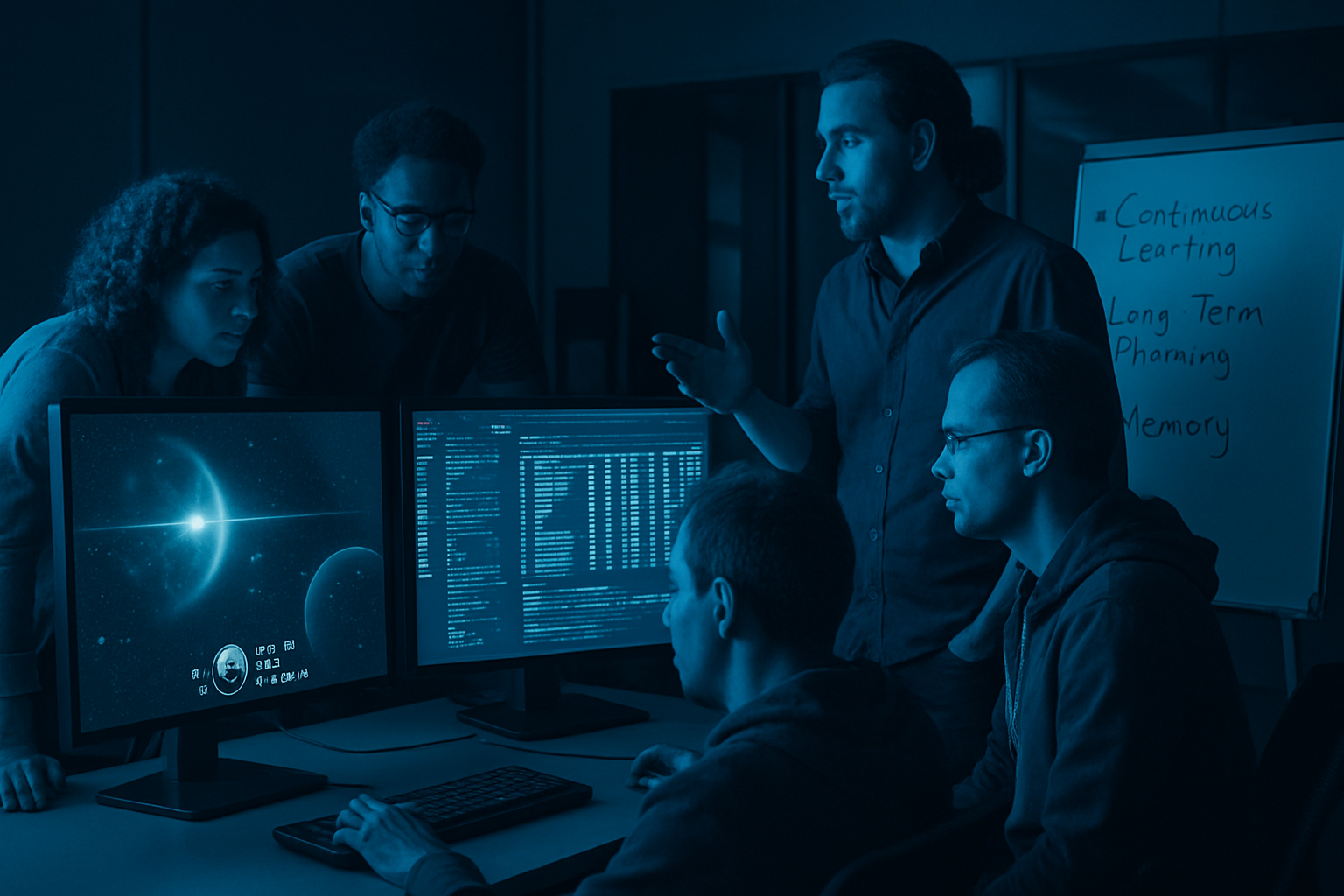
Since 2003, EVE Online, developed by Fenris Creations, has brought together thousands of players in a unique and persistent world that has continuously evolved for over twenty years. The economy, controlled by the players themselves, the trading networks spanning thousands of star systems, and an environment shaped by alliances, conflicts, and diplomacy are all based on human interactions. For Google DeepMind, this dynamic universe represents a significant opportunity to test skills considered crucial for advanced AI: continuous learning without knowledge loss, memory capacity over durations far exceeding current context windows, long-term planning that can extend over weeks, months, or even years, as well as managing complex multi-agent dynamics. The studio emphasizes that EVE was designed as a sandbox with lasting consequences and argues, alongside Google DeepMind, to engage in a territory where AI must learn, adapt, and remember over unprecedented horizons, while illuminating the coexistence of humans and AI in a virtual environment.
What general agents could change in gameplay and production
Google DeepMind believes that a truly general game agent could operate with existing games without modifying their code and open up new forms of gameplay, from companions capable of understanding the game world to NPCs that adapt beyond scripts. The team also suggests that these capabilities could unlock new experiences in the future. On the production side, these agents are presented as likely to transform methods: enabling more robust quality assurance testing during development, then adapting in real-time to added content and unpredictable player behaviors without re-scripting. DeepMind adds that these learnings could eventually transfer to real-world problems.
Research conducted with studios and playable prototypes
To conduct this program safely and responsibly, Google DeepMind states that it has established partnerships with studios and built a growing portfolio of games dedicated to research. The studios bring their expertise, worlds, and knowledge of their communities, while DeepMind shares its models, work on generative interactive environments, and embodied agents, as well as its experience in game research and development. The collaboration claims a "show, don't tell" approach, with exploration of ideas and playable prototypes built hand in hand. In addition to collaborations with Hello Games, Coffee Stain Studios, and Foulball Hangover, a new alliance with Fenris Creations and the EVE universe was unveiled earlier this year and represents the latest chapter.
SIMA 2, an agent playing via keyboard and mouse without access to APIs
At the center of the project, SIMA (for Scalable Instructable Multi-world Agent) is presented as a versatile agent capable of perceiving the screen like a player, understanding instructions in natural language, and interacting via keyboard and mouse, without needing access to APIs or source code. Operating through the Gemini models, Google DeepMind describes SIMA 2 as an interactive assistant with reasoning capabilities and real-time exchanges. According to the team, SIMA 2 manages to play at a level comparable to humans in 3D research environments as well as in games like No Man’s Sky, Valheim, or Hydroneer. These elements serve as the foundation for the intended use cases with existing games.
From Atari to Grandmaster level: fifteen years of milestones
Google DeepMind began its research in gaming with the Deep Q-Network, a system trained from raw pixels to play 49 Atari 2600 titles, from Pong to Breakout and Space Invaders, without specific engineering for each game. Published in 2015 in Nature, this result is presented as a catalyst for modern deep reinforcement learning. Following were AlphaGo, victorious against Lee Sedol in 2016 when experts thought the feat was still far off, AlphaGo Zero through self-play without human data, AlphaZero generalizing the method to chess, shogi, and Go, and then MuZero without explicit knowledge of the rules. In 2019, AlphaStar reached Grandmaster level in StarCraft II. These systems have had observable effects in games: AlphaGo's move 37 was initially thought to be a mistake before inspiring new strategies, and AlphaZero sparked unprecedented lines of play in chess. The foundations from this exploration have also fed into AlphaFold, which tackled the 50-year challenge of predicting protein structures, an advancement recognized by the 2024 Nobel Prize in Chemistry.
Stated goal: a catalyst AI and applications beyond gaming
Google DeepMind, founded in 2010 by a team that includes former developers like Demis Hassabis, reaffirms that games are at the heart of its approach to understanding intelligence and have contributed to breakthroughs ranging from Atari to structural biology. The organization argues that the increasing complexity of games calls for more capable AI systems to navigate them. The declared aim remains a catalyst AI, not a substitute, with the ambition of creating unprecedented, more accessible, and personalized experiences, and the desire to apply what is learned in games to real-world problems and scientific discovery. Google DeepMind thanks its partners, including Fenris Creations for this new chapter, and announces its intention to share upcoming advancements.
Brief IA — L'actualité IA en français
L'essentiel de l'actualité de l'intelligence artificielle, décrypté et expliqué chaque jour.