Google and Kaggle: a Free Course on Agentic AI
Massive Participation for an AI Agents Course
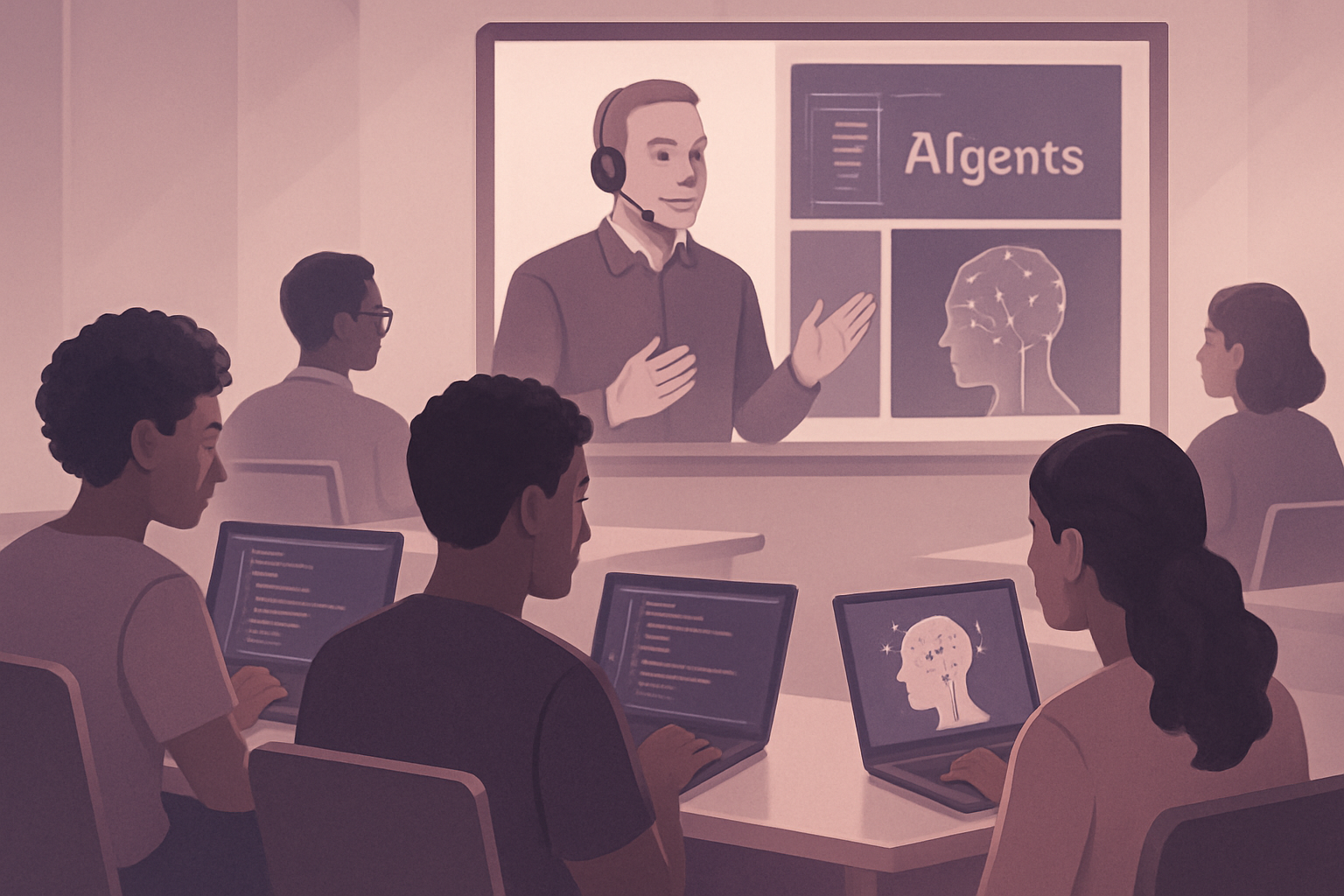
In November 2025, over 1.5 million people enrolled in a free course dedicated to creating artificial intelligence agents. Unlike other online courses where enrollments do not always translate into active participation, this program saw its participants submit more than 11,000 final projects. Organized by Google in collaboration with Kaggle, this intensive five-day course has emerged as one of the largest in terms of participation.
For those who could not attend the live session, there is good news: the course is now available for free online and can be taken at one's own pace. This flexibility allows learners to discover much more than the initial excitement might suggest.
A Well-Structured Program
This course is actually a sequel to the 2024 GenAI Intensive, also offered by Google and Kaggle, which had already attracted over 140,000 developers. This event even set a Guinness World Record for the largest virtual AI conference. In 2025, the program refocused its content, shifting from generative AI in general to a particular emphasis on agents, a wise decision given the many confusions that still surround this concept.
The original session took place over five days in November 2025, but it has been transformed into a Kaggle Learning Guide accessible at any time. For those who prefer a cohort experience, an updated session focused on "vibe coding" was offered in June 2026. Regardless of the chosen format, the content remains the main attraction.
Each day of the program pairs a technical article with two practical codelabs, utilizing the Gemini tools and Google’s Agent Development Kit. This allows participants to read theoretical concepts before applying them immediately.
Le brief IA que les pros lisent chaque soir
Les 7 actus IA du jour, décryptées en 5 min. Gratuit.
Inclus dès l'inscription : notre sélection des meilleurs guides & comparatifs IA.
Choisissez votre rythme
Gratuit · Pas de spam · Désabonnement en 1 clic
A Five-Step Learning Journey
-
Day 1: Introduction to Agents. Participants learn about agent architectures and how to determine when a task requires an agent rather than a simpler process. They build their first agent and a multi-agent system.
-
Day 2: Tools and Interoperability with the Context Protocol (MCP). Participants explore how agents use tools, how to create custom tools, and how the Context Protocol Model (MCP) enables agents to communicate with external systems. This day also introduces human approval for long-duration operations, which distinguishes a useful agent from a potentially dangerous one.
-
Day 3: Context Engineering, Sessions, and Memory. Participants learn to create agents with long-term memory, a crucial aspect where many fail quietly.
-
Day 4: Agent Quality. This day focuses on logging, tracing, metrics, and evaluating an agent's responses. Measuring whether an agent is functioning is a skill that almost no one teaches and that everyone deploying in production desperately needs.
-
Day 5: From Prototype to Production. Participants learn about the agent-to-agent protocol and deployment in a managed environment like Vertex AI Agent Engine.
Who It's For and How to Maximize Learning
This course is primarily aimed at those with Python skills and experience with LLM APIs. It does not require prior expertise in agents, making it accessible to the majority of current developers.
One piece of advice to get the most out of this program: don’t rush through the technical articles to jump straight into coding. Days three and four, focused on evaluation and context engineering, are crucial for lasting understanding. The codelabs teach how to build an agent, but the articles explain why some agents fail.
The entire course is available for free on Kaggle, and the final project offers a tangible achievement to showcase. With over one and a half million participants having found the time for this program, it’s likely you can benefit from it as well.
Brief IA — L'actualité IA en français
L'essentiel de l'actualité de l'intelligence artificielle, décrypté et expliqué chaque jour.