Google and the Rise of AI Summaries: A Revolution in Search
Le brief IA que les pros lisent chaque soir
Les 7 actus IA du jour, décryptées en 5 min. Gratuit.
Inclus dès l'inscription : notre sélection des meilleurs guides & comparatifs IA.
Choisis ton rythme
Gratuit · Pas de spam · Désabonnement en 1 clic
The Growing Impact of AI Summaries in Google Searches
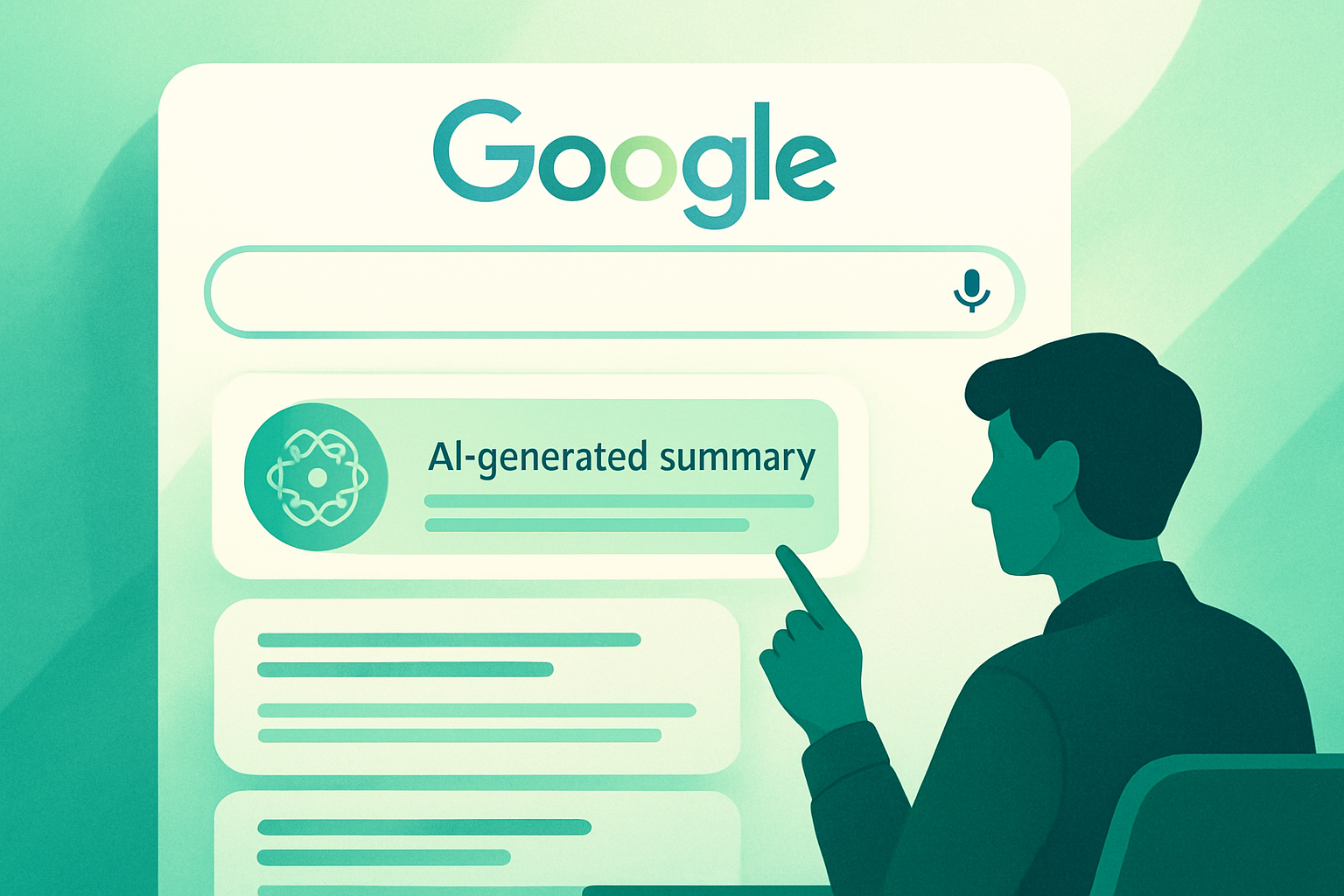
AI-generated summaries from Google have seen a significant increase in search results in the United States. According to a report from Similarweb, these summaries now appear in 43% of searches, a notable rise from the 15% recorded the previous year. This figure comes from the 2026 report on the landscape of generative AI by the market intelligence firm.
AI previews, which present summaries generated within traditional Google search results, are accompanied by an AI Mode. This mode offers a conversational interface, allowing users to ask longer questions and request follow-ups. Users can switch from an AI preview to AI Mode while retaining the initial context of their search.
Google explained that AI Mode uses a technique called "query fan-out." This method breaks a question into related sub-themes and performs multiple searches for each sub-theme. The information gathered is then used to produce a comprehensive answer, accompanied by relevant supporting links.
Expanding Conversational Search by Google
According to Similarweb, the web experience of Google's AI Mode saw visits rise from 126 million in June 2025 to 279 million in May 2026. In May, Google also announced that AI Mode had surpassed one billion monthly users. This figure, while impressive, refers to users rather than web visits, making it difficult to draw a direct comparison with Similarweb's estimates.
The figures measure different facets of Google search. The 43% figure refers to the share of U.S. searches displaying AI previews, while the AI Mode figures relate to activity within Google's conversational search service.
The introduction of AI Mode has also led to a 5.4% increase in the average length of Google searches. Users have begun to formulate longer, more natural language searches, similar to queries used with AI assistants. "People are now adopting a new way to search and discover that feels more natural," said Ethan Smith, CEO of the digital marketing agency Graphite, in the Similarweb report.
Users can now provide more details in a single search, rather than being limited to short keyword combinations. Google's AI interfaces are capable of responding to these longer searches and supporting additional questions without requiring the immediate opening of an external website.
Similarweb clarified that its estimates are based on first-party analyses, anonymized device information, external data partnerships, and publicly available web data. The company models these inputs to estimate traffic and user behavior, meaning its figures are not direct counts provided by Google or OpenAI.
The Growth of Generative AI Websites
The report indicates that generative AI websites received an average of 9.5 billion monthly visits between June 2025 and May 2026, marking a 70% increase compared to the previous year. The number of unique monthly visitors also rose by 57%, reaching 655 million, while mobile app downloads surged by 58%, reaching 4.4 billion.
These figures cover the broader generative AI market, including standalone services such as ChatGPT, Gemini, Claude, and Perplexity. They provide context for Google's expansion of AI within a search product that already reaches a wider internet audience.
Similarweb also found that most ChatGPT users continued to use Google. The audience overlap between ChatGPT, Gemini, and Claude indicated that people were using multiple search and AI services rather than moving exclusively to a single platform.
Publisher Concerns Over Referral Traffic
Publishers have expressed concerns regarding referral traffic when their content is incorporated into an AI-generated response without generating a visit. Similarweb previously identified news publishers among the sectors affected by traffic changes due to AI-based search tools.
Google responded by modifying how external sources appear in AI previews and AI Mode. In May, the company announced direct links in responses, article suggestions, website previews, and more prominent references to original material.
Google stated that these changes aimed to provide more information about linked pages and make relevant sites easier to identify. It has not released traffic data showing how the updates have affected click-through rates to publishers or other external sites.
Citations Do Not Always Generate Traffic
Similarweb found that the share of ChatGPT responses containing web citations increased more than fivefold over the past year. The proportion rose from about 1.3% in June 2025 to 6.8% in May 2026, based on desktop activity in the United States.
The measure covers responses displaying source references, rather than the proportion of user queries that led ChatGPT to search the web. Citations also do not confirm that a user opened the linked source.
Citation rates varied by sector. Similarweb recorded higher rates for travel, retail, and sports-related responses, where information such as prices, availability, comparisons, and results can change frequently.
The company also noted a difference between pages cited in AI responses and those receiving referral traffic. About 65% of the URLs cited by ChatGPT were found two or three folders below the main domain, including articles, product pages, and other detailed content.
The second-level folder alone accounted for 41.7% of the cited URLs. In comparison, 58.8% of AI referral traffic landed on homepage pages.
The results indicate that the content used to support an AI response and the page visited after a click often serve different functions. Detailed pages may provide information for a response, while the displayed links may direct users to a company's or publisher's main site.
The ChatGPT search update on May 7 gave greater visibility to brand links in generated responses. Similarweb recorded a 157.7% week-over-week increase in referral traffic following the update, while references to homepage pages rose by 354.7%.
The company observed these increases after the interface change but did not establish that the update was solely responsible. The data covers ChatGPT's referral activity and does not measure clicks from Google’s AI previews or AI Mode.
Before the update, about 26% to 32% of ChatGPT's referral visits landed on homepage pages. The proportion increased to around 60% after May 7, based on desktop activity measured between April 30 and May 20, 2026.
The difference between cited sources and referral destinations provides publishers and website operators with distinct metrics to track. Citation data measures which pages appear as sources, while referral data records where users arrive after clicking a link.
Cloudflare Tests a Pay-Per-Crawl Service
Cloudflare is also testing a "pay-per-crawl" service that allows participating website operators to permit, charge, or block individual AI crawlers. The private beta program enables publishers to set a fee that an authenticated crawler must pay before accessing content.
The system can return an HTTP "402 'Payment Required'" response when paid access applies. Cloudflare records completed paid requests, bills the crawler operator, and distributes the profits to the website owner.
Cloudflare has also made configurable "402" HTTP responses available to paying customers through its "AI Crawl Control" service. Website operators can use the response to provide licensing terms or contact information to crawlers, while automated payments via pay-per-crawl remain in beta.
These measures add an additional option for publishers deciding how AI services can access their material as generated responses become more common on search platforms and standalone AI services.
Brief IA — L'actualité IA en français
L'essentiel de l'actualité de l'intelligence artificielle, décrypté et expliqué chaque jour.