Google and Meta Bet on AI to Automate Tasks
Le brief IA que les pros lisent chaque soir
Les 7 actus IA du jour, décryptées en 5 min. Gratuit.
Inclus dès l'inscription : notre sélection des meilleurs guides & comparatifs IA.
Choisis ton rythme
Gratuit · Pas de spam · Désabonnement en 1 clic
The New Frontier of AI: Understanding Human Functioning
Tamay Besiroglu, co-founder and CEO of Mechanize, a San Francisco startup, has set an ambitious goal: to automate all jobs. Mechanize focuses on using reinforcement learning (RL) environments to achieve this aim, an approach that has attracted the attention of giants like Google. The evolution of artificial intelligence is shifting from training chatbots to creating RL environments, allowing machines to learn complex tasks. Meta, for its part, has explored the possibility of tracking employee actions to enrich AI development.
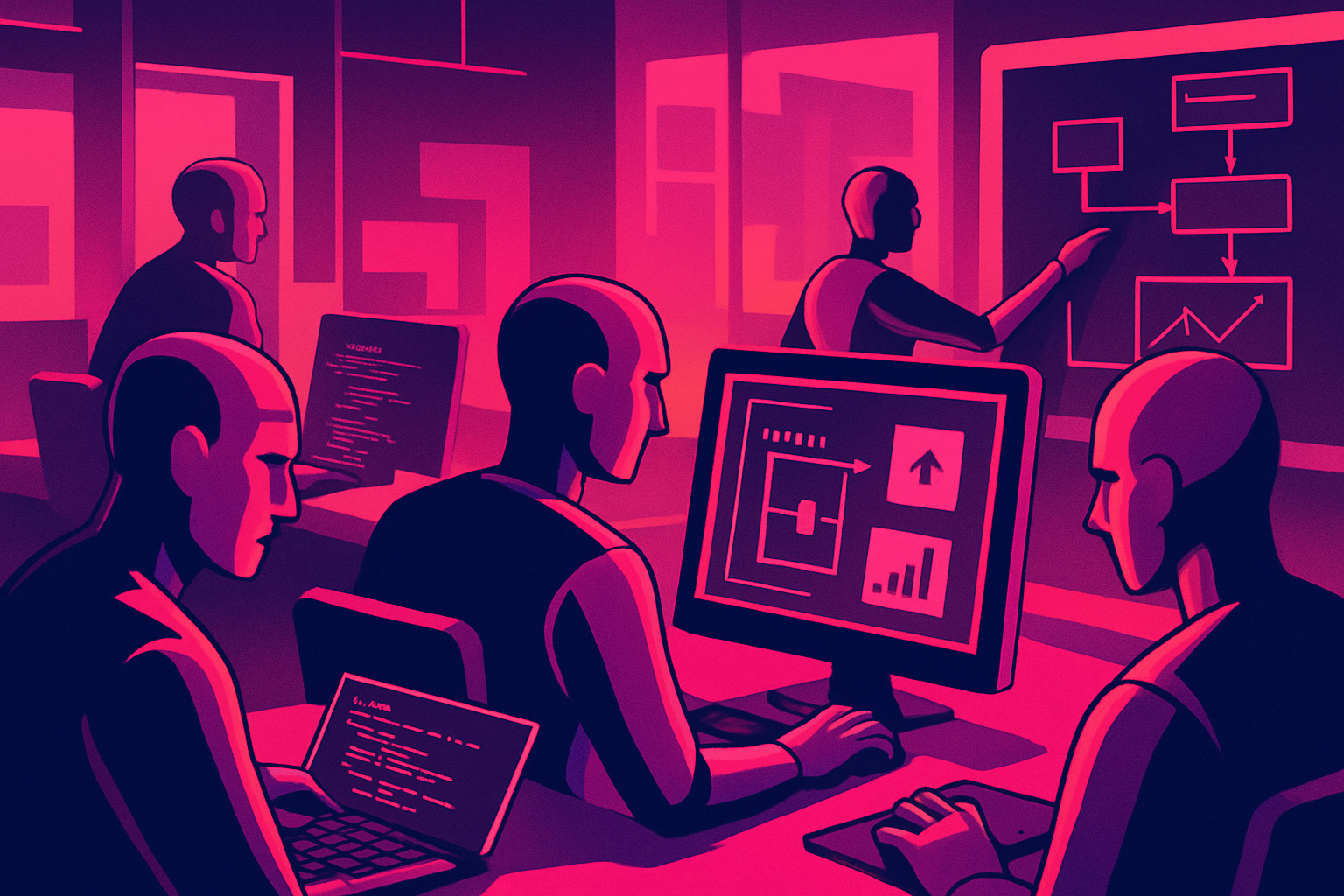
The current trend in the field of AI is no longer limited to training chatbots to answer questions. Tech companies are moving towards creating agents capable of executing entire jobs. After years of training models on online text and evaluating responses through contractors, the industry is now focused on creating realistic digital workplaces. These environments allow AI to practice coding, using professional software, making decisions, and completing prolonged tasks, thereby mimicking human work. These digital training domains are referred to as reinforcement learning environments.
Massive Investments and Data Collection Initiatives
Two recent developments illustrate this growing trend in the industry. Google is considering investing over $1.5 billion in Mechanize, a startup developing virtual work environments to train AI agents. Meanwhile, Meta is working to collect data such as keystrokes, mouse movements, and clicks, claiming that this will help AI understand how people actually use computers.
These initiatives mark a significant shift in how advanced AI systems are developed. The first generation of large language models relied on two main types of data: vast amounts of text from books and the internet, followed by human feedback to assess the quality of chatbot responses.
The Evolution of AI Training Methods
While this approach has led to the creation of powerful conversational AIs, it has failed to produce agents capable of autonomously completing complex tasks over extended periods. The industry is increasingly turning to RL environments, realistic simulations where AI agents learn through action rather than merely predicting the next word.
Scale AI, one of the leading training data providers, emphasizes that major AI companies are moving away from exclusive reliance on static datasets and human feedback. They are heading towards simulated environments where agents can safely learn through trial and error. Chetan Rane, product lead for agents and RL environments at Scale AI, recently stated that the way models are trained is evolving, and cutting-edge models increasingly need to learn in realistic simulated environments.
Nearly half of the company's new AI training projects now involve RL environments that model realistic coding, computer usage, and business workflows.
Complete Automation of the Economy
Mechanize bets on this approach as one of the most crucial aspects of AI development. Founded last year by Tamay Besiroglu, the startup aims for nothing less than the "complete automation of the economy." Although this ambition has been criticized for its bold scope, Besiroglu and his co-founders explained in a blog that their goal is to create simulated environments and assessments that capture all the tasks performed by workers. The market potential is immense: workers in the United States earn about $18 trillion annually, and this figure exceeds $60 trillion globally.
Reward Signals: A Key Element
According to Mechanize, current AI systems are unreliable for prolonged tasks because they lack realistic environments to learn from. Their primary focus is software engineering. Mechanize argues that future coding agents will first learn from examples provided by professional programmers, before improving through reinforcement learning in increasingly realistic software environments that capture the complexity of real engineering projects.
As these environments improve, Mechanize believes that the same approach can extend to all types of office work. Reward signals play a crucial role in these RL environments. Besiroglu explained that it is essential to indicate to the model whether a task has been performed correctly or not, and to use this information to reinforce the behaviors that led to the correct execution of the task.
Meta's Data Collection Strategy
This approach also provides an explanation for the sudden interest of major tech companies in collecting data on how their employees actually work. Meta announced that its tracking software would help AI understand how people accomplish everyday computing tasks, as agents need to be trained on real-world examples. The software captures inputs such as mouse movements, clicks, keystrokes, and on-screen context through approved professional applications.
Similar Initiatives in the Industry
Other companies are exploring similar ideas. Uber recently announced the integration of high-level AI engineers into various departments such as finance, legal, human resources, marketing, procurement, and customer support. The goal is to observe how employees work before redesigning these workflows around AI. This initiative is called "Agentic Pods."
Ultimately, the new race in the AI industry may no longer be about creating smarter chatbots. Instead, companies are competing to create detailed digital versions of real workplaces, where AI agents can practice the thousands of decisions, actions, and workflows that make up modern jobs. If the industry's major players are correct, these virtual workplaces will become the training grounds for the next generation of AI.
Brief IA — L'actualité IA en français
L'essentiel de l'actualité de l'intelligence artificielle, décrypté et expliqué chaque jour.