Google Gemini: Tools, Models, and Integrations
Le brief IA que les pros lisent chaque soir
Les 7 actus IA du jour, décryptées en 5 min. Gratuit.
Inclus dès l'inscription : notre sélection des meilleurs guides & comparatifs IA.
Choisis ton rythme
Gratuit · Pas de spam · Désabonnement en 1 clic
Born under the name Bard and renamed in 2024, Gemini claims over one billion monthly users as of August 11. The ecosystem ranges from a cross-platform assistant to specialized models and enterprise deployment platforms. Here is a pragmatic guide to access, versions, tools, and uses.
Access, Subscriptions, and Versions: Understanding the Gemini Range
Some capabilities of Gemini require a subscription: the Deep Think mode and the autonomous agent Gemini Spark are reserved for Google AI Ultra subscribers. Gemini models are identified by a generation number (3, 3.1, 3.5, etc.) and a capability suffix (Flash-Lite, Flash, Pro). Generations are no longer synchronized across tiers: the latest Flash, numbered 3.6, is two generations ahead of the latest Pro, 3.1.
In the Gemini app, Flash is the default model, and AI Mode in Search also uses a Flash model by default. For the general public, the most recent version is 3.7 Flash, available since August 2026, while the Pro branch stops at 3.1 Pro, dated February 2026. The lighter Flash-Lite model targets high-volume simple tasks and is primarily aimed at developers via the API.
Developing and Deploying AI Agents: Antigravity, AI Studio, and Agent Platform
Google Antigravity is an agent development platform that allows for the orchestration of multiple AI agents in parallel, featuring a desktop application, a command-line tool, and an SDK. Its version 2.0 was announced at Google I/O 2026 and has replaced Gemini CLI for individual developers.
For prototyping via API, Google AI Studio offers a web environment to test queries, compare models, and retrieve code for integration. For enterprise production, Vertex AI was renamed Agent Platform in April 2026: it enables the construction, deployment, and governance of AI agents at the organizational scale, with access to Gemini models, third-party models like Claude, and open models like Gemma. For interface design, Google Stitch transforms a description, sketch, or screenshot into a mockup, with export options to Figma, HTML/CSS, and React.
Integrations: Search, Workspace, Chrome, and Android
In Search, AI Mode uses a conversational approach to handle complex questions, provides enriched answers, and relies by default on the Flash model. This mode operates alongside AI Overviews, which offers AI-generated summaries placed at the top of traditional results. In Google Workspace, Gemini is present in Gmail, Docs, Sheets, Slides, Vids, and Meet to facilitate writing, summarization, data analysis, presentation creation, and video editing.
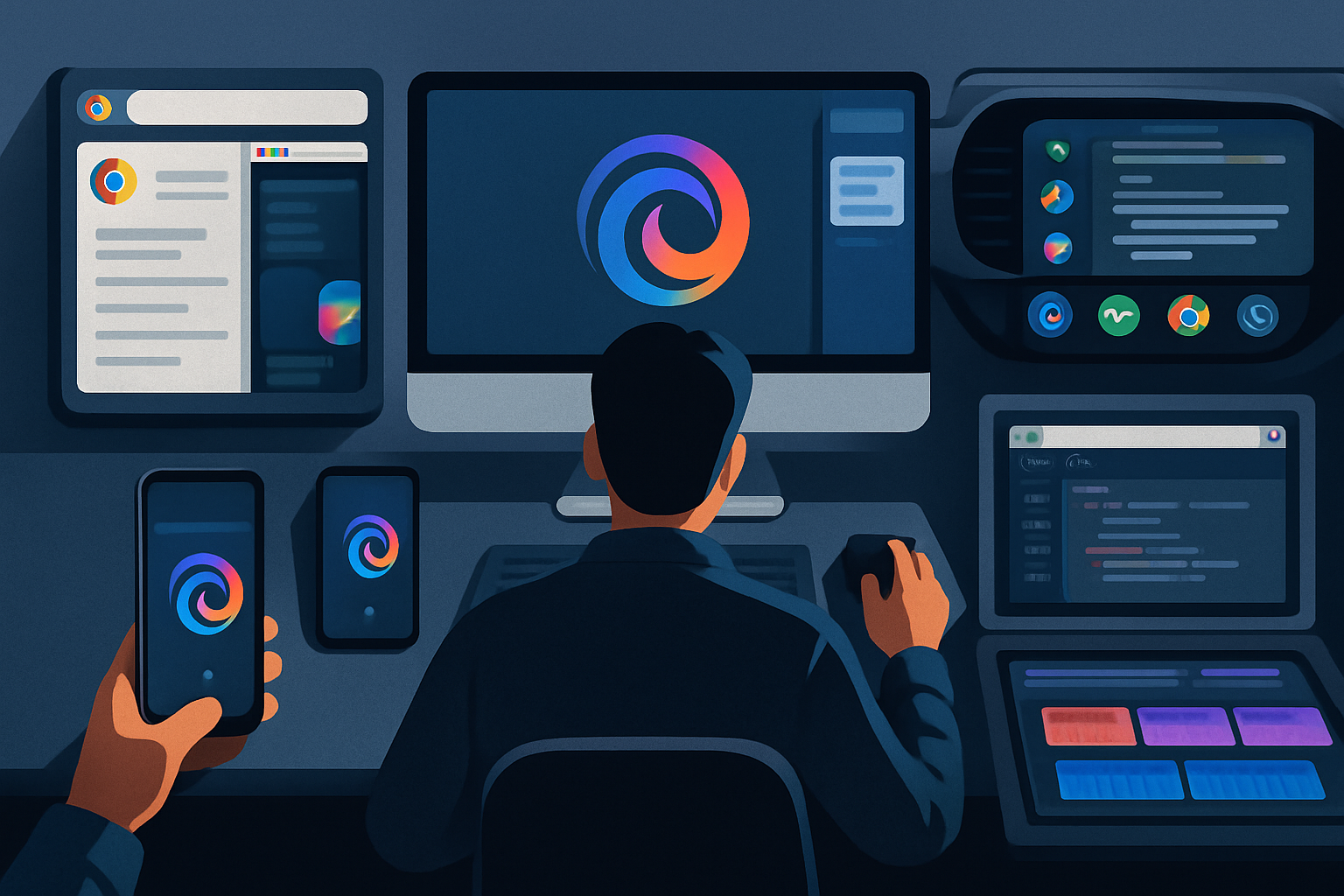
In Chrome, Gemini is integrated directly without the need for an extension and appears in a sidebar: it can access displayed content, summarize it, and automate certain navigation actions. On Android and via Android Auto, Gemini replaces Google Assistant, ensuring continuous interaction and connecting to the user's applications.
Creation: Image, Video, and Music
For image creation, Nano Banana generates and edits visuals from a description. For video, Veo generates video sequences with soundtracks from text or images and connects directly to Vids. At Google I/O 2026, Gemini Omni was introduced as capable of processing text, images, audio, and video inputs to create videos; according to Google, it is the video counterpart of Nano Banana.
For music, Lyria is the music generation model developed by Google and powers the Flow Music platform, which creates tracks on demand, with or without vocals, while offering remixing, exporting separate tracks, and creating video clips.
Assistant and Productivity: Uses, Customization, and In-Depth Research
The Gemini assistant is accessible from the browser, via iOS and Android apps, and as a desktop application for Mac. It also supports voice through Gemini Live. Gemini Notebook, formerly NotebookLM, allows for document analysis, producing summaries, audio and video summaries, as well as mind maps, consistently citing original passages.
Customization and productivity tools complement these features: Gems correspond to customized versions with instructions and files, which can be reused and shared. Canvas allows users to open a workspace alongside the discussion to write text, generate code, or design a prototype, with the ability to edit directly, make targeted tweaks without regenerating everything, have a real-time web preview, and export to Google Docs. Deep Research breaks down a question into sub-elements, examines online sources, and compiles a comprehensive report. Finally, Gemini Spark, an autonomous agent that can be activated from the app, can organize folders, build documents from local files, and chain actions in Workspace; this feature is reserved for Google AI Ultra subscribers.
Brief IA — L'actualité IA en français
L'essentiel de l'actualité de l'intelligence artificielle, décrypté et expliqué chaque jour.