Google is Developing Space TPUs, Robotics Seeks Its Recipe
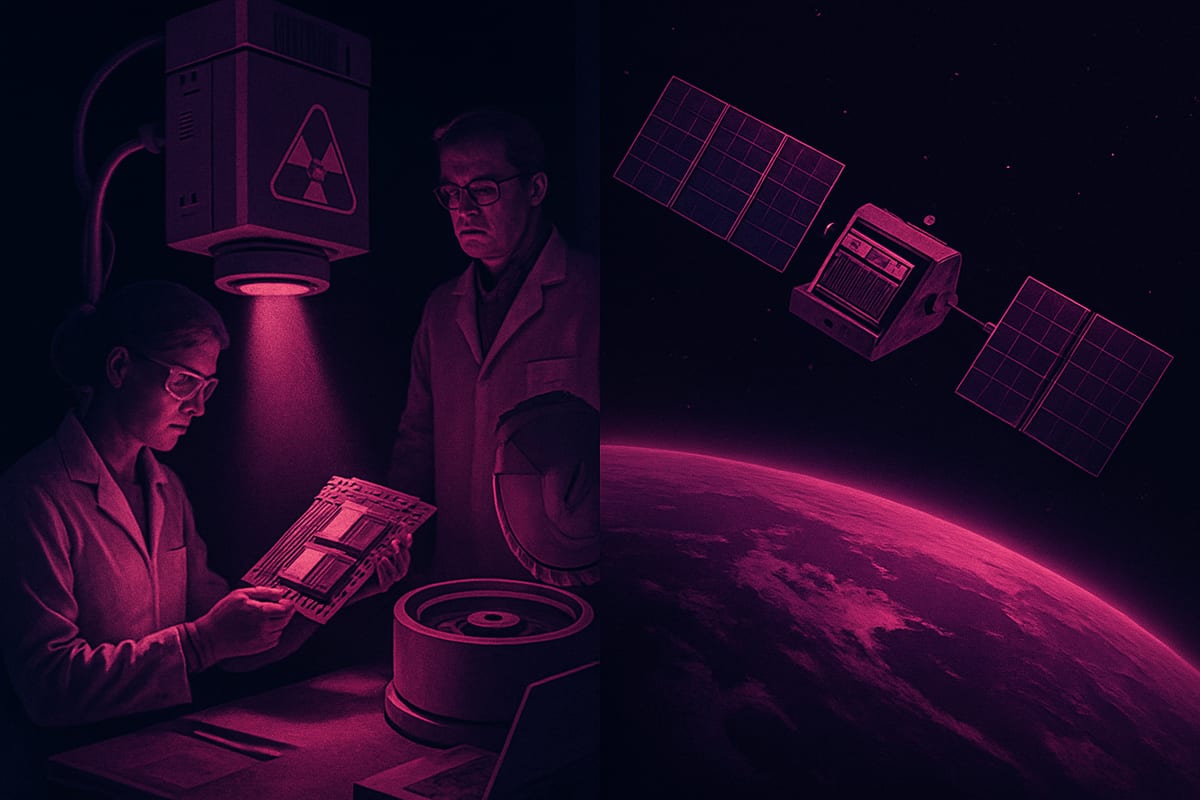
Google is testing computing accelerators for orbital deployment, while researchers are calling for a post-training method for large-scale robotics. Meanwhile, Michael Levin is advancing a non-physicalist thesis of the mind, without experimental validation at this stage, relying on biofabricated systems and perturbed algorithms.
In Suncatcher, Google Aims for AI Beyond Earth Orbit
The Suncatcher project is presented as likely to shift AI training and inference off the planet. Google is preparing to send TPUs into space as part of this initiative. The company has subjected its chips to stress tests to evaluate their resilience against gravitational forces and radiation. The results are described as promising by Google.
For Robotics, Stable Post-Training Still Lacking
Perry Dong and Chelsea Finn describe obstacles that hinder the advancement of robotics and compare the situation to that of language models. They argue that, unlike LLMs, robotics lacks a shared recipe for post-training learning. According to them, the field needs a dedicated algorithm for fine-tuning cutting-edge robotic models that remains stable even when applied to models with billions of parameters. They remind us that, for LLMs, a solid pre-trained model and a common post-training recipe have been crucial.
A Platonic Thesis of the Mind Without Conclusive Evidence
Michael Levin posits that the complexity of the world could be explained by a Platonic realm of patterns seeking to manifest in reality. He connects this idea to emerging sciences and proposes analyzing the mind as one relates mathematical patterns to morphogenetic outcomes. In his framework, bodies—whether living, designed, or hybrid—serve as interfaces to patterns represented by biophysical, biomechanical, or chemical fields, which encode references for homeostatic or allostatic processes. He argues that non-physical patterns influence physical phenomena such as growth and shape, describing a latent space ranging from loosely structured forms to highly organized patterns, referred to as types of minds. He proposes that these minds share the same non-physical nature as the patterns that guide simple structures. However, no conclusive experiments currently support this theory.
Le brief IA que les pros lisent chaque soir
Les 7 actus IA du jour, décryptées en 5 min. Gratuit.
Inclus dès l'inscription : notre sélection des meilleurs guides & comparatifs IA.
Choisissez votre rythme
Gratuit · Pas de spam · Désabonnement en 1 clic
Xenobots, Anthrobots, and Perturbed Algorithms as Indicators
Phenomena are presented as indicators of simple systems exploring rich patterns adjacent to a Platonic space. Xenobots, bio-robots made from frog cells, serve as examples related to patterns similar to those of frog embryos. Other examples include anthrobots designed from human tracheal cells, which, once extracted from the body, take on unusual forms and exhibit behaviors such as an autonomous ability to repair neural damage. Another experiment reports a modification of a classic sorting algorithm, suggesting that algorithms may develop novel properties when integrated into a complex system. In this context, Michael Levin suggests that the minds of AI and humans could be similar without being exactly the same, and that the proposed research could help address philosophical issues as well as alignment challenges. He even hypothesizes about vessels colonized by patterns from elsewhere.
Brief IA — L'actualité IA en français
L'essentiel de l'actualité de l'intelligence artificielle, décrypté et expliqué chaque jour.