Google Restructures Its AI: Internal Tensions and Strategic Stakes
Le brief IA que les pros lisent chaque soir
Les 7 actus IA du jour, décryptées en 5 min. Gratuit.
Inclus dès l'inscription : notre sélection des meilleurs guides & comparatifs IA.
Choisis ton rythme
Gratuit · Pas de spam · Désabonnement en 1 clic
Google Restructures Its AI: Internal Tensions and Strategic Challenges
Recent leadership changes in the AI sector at Google may be the result of pressures to accelerate product development, as well as internal ethical conflicts.
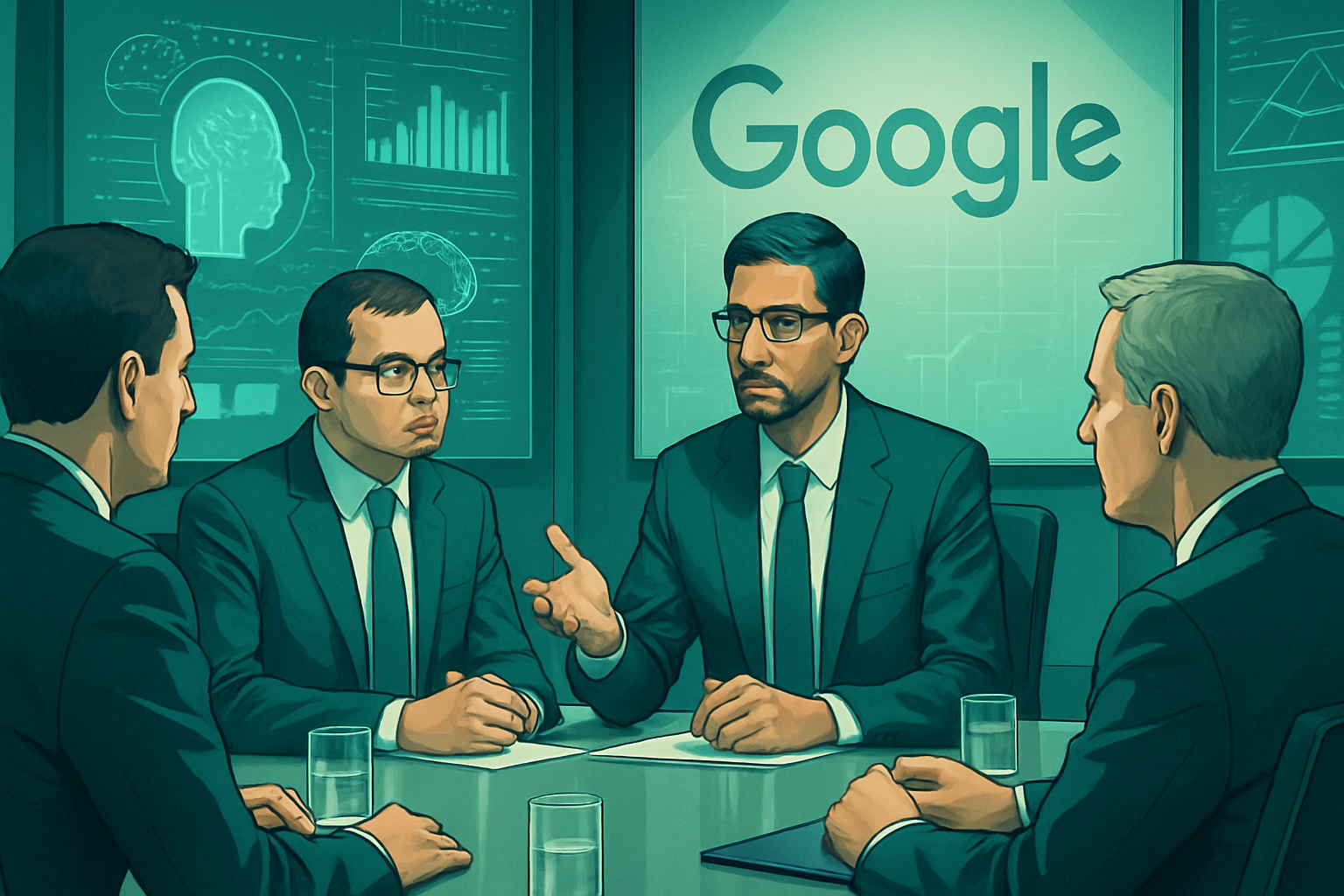
In the AI industry, Google presents itself as the adult in the room: calm, stable, and proven. However, even during the announcement of its largest AI reorganization to date, Google and its leaders maintained a united front, focusing on how these changes lay the groundwork for future success.
The reality is that the list of executive changes likely signals deeper issues within Google's AI organization. This begins with its precarious position in the AI race and extends to problems such as the interest of Google DeepMind leader Demis Hassabis in long-term research rather than short-term product launches, as well as the growing political opposition from some high-level employees, like DeepMind's chief scientist, Jeff Dean.
A current Google employee, who requested anonymity for fear of retaliation, stated that one of the changes — Dean's departure — is an example of the complete disappearance of "the remnants of Google's idealism." "Losing Jeff continues the brain drain at Google," he added. "Mediocrity is the likely outcome."
Wednesday's news shook the AI industry, which is difficult to achieve in an era where AI researchers are constantly changing roles and labs. Google announced that Demis Hassabis would step back from the daily operations of DeepMind to focus on AGI and research; Koray Kavukcuoglu, the current CTO of DeepMind, will take over. Meanwhile, Jeff Dean, a 27-year veteran at Google and the company's 30th employee, will leave the organization along with three other high-level researchers to found a new AI startup.
Google is widely regarded as the most successful of the established tech giants in the AI race, far outpacing the advancements of Meta, Amazon, and Apple. However, Google is still perceived as being slower than OpenAI and Anthropic, and it has certainly not taken the lead over them in terms of cutting-edge models. Both Hassabis and Google CEO Sundar Pichai have emphasized this point in their statements.
- Pichai wrote: "We are committed to being at the forefront and are very focused on the areas where we need to improve."
- Hassabis stated that the company is entering a "new chapter" and that it has "all the ingredients to lead from here, and I firmly believe we will."
Key figures in the AI industry seem to view these changes as a step aside by Hassabis in favor of a faster, product-focused approach at GDM. A former Google employee noted that there has been much more internal competition at Google in recent years, primarily around the AI product space, with increased pressure to hire more employees capable of accelerating product launches.
Another industry player, who also requested anonymity, stated: "I agree with everyone's analysis that this is a sign of Demis's waning influence."
Hassabis has not hidden that his interests lie in the potential scientific advancements that AI could offer, perhaps more than in commercializing the technology. Pichai wrote in a blog post that Hassabis's next move will focus on "actively shaping the future of AGI" as president of DeepMind and chief scientist of Alphabet, while continuing his role at the helm of the drug discovery subsidiary, Isomorphic Labs.
But leadership in AI is just one of the issues Google is facing. Industry experts interviewed by The Verge highlighted a key question: how many of these changes are related to growing ethical conflicts within Google itself?
A contributing factor to Hassabis's change in role and Dean's departure could be Google's agreement with the Department of Defense, which could potentially allow the use of Google's AI in mass surveillance and lethal autonomous weapons.
- Tyler Johnston, founder of the nonprofit organization The Midas Project, stated: "This has already caused staff departures and a unionization effort at DeepMind."
- "There are many signs suggesting that Dean and Hassabis may have felt personally opposed to this."
Dean is leaving to launch Discovery Loop, an AI startup aimed at automating thousands of scientific and engineering experiments in fields such as drug discovery, hardware design, clean energy, and materials design. He is joined by three other high-level researchers from Google: Sanjay Ghemawat, Quoc Le, and Oriol Vinyals.
"Losing Jeff seems to be a blow to morale and basic human decency within Google," said the current Google employee. "He was one of the few visible and powerful figures here willing to speak out on moral issues such as the execution of American citizens by ICE agents, AI surveillance, and lethal autonomous weapons."
Dean has been one of the most prominent dissenters against the Department of Defense's decision to classify Anthropic as a supply chain risk after the company maintained its red lines regarding the military use of its AI. In March, Dean was one of dozens of tech industry leaders and employees to file an amicus brief in support of Anthropic's lawsuit, expressing concerns about the Trump administration's decision — as well as the risks and implications of AI.
Dean had publicly disavowed the same red lines as Anthropic in the past. In April, after Anthropic's long battle with the DoD regarding its red lines — prohibiting domestic mass surveillance and lethal autonomous weapons — Google became one of the companies to fill the void left by Anthropic's blacklisting by the Pentagon.
Dean had publicly disavowed these red lines in the past. In February, he wrote on X: "Mass surveillance violates the Fourth Amendment and has a chilling effect on free speech. Surveillance systems are likely to be misused for political or discriminatory purposes."
And in 2018, Dean and Hassabis signed a public commitment disavowing lethal autonomous weapons: "We, the undersigned, agree that the decision to take a human life should never be delegated to a machine."
Alex Turner, a Google researcher who resigned due to the company's agreement with the Pentagon, wrote in an op-ed last month that Dean's departure "would be a disaster for the company" and that "by signing [the amicus brief], he stepped away from the company's line, which likely made things delicate within management."
Dean's departure may remove a high-level critic, but it certainly will not dissipate the criticisms within the organization as a whole. Since the beginning of the year, a growing number of Google employees have expressed their dissatisfaction with the organization's policies.
"Sergey [Brin] has made a 180-degree political turn, Sundar supported Trump at his inauguration," said the current Google employee. "Now, one of the only remaining figures in the company willing to speak out on moral issues is gone. Who knows what we will sell next?"
Brief IA — L'actualité IA en français
L'essentiel de l'actualité de l'intelligence artificielle, décrypté et expliqué chaque jour.