Google Restructures AI Leadership: Demis Hassabis Promoted
Le brief IA que les pros lisent chaque soir
Les 7 actus IA du jour, décryptées en 5 min. Gratuit.
Inclus dès l'inscription : notre sélection des meilleurs guides & comparatifs IA.
Choisis ton rythme
Gratuit · Pas de spam · Désabonnement en 1 clic
A Strategic Reorganization at Google
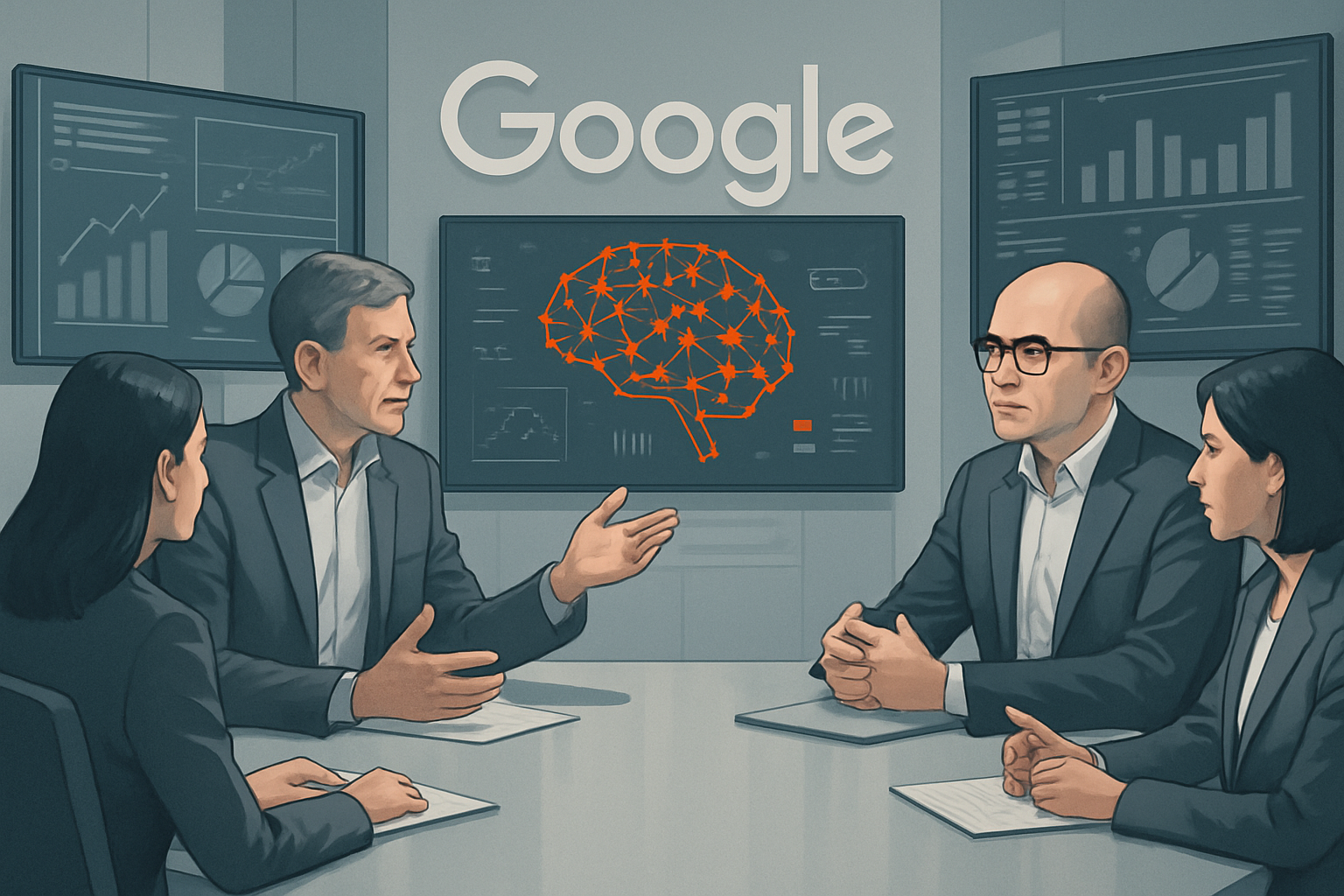
Demis Hassabis, until now the CEO of DeepMind, has been appointed Chief Scientist of Alphabet, Google's parent company. This change is part of a broader strategy aimed at strengthening the focus on artificial intelligence safety and promoting long-term research initiatives. This reorganization comes as Google faces increased competition in the AI space, particularly from OpenAI and Anthropic, which are positioning themselves as major players in the development of advanced technologies.
Google CEO Sundar Pichai announced these changes, emphasizing the importance of long-term research in the field of AI. Meanwhile, Jeff Dean, a Google veteran, is stepping down from his current role to launch a new initiative with Sanjay Ghemawat, another engineering leader. This reorganization had an immediate impact on the market, with Alphabet's shares dropping by 5% following the announcement.
Reactions from Industry Experts
Sebastian Mallaby and the Formalization of Roles
Sebastian Mallaby, a British journalist and author of a biography on Demis Hassabis and DeepMind, shared his perspective on this transition. According to him, this change formalizes a role that Hassabis was already informally occupying. Mallaby describes Hassabis as an "AI diplomat" within Google, having already played a crucial role in steering research at Google DeepMind. He also highlights Hassabis's commitment to AI safety, recalling his three-year struggle to obtain external oversight on DeepMind's AI deployments. Mallaby also mentions that Koray Kavukcuoglu has been leading research at Google DeepMind for some time, indicating continuity in leadership.
Vinod Khosla and Google's Impact on AI
Vinod Khosla, entrepreneur and co-founder of Sun Microsystems, praised Google's impact in the field of AI. He noted that Google has been at the forefront of accelerating AI, particularly through the development of Waymo's autonomous vehicles. Khosla credits the Google team, including Sundar Pichai, Larry Page, and Sergey Brin, for believing in AI and investing heavily to accelerate its development.
Ben Pouladian and the Streamlining Strategy
Ben Pouladian, founder of BEP Research, interpreted this reorganization as a sign that Google now wants to "play to win." He emphasized the importance of Amin Vahdat's appointment, the architect behind Google's TPU infrastructure, to a more central role. According to Pouladian, this could mean better allocation of computing resources and a reduction in internal policies, thus allowing for a more coherent AI strategy.
Zvi Mowshowitz and the Implications for AI Safety
Zvi Mowshowitz, founder of Balsa Research, expressed concerns about the impact of these changes on AI safety at Google. He noted that recent movements at Google DeepMind could signify a decrease in significant safety practices and DeepMind's independence from the rest of Google. Mowshowitz also mentioned the "promotion" of Demis Hassabis, which could be seen as a sidelining of daily operational responsibilities.
Tae Kim and the Future of DeepMind
Tae Kim, a technology journalist and author of the "First Adopter" newsletter, suggested that these changes could mark the end of an era for DeepMind. He pointed out that Jeff Dean and Demis Hassabis were two of the most important figures in AI at Google. With Jeff Dean's departure and Demis Hassabis stepping back from the day-to-day management of DeepMind, Kim questions the future of the organization and its role in Google's overall AI strategy.
Brief IA — L'actualité IA en français
L'essentiel de l'actualité de l'intelligence artificielle, décrypté et expliqué chaque jour.