Google Schools: Search Maintained with AI, Separate Controls
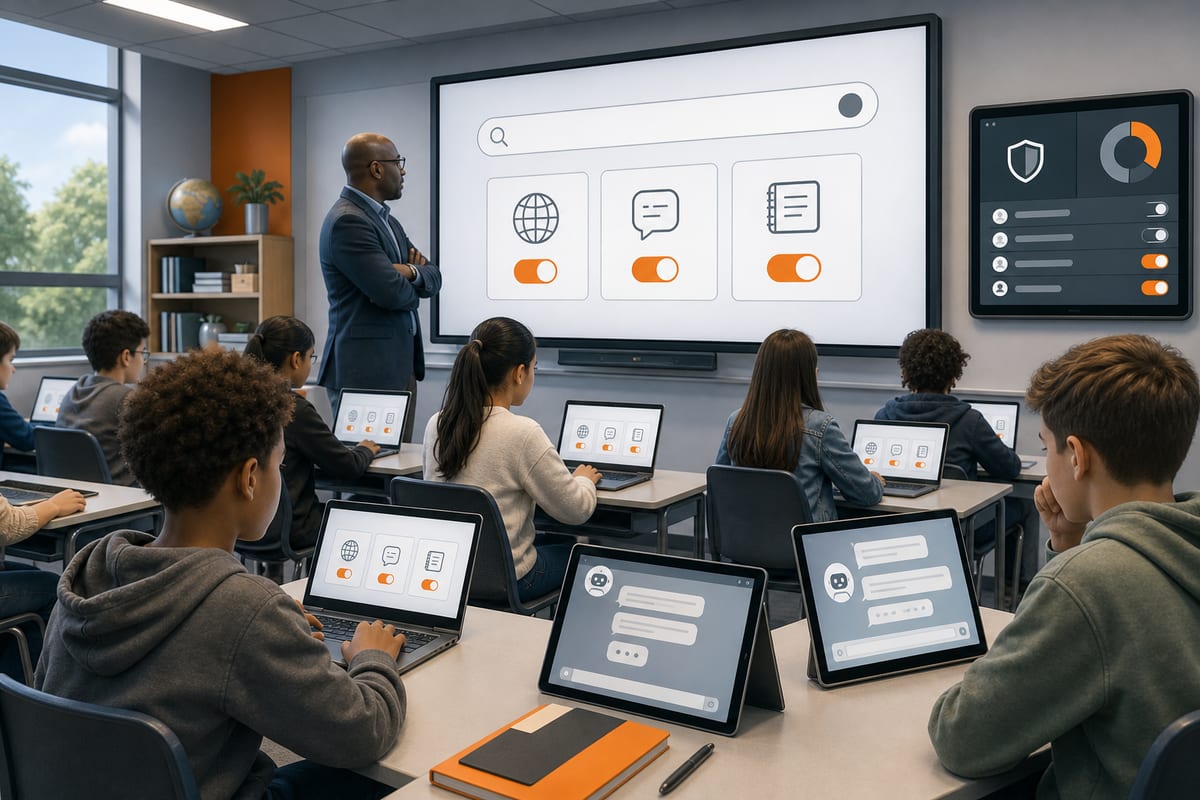
Google plans to disable its AI services by default for students next year, while maintaining a search that incorporates generative AI and allowing institutions to choose to activate Search, Gemini, and Gemini Notebook separately. While OpenAI claims that queries similar to search account for about 20% of Google’s volume, an expert considers a Search without generative features possible but unappealing. Rejecting AI proves difficult as many services, including Search, have relied on AI components for years.
OpenAI claims queries equivalent to 20% of Google
An executive from OpenAI stated that ChatGPT now handles requests similar to search, equivalent to about 20% of Google’s search volume. This figure does not represent market share, but it shows that habits are shifting towards direct answers. Many people prefer to ask a conversational agent and receive a helpful response rather than sifting through web links. Google cannot afford to let OpenAI capture this attention, especially among young users who are developing long-term habits. A significant shortfall in third-quarter revenue for Google Search intensifies the pressure to evolve.
Google maintains AI in the classroom but promises safeguards
In the education sector, Google plans to continue integrating AI into Search while offering more control to institutions and modifying how AI responds to students' questions. Schools will have the option to individually activate Search, the Gemini chatbot, and Gemini Notebook. According to Google, Search will continue to incorporate generative AI, but it will provide educational tools designed to assist students in problem-solving rather than giving direct answers. Additionally, Google intends to make its AI services inaccessible by default to students starting next year, in response to requests from certain schools seeking enhanced control.
Le brief IA que les pros lisent chaque soir
Les 7 actus IA du jour, décryptées en 5 min. Gratuit.
Inclus dès l'inscription : notre sélection des meilleurs guides & comparatifs IA.
Choisissez votre rythme
Gratuit · Pas de spam · Désabonnement en 1 clic
Rejecting AI also affects Search and our daily usage
Google Search has relied on AI for at least a decade, with technologies like RankBrain, introduced in 2015, and BERT, deployed in late 2019. Beyond Search, platforms like Instagram, Netflix, and Spotify also use AI systems to personalize user experiences, just like many other daily services supported by data centers. Therefore, rejecting AI is not only about recent conversational agents but also about essential elements of the current digital experience.
A search without generation? Possible, says an expert, but little demanded
A version of Search without AI Snippets or AI Mode, but retaining historical indexing and ranking algorithms, would be technically possible according to Ethan Smith, CEO of Graphite. However, he believes that Google likely has no interest in offering it, as the effort would not be worth it. He argues that the demand for such an experience would be very low, and many users appreciate AI, especially when they are unaware that it is being used.
What response generation changes for learning
AI Snippets and AI Mode in Google Search produce summaries and direct answers, adding a layer between students and original evidence, whereas traditional search directed users to sources to explore. The distinction between AI and generative AI is central: generative AI creates responses that may reduce reliance on primary sources. Google aims to align its educational uses more closely with a tutor, an approach reminiscent of the Study Mode launched last year by OpenAI, though it has not been established that this improves learning. Generative AI is also seen as potentially undermining educational goals based on inquiry and verification. More broadly, Google’s announcement, criticized and debated, comes amid a backdrop of reluctance towards AI, against concerns about energy usage and alerts raised by players like Anthropic.
Brief IA — L'actualité IA en français
L'essentiel de l'actualité de l'intelligence artificielle, décrypté et expliqué chaque jour.