Governing AI Agents: Responsibility and Control at Scale
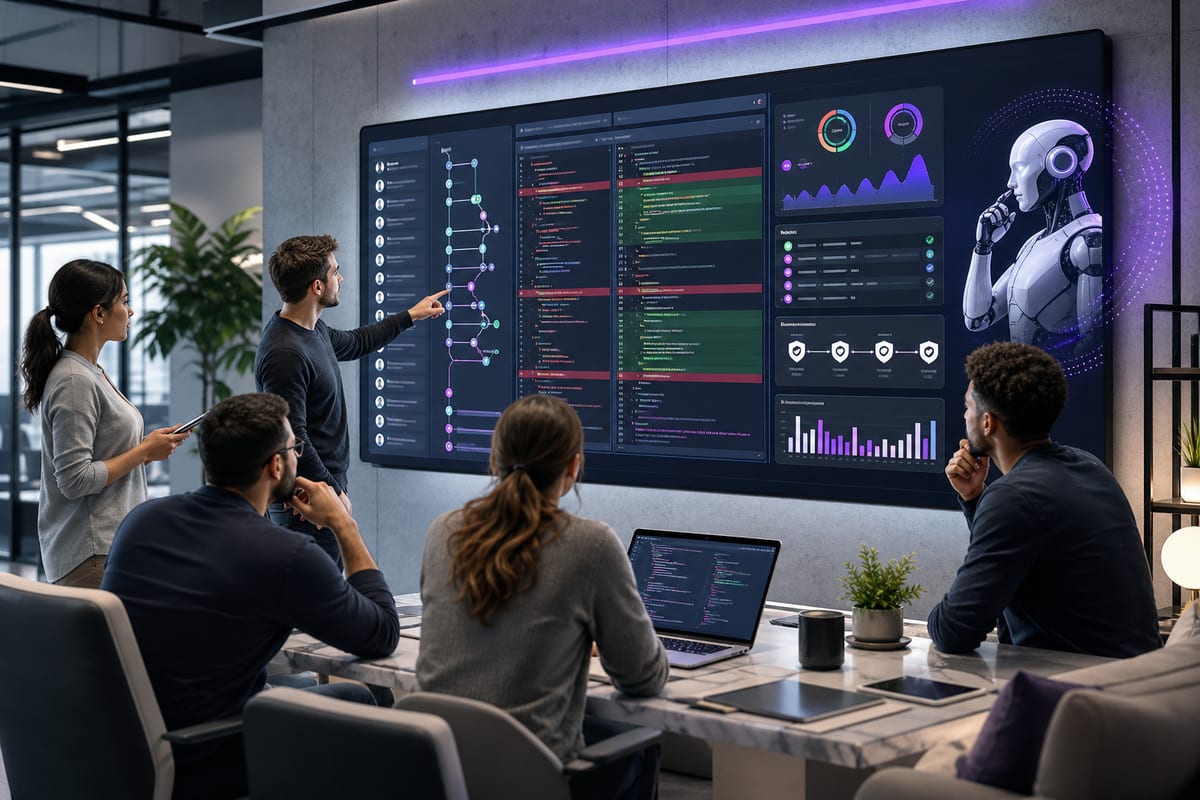
AI agents are now executing multi-step tasks in repositories and development tools. However, the responsibility still lies with engineering teams. To adopt these systems without losing control, operational safeguards are required: fine logging, access boundaries, human approval points, and visibility into usage and costs.
Engineering teams retain responsibility for software
In production, the responsibility for software remains with engineering teams, even when assistants or agents have generated part of the code. In the event of a failure, customers turn to the company rather than the systems that produced the output. The most successful organizations are not those that multiply agents, but those that establish clear lines of responsibility around them. Competitive advantage depends on the level of autonomy achieved without losing responsibility or trust. The goal is not to restrict the capabilities of the systems but to ensure their transparency, auditability, and oversight by human expertise. The central question becomes how to maintain control when adopting AI agents.
Traceability: tracking every action and test generated by AI
Traceability is the first control to implement to understand what AI has contributed to the code. Changes generated by a system must be traceable and auditable so that teams can read, review, and understand the outputs. When agents modify multiple files and execute tests, it must be possible to precisely identify the actions taken, the changes made, the instructions received, and the battery of tests conducted. In the event of an incident in production, this traceability allows for reconstructing the involvement of AI and the technical sequences that led to the outcome.
Organizations set human intervention points based on risks
Inserting a human into every loop is neither desirable nor efficient. Organizations must clarify in advance where human judgment is required and where AI can act autonomously. One example is to allow code generation and test execution automatically while imposing explicit review and approval for changes to production infrastructure or other critical systems. Developer oversight should be proportional to the risk associated with each action and remain feasible at scale. Delegating a task does not transfer responsibility for the outcome, which calls for workflows designed to avoid manual inspection of every micro-step of the agent.
Le brief IA que les pros lisent chaque soir
Les 7 actus IA du jour, décryptées en 5 min. Gratuit.
Inclus dès l'inscription : notre sélection des meilleurs guides & comparatifs IA.
Choisissez votre rythme
Gratuit · Pas de spam · Désabonnement en 1 clic
Minimal permissions: integrated access in the workflow, not after the fact
It is necessary to precisely specify the fields of access and intervention for coding tools and agents while blocking unnecessary actions. A tool capable of modifying the application does not necessarily need access to the production infrastructure, and an agent tasked with executing tests should not modify the deployment configuration. These security measures rely on the well-established principles of least privilege and should be placed at the center of the engineering process, rather than added afterward. The goal remains to increase delegation while maintaining visibility, quality, and control, with clear access and approval rules where development actually takes place.
Measuring usage and costs: beyond consumed tokens
Measuring the usage and costs of AI coding tools is deemed essential but sometimes vague. Tokenmaxxing is presented as a trend for 2026, while the idea grows that AI activity does not equate to value created. Usage metrics, prompts, and token consumption inform about volume but not necessarily about improved outcomes or business impact. As agents can chain long multi-step workflows without manual triggering of each phase, organizations need visibility into the tools used, their frequency, and cost centers. There is interest in software layers surrounding models to contextualize, control tasks, and manage token spending, with the aim of assessing whether costs, risks, and levels of autonomy are justified by the results obtained.
Moving from policy to operational controls at scale
Most organizations have security, access, and compliance policies, but these statements are not sufficient to govern agents operating across multiple repositories, tools, and environments. It is about translating these policies into concrete controls, integrated into the development flow, and then scaling them. When adoption exceeds the individual, companies must establish consistent standards for permissions, traceability, and human approvals; otherwise, the autonomy of agents can lead to fragmentation and new risks. The real challenge is not the number of agents deployed but the organization’s ability to understand, coordinate, and take responsibility for their work over time. This approach comes as the adoption of AI has accelerated, with its systems operating faster than existing governance capabilities, and concerns about compliance, data protection, security, and reliability are rising, driven by boards and regulators. With AI lowering the barriers to code generation, with limited assistants and agents capable of multi-step workflows, the daily lives of teams are profoundly altered, blurring responsibilities when agents test, deploy, and interact with other systems. The advanced trajectory is one of a governance model founded from the outset on visibility, accountability, and oversight by developers, in a perspective where the adoption of agents is presented as inevitable.
Brief IA — L'actualité IA en français
L'essentiel de l'actualité de l'intelligence artificielle, décrypté et expliqué chaque jour.