OpenAI's GPT-5.5-Cyber: A Direct Challenge to Mythos in Cybersecurity
Le brief IA que les pros lisent chaque soir
Les 7 actus IA du jour, décryptées en 5 min. Gratuit.
Inclus dès l'inscription : notre sélection des meilleurs guides & comparatifs IA.
Choisis ton rythme
Gratuit · Pas de spam · Désabonnement en 1 clic
OpenAI Unveils GPT-5.5-Cyber, a Revolutionary Model in Cybersecurity
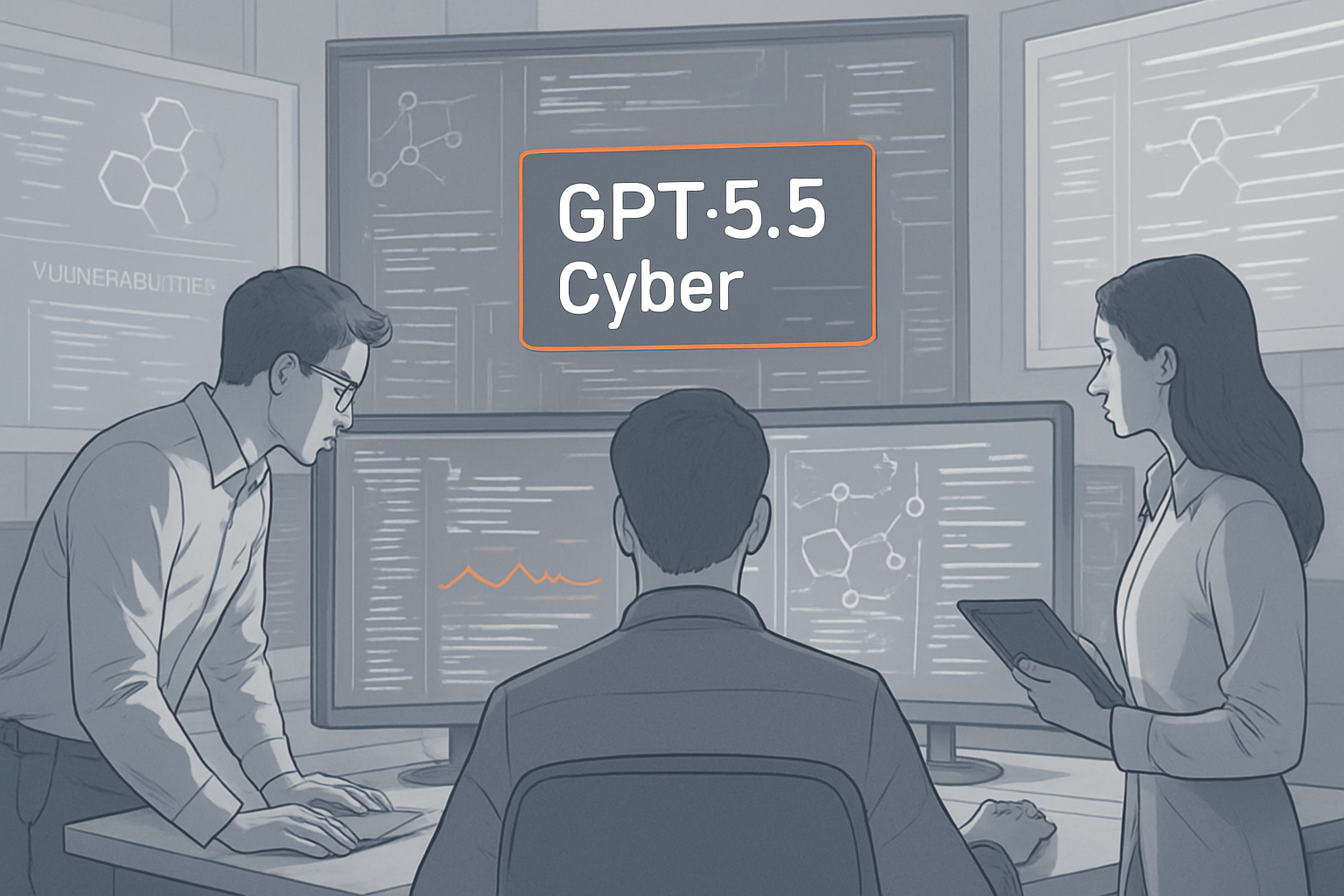
OpenAI has recently unveiled its latest specialized model, GPT-5.5-Cyber, which has set a new record by achieving a score of 85.6% on the CyberGym benchmark. This model represents a significant advancement in the field of artificial intelligence dedicated to cybersecurity, surpassing Mythos 5, the model from Anthropic that was previously considered the gold standard. OpenAI is focusing on integrating this model into tools for security professionals and open-source projects, thereby reinforcing its commitment to digital security.
An expert recently described the rapid evolution of AI models as an "opening of Pandora's box," a metaphor that aptly illustrates the speed at which these technologies are progressing. With the launch of GPT-5.5-Cyber, OpenAI once again demonstrates its ability to push the boundaries of innovation in artificial intelligence, taking the lead in academic benchmarking and setting new standards in the industry.
An Impressive Score on the CyberGym Benchmark
The CyberGym benchmark is not just a theoretical test. Developed by the University of California, Berkeley, it relies on 1,507 real vulnerabilities from 188 open-source projects. This test aims to evaluate a model's ability to identify a vulnerability, understand its cause, and propose an appropriate fix. GPT-5.5-Cyber achieved a score of 85.6%, surpassing Mythos 5, which scored 83.8%. Previous versions of GPT-5.5 and Claude Opus 4.1 also lag behind this new model.
While a two-point difference may seem minimal, it is significant in the field of cybersecurity where every improvement can have a major impact. The fact that CyberGym is based on real vulnerabilities makes this score particularly relevant for professional use, unlike other more academic benchmarks.
The success of GPT-5.5-Cyber against Mythos 5 is even more noteworthy given that the Trump administration recently restricted access to this AI from Anthropic in the United States. However, OpenAI emphasizes that GPT-5.5-Cyber is designed for defensive and authorized uses, not for automating attacks. The model is capable of tracing the origin of vulnerable code, verifying the reality of a flaw, proposing a fix, and preparing the necessary elements for human validation. Thus, it does not replace experts but enables them to focus on more complex tasks by automating repetitive processes.
Expansion of the Daybreak Platform with New Tools
Alongside this announcement, OpenAI has expanded its Daybreak platform, which encompasses a suite of tools dedicated to software security. Among the new features is a plugin named Codex Security, designed to detect, validate, and fix vulnerabilities in Codex. Additionally, OpenAI has made GPT-5.5-Cyber fully accessible to trusted defenders.
Another major development is the launch of the Cyber Partner Program. This program allows security-focused companies, such as IBM, to integrate GPT-5.5-Cyber into their own products through controlled access. This enables the clients of these companies to benefit from the model's advanced capabilities while reserving direct access for selected partners.
Finally, OpenAI continues to support the Patch the Planet initiative, which aims to assist maintainers of open-source projects. The company announced that it has contributed to the integration of 37 patches in one week across several critical projects, including cURL and Python. The goal is to accelerate the fixing of vulnerabilities before they can be exploited by cybercriminals. While this program is ambitious, it remains to be seen how it will translate into concrete results on the ground, as is often the case with promises of AI.
Brief IA — L'actualité IA en français
L'essentiel de l'actualité de l'intelligence artificielle, décrypté et expliqué chaque jour.