GPT-6.2: Five-Target Connections Observed in the Lab
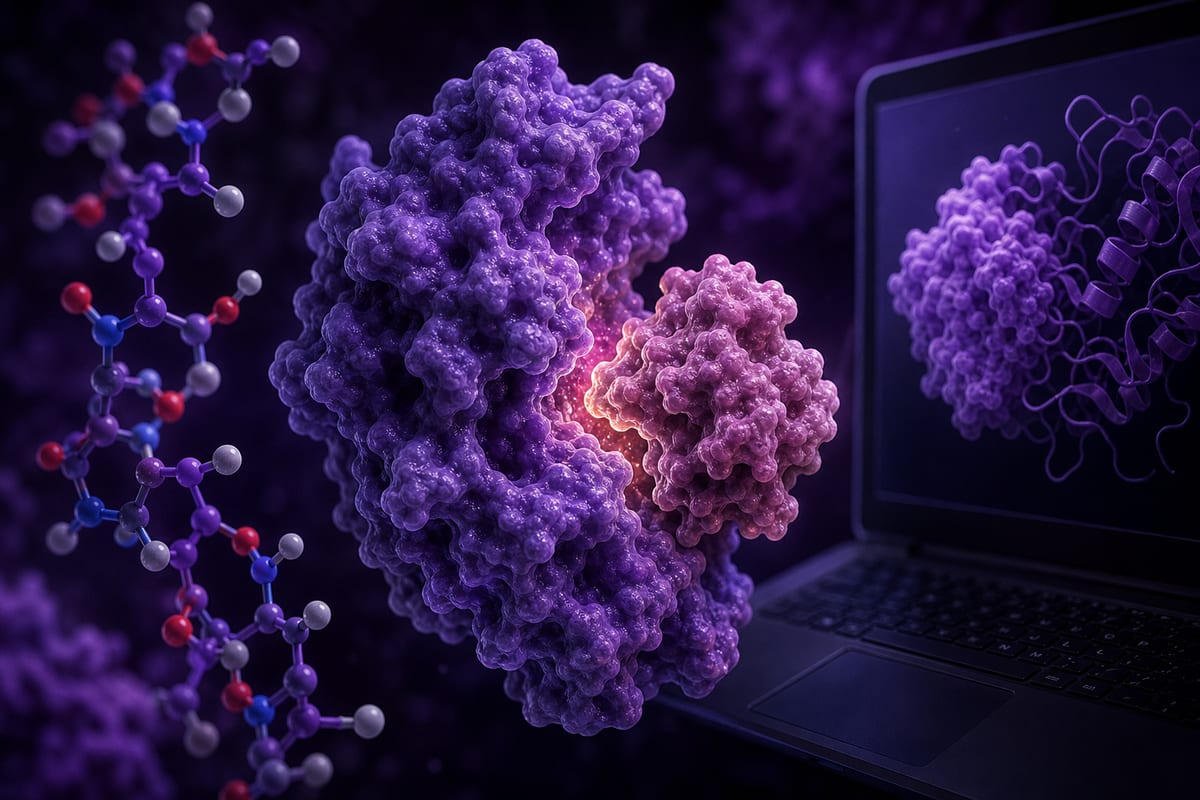
Proteins derived from designs by GPT-6.2 have shown signs of binding to 5 targets during trials conducted with Onava, researchers announced on November 24, 2026. Specialized models also contributed to providing sequences and selecting the candidates tested.
Trials Distinguish Proposed Structures and Sequences
To evaluate small binding proteins, known as minibinders, researchers tested 322 candidates against 5 targets. They observed 35 positive results, or 10.9%: 5 for PD-L1, 3 for IL-7Rα, 1 for TrkA, 8 for VEGF-A, and 18 for IL-17A. Some cancers use PD-L1 to evade immune defenses.
In a computational comparison with RFdiffusion, a model specialized in protein design, the structures proposed by GPT-6.2 received slightly lower scores. The latest internal models performed better than RFdiffusion. Engineered antibodies also retained their binding capacity.
Another experiment isolated the production of sequences: GPT-6.2 received the three-dimensional representation of minibinders associated with their targets, without knowing their initial sequence. For three targets, these representations were computational predictions regarding already confirmed minibinders, whose sequences had been collected in previous research.
Initial measurements detected binding for 75 proposals out of 88 targeting MDM2, or 85%, and for 26 out of 42 targeting VEGF-A, or 62%. For PD-1, the result was 8 out of 59, or 14%. Researchers see this as a possibility that GPT-6.2 could produce both the structure and the sequence of a minibinder itself.
Researchers Guide Proposals with Instructions
According to the team, GPT-6 models can propose protein shapes and their sequences through reasoning and programming, without a specialized biological model to generate these designs. An internal research model has also matched or surpassed specialized tools on many tasks. Researchers indicate they can specify both the area where a protein should bind and its expected geometry.
Le brief IA que les pros lisent chaque soir
Les 7 actus IA du jour, décryptées en 5 min. Gratuit.
Inclus dès l'inscription : notre sélection des meilleurs guides & comparatifs IA.
Choisissez votre rythme
Gratuit · Pas de spam · Désabonnement en 1 clic
Natural language instructions can pertain to atomic binding as well as the overall shape of a protein. In one exercise, GPT-6.2 had to determine where and how a small molecule would attach to a protein. When researchers knew the two linked atoms, they could communicate this constraint to request the arrangement of the rest of the molecule. A modification of the instruction allowed for a change of task without new training.
The team contrasts this flexibility with the requirements of specialized tools, whose coordinated use would require significant expertise. Each accepts particular categories of inputs and constraints; integrating information of a new type generally requires software adaptation or additional training, researchers explain. They thus present a generalist model capable of fulfilling several of these functions as easier to adapt to new requirements.
Design Must Connect Shape and Function
A protein consists of a chain of amino acids whose order determines its folding in space. This geometry influences its activity. Designing a protein therefore involves finding both a shape suitable for the desired effect and the sequence likely to produce it.
The biological functions involved are diverse: proteins participate in the chemical reactions essential to life, transport blood oxygen, and contribute to defenses against infections. An incorrect conformation can also lead to diseases and dysfunctions. Scientists may thus seek a protein capable of blocking an immune evasion signal from cancer cells or helping to capture atmospheric carbon dioxide.
For researchers, the written traces of reasoning and the code produced by the models suggest the mobilization of mathematical, physical, chemical, and biological knowledge. This knowledge would play a role in processing protein shapes and interactions with other molecules.
Brief IA — L'actualité IA en français
L'essentiel de l'actualité de l'intelligence artificielle, décrypté et expliqué chaque jour.