GPT-6.2 Identifies the Artist of a Sketchbook in 22 Minutes
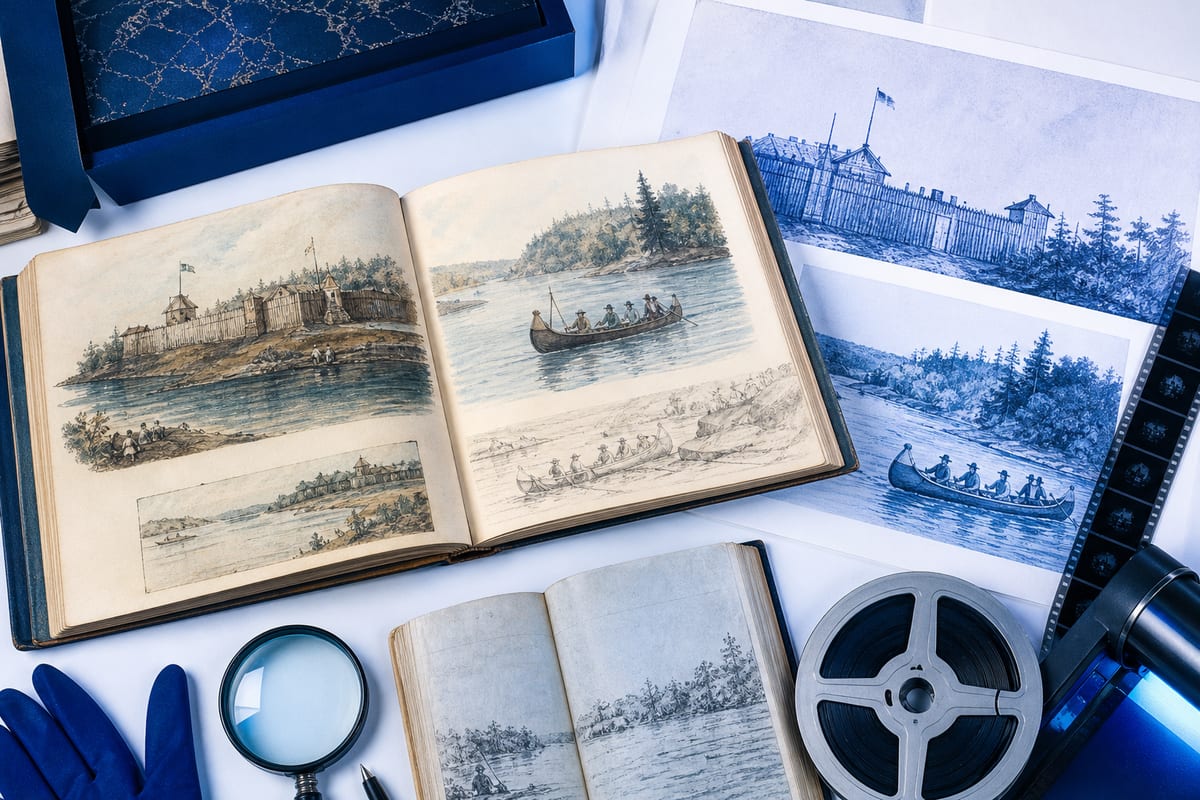
GPT-6.2 Astra identified the artist of an anonymous sketchbook preserved at Yale in just 22 minutes, reports Mark Humphries, a history professor at Wilfrid Laurier University in Canada. Subsequent checks on a microfilmed journal provided, according to him, corroborating evidence in favor of the viscount de Chabot.
A Journal Provides Verification Elements
To test the proposed attribution, Astra recommended obtaining a travel journal identified during its research, preserved on microfilm at the Special Collections of Cleveland State University. Humphries ordered digital reproductions. He reports a match between the handwriting, as well as between the described journey and the dated drawings.
One passage seems particularly compelling to him: on June 18, 1808, Chabot notes that he sketched after arriving by canoe at Fort St. Joseph. The following description would precisely correspond to the view of the fort depicted in the sketchbook.
This journal contains about 162 detailed pages. It had received a single mention in a footnote in a dissertation dedicated to another historical field; Humphries claims it was unknown to specialists in Canada or the fur trade. Excerpts from papers, journals, and correspondence from the North West Company accompanied it, while the original documents had long since disappeared.
Humphries emphasizes the rarity of such discoveries in the history of the fur trade, which has already been extensively studied. The recognized specialists to whom he presented these findings were also surprised, he reports.
The Sketchbook Resisted Humphries' Research
At the Beinecke Library of Yale University, the drawings trace a journey made in 1808 between Montreal and Fort William, up to Lake Superior, and then back. Some of the sites depicted no longer exist. Only four images include both a date and a caption.
Le brief IA que les pros lisent chaque soir
Les 7 actus IA du jour, décryptées en 5 min. Gratuit.
Inclus dès l'inscription : notre sélection des meilleurs guides & comparatifs IA.
Choisissez votre rythme
Gratuit · Pas de spam · Désabonnement en 1 clic
Humphries dedicated long hours over several years to this attribution without success. According to his estimate, several thousand people could have been the sought-after artist. The route was commonplace, he explains, even though the sketchbook was unique: lacking a name to guide the research, it would have remained anonymous for over 200 years.
The candidate proposed by the model is Louis-Guy-Charles-Guillaume de Rohan-Chabot, a French aristocrat known as the viscount de Chabot, who lived from 1780 to 1875. An officer in the service of the British army, he spent most of 1808 in Canada. Before this research, Humphries claims he knew neither this man nor his journal.
Humphries Describes a Largely Delegated Investigation
In his announcement on X, the historian explains that he used GPT-6.2 Astra within ChatGPT, with minimal instructions. The suggestions he had introduced were poor leads. According to his account, the model consulted both primary and secondary resources, freely accessible online, and then developed and defended a hypothesis based on limited clues.
Humphries describes a work conducted from two directions: the limited traces of the journey found in the sketchbook and the mass of information remaining about British North America. He attributes the result to the connections made between scattered data. He presents his own role primarily as that of the person responsible for obtaining the necessary paper document copies, while acknowledging that the internal operations of ChatGPT remain partially opaque.
The historian considers the contribution significant for historical knowledge and believes it unlikely that a human could replicate such an approach. He sees it as an extension of the discovery capabilities already observed in mathematics. In his view, the situation is reminiscent of mathematicians about eleven months ago when language models began solving Erdős problems.
He describes, over the past year, a progression from manuscript deciphering to historical reasoning, then to academic writing and modest contributions to knowledge with relative autonomy.
Brief IA — L'actualité IA en français
L'essentiel de l'actualité de l'intelligence artificielle, décrypté et expliqué chaque jour.