Granola: The AI that Protects Privacy in Business
Le brief IA que les pros lisent chaque soir
Les 7 actus IA du jour, décryptées en 5 min. Gratuit.
Inclus dès l'inscription : notre sélection des meilleurs guides & comparatifs IA.
Choisis ton rythme
Gratuit · Pas de spam · Désabonnement en 1 clic
The Growing Impact of AI Note-Takers
In a world where technology is evolving at breakneck speed, artificial intelligence tools, particularly AI note-takers, are becoming increasingly important in our professional lives. During a recent appearance on the Platformer podcast, Thomas Paul Mann from Raycast made a bold prediction: in a few years, up to 50% of the applications on our Mac computers could be personal creations. This perspective highlights the growing impact of AI tools, especially those that assist our meetings by capturing notes automatically.
This week, the spotlight is on Granola, an AI note-taker that stands out for its unique approach to privacy. Chris Pedregal, co-founder and CEO of Granola, shared his journey and the philosophy behind his company. After working at Google, where he started in 2008 as an associate product manager and founded Socratic, a homework help app acquired by Google in 2018, Pedregal launched Granola in 2022 with Sam Stephenson. Their goal: to explore large language models before the era of ChatGPT. Granola has been my own AI note-taker since shortly after its launch.
Granola: An Innovative and Discreet AI Tool
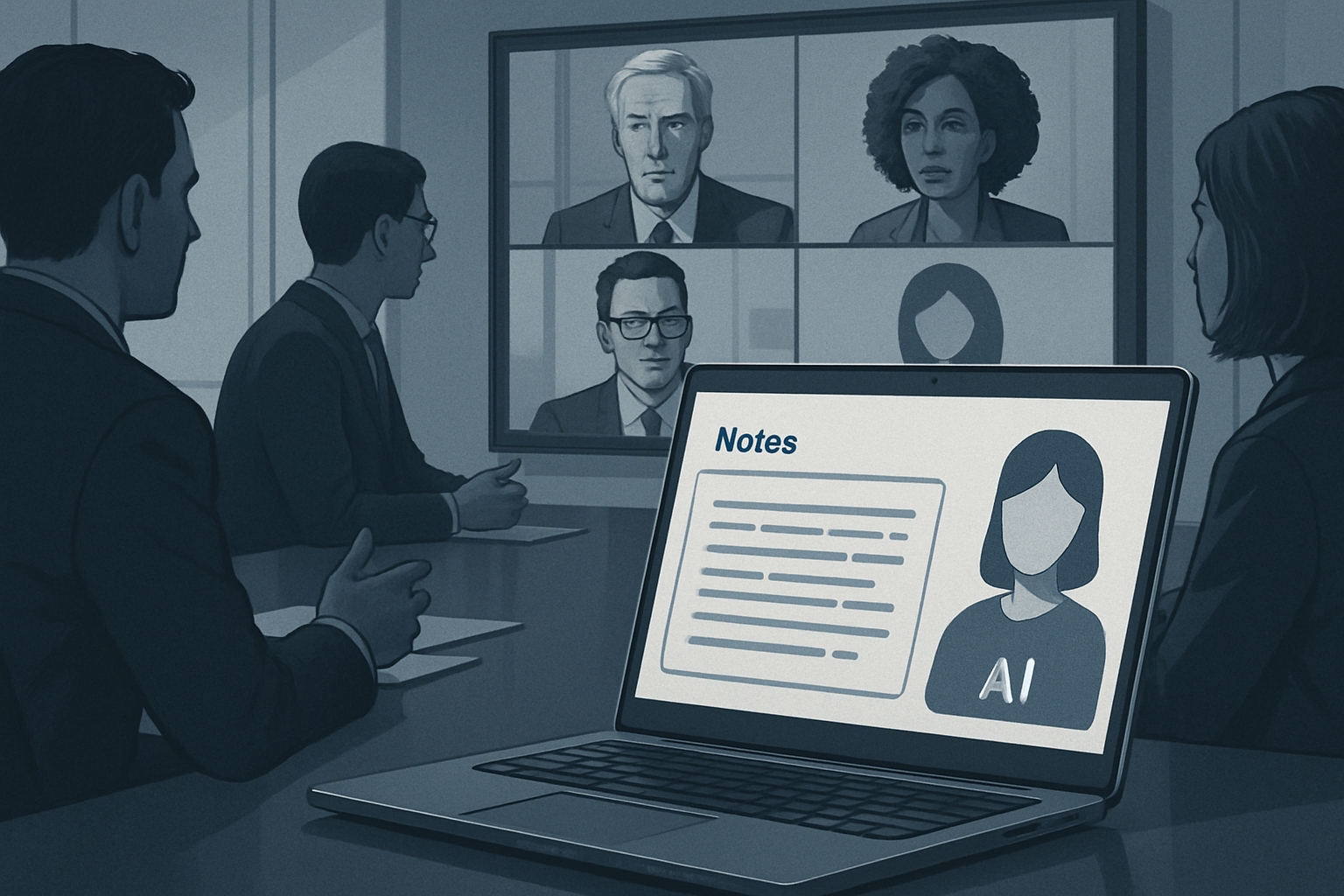
Granola distinguishes itself in a saturated market of chatbots thanks to its sleek design and advanced features. The application captures audio directly from the user's computer, allowing for manual note-taking in parallel and providing an instant summary at the end of each meeting. This ability to deliver accurate summaries has convinced many users to become paying customers. Granola recently reached an impressive valuation of $1.5 billion.
Unlike some competitors, Granola operates discreetly, without alerting other meeting participants. This invisibility has raised concerns about secret surveillance. Pedregal explains that this design stems from the limitations of existing meeting software, which complicates the integration of third-party bots. To address this, Granola displays an animated watermark on the user's video feed, an innovative solution to obtain participant consent.
Privacy at the Heart of Granola
Granola stands out for its commitment to user privacy. The notes generated by the application are private by default, an approach that does not sit well with all companies. According to Pedregal, businesses dislike Granola for this privacy policy. CEOs regularly request access to every employee's transcription, but Granola refuses to comply with these demands. He believes that allowing such use of personal data would go against the company's ethics.
Pedregal envisions a future where business meetings are transcribed by default, with the option for participants to opt out. He hopes that in social contexts, transcription will remain optional, thus preserving individuals' privacy.
Towards Ethical Data Management
Granola is currently exploring the possibility of automatically deleting verbatim transcriptions after a certain period while retaining essential knowledge in a working memory. This approach aims to balance the utility of data with privacy protection. The company is also testing "enhanced transcriptions" designed for use by AI agents within a corporate knowledge base.
Pedregal emphasizes the importance of designing privacy-respecting technologies from the ground up. Granola has never stored audio recordings, a decision that reflects its commitment to privacy. The company continues to seek ways to compress data to reduce the long-term impact of retaining transcriptions.
The Future of AI Note-Takers
Pedregal remains optimistic about the future of AI note-takers. He downplays fears of major disruptions to the job market due to AI, reminding us that the advent of computers did not lead to the hoped-for reduction in working hours. According to him, transcription is just the beginning of a broader technological revolution, with new work interfaces on the horizon.
Granola, with its ethical and innovative approach, could well become an essential tool in the modern professional landscape, much like Slack. However, the challenge will be to maintain this balance between utility and respect for privacy while navigating a constantly evolving technological environment.
Pedregal currently leads a company of about 80 people, with potential growth up to 120 employees. He expressed his belief that we are only at 5% of this new technical revolution, comparing transcription to the era of word processors before the arrival of spreadsheets and graphical interfaces.
Excerpts from the Conversation
Casey Newton: I find myself using Granola for everything, but perhaps searching my notes less than I expected. I get a lot of peace of mind from capturing everything, but it turns out I don't really need to go back to what that person said. How true is this for your user base?
Chris Pedregal: I go back less than you might think, and some companies might look at that and say, okay, how can we increase that number? I actually think that forgetting — not going back to things — is a feature as much as a bug. Our brains are actually pretty good at remembering the most important things. What’s powerful is that moment when you say, oh shoot — what did I say in that meeting? Just knowing you have it is very valuable.
What has changed: our use of MCP is the fastest-growing graph we have, and agents have many more cycles, so agents will go back and check things. I think this trend will only increase. Transcriptions are this goldmine of context. By default, agents are really smart, but they know nothing about you. And it turns out we have tons of meetings, and talking is pretty easy. There’s this contextual completeness that you naturally produce, and something like Granola simply captures it.
Newton: I want to ask you about a design choice you made that seems very powerful, but that people also feel, which is that Granola is invisible. There were other AI note-takers before, and often they involved adding a bot to a meeting. How did you come to say that we’re just going to record audio from a laptop?
Pedregal: The reason we made that decision wasn’t for Granola to be hidden. I don’t really like bots, but that wasn’t the initial goal. The initial goal was that we thought it was really important for Granola to always work. It doesn’t matter if you’re in a Slack huddle, a Zoom meeting, or an in-person meeting: if you hit start, it just starts transcribing. And the only way to do that is to use your computer’s system audio. We also didn’t like bots because we thought they were a really clunky and dehumanizing force in a meeting.
The downside of our approach, however, is that when you use Granola by default, other people don’t know you’re using it. So, we place the responsibility on the user to tell others that they’re using Granola. And that’s actually not our choice. If there were an easy way that didn’t involve a bot to make this visible, we would do it — that’s where social norms are going anyway, and it’s just good for everyone to know if you’re being transcribed or not. The problem is that the Zooms and Meets of the world make that almost impossible because they push their own note-taking systems. There’s no API call where we could ask everyone in a meeting for consent — we would do it. So, we had to go to great lengths. I can show you what we built: if I activate Granola now, do you see that watermark that appears at the bottom of my screen?
Pedregal: That’s something we built, and users can activate it. Any company that deploys Granola tends to want that activated because they want visibility. But the way we had to build it was a bit crazy. It’s actually a virtual camera on your computer, and we inject it into the video feed before it reaches Zoom or Google Meet, because that’s the only way we can control how it appears and ensure it shows up.
I think social norms will evolve, I think video conferencing platforms will give us more control, and I think we’ll end up in a good place. I think we’ll probably end up in a world where, in work meetings, the expectation is that you’re transcribed by default, and you ask not to be. I hope that in social environments, the default remains that you’re not transcribed, and you ask to be transcribed.
Newton: It seems like you’ve essentially embraced the critique around privacy.
Chris Pedregal: That’s something that’s been on our minds from the beginning. Another design choice we made — unlike, I think, anyone at the time — is that we never stored audio. We have access to audio, we could have access to video, and we never, ever stored audio because we wanted Granola to feel like a notebook. In the beginning, we actually intended to delete transcriptions: you would get the notes, and then we would delete the transcription. We realized we shouldn’t do that — transcriptions are super valuable, and if you want to regenerate your notes, you need the original source material.
Whenever a new technology emerges, you have to be thoughtful about the design choices you make, and then society will adapt. I’m very glad we decided not to store audio — it was the right decision. Right now, we’re looking at whether we should automatically delete the transcription after a certain time for all users. There’s a lot of value that gets lost, so we’re researching compression. You probably don’t need a verbatim transcription of a conversation you had three years ago, but you might want to go back and discuss that meeting. There’s utility and invasiveness, and you have to navigate between those two aspects.
Brief IA — L'actualité IA en français
L'essentiel de l'actualité de l'intelligence artificielle, décrypté et expliqué chaque jour.