H6.ai Secures Accounting Automation with Lakebase Postgres
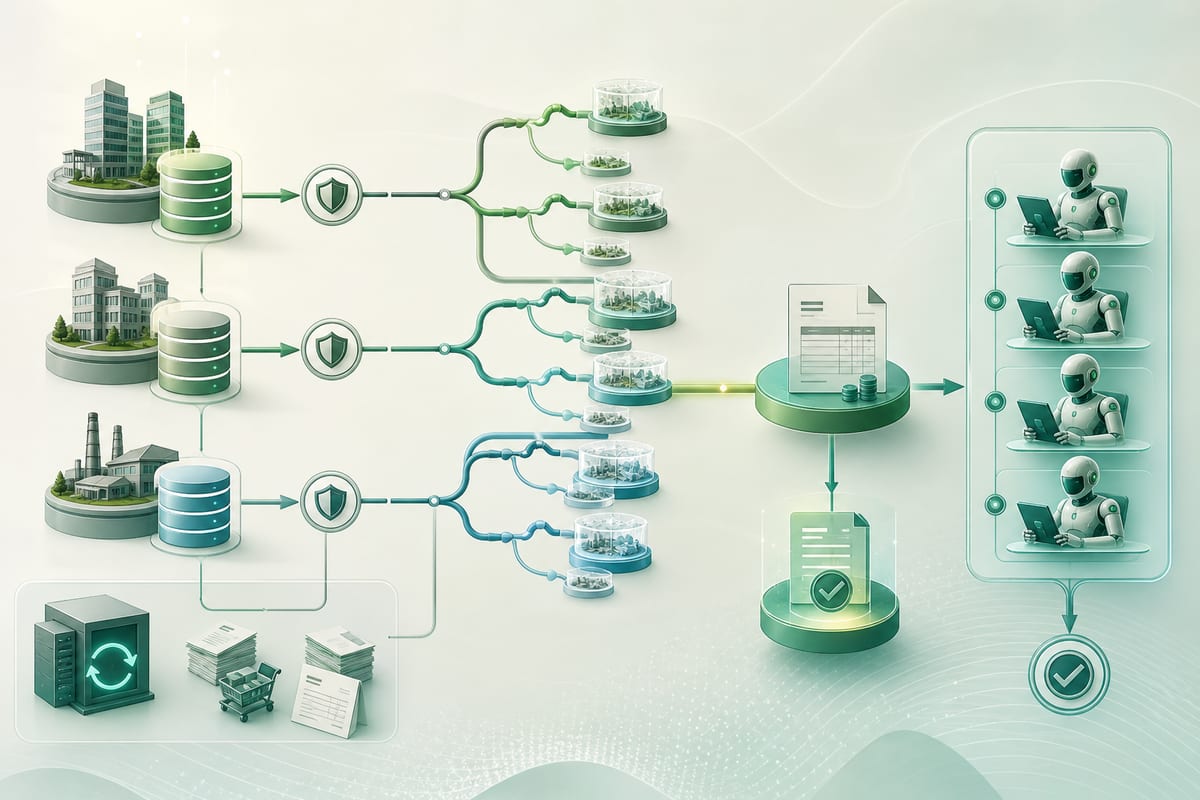
The accounts payable automation publisher deploys a Lakebase Postgres database per client and utilizes copy-on-write branches to replay real cases without affecting production environments. An AI panel of judges complements deterministic checks to assess the accuracy of the processes. H6.ai also plans to execute Lakehouse//RT queries in read-only mode, without data duplication.
H6.ai isolates and protects client data with Lakebase
Lakebase Postgres provides the expected isolation of a multi-tenant financial platform through a dedicated database for each client. When an incident occurs, a branch preserves the exact financial state at that moment, regardless of subsequent changes to active data. Copy-on-write branches create ephemeral and low-cost copies for each execution, which are then deleted. Replays remain secure thanks to migrations applied to specific branches. H6.ai neither simulates the database nor the pipeline: all test writes are confined to the execution branch and deleted after use, never published in the ERP or modifying the live database. Tests are conducted on copies of production data with the same code paths as in production, while maintaining the integrity of the books. Branch management relies on service principals with minimal rights and guards preventing any action on a client's active branch.
Testing on snapshots and an AI panel to decide
Each test case associates an invoice, a snapshot, and an expected result, including the targeted purchase order, line item assignments, and any potential hold for review. The process follows four steps: updating the snapshot via a branch migrated to the current schema, creating a temporary execution branch, actual processing by the candidate pipeline as in production, and then comparing to the expected result before deleting the branch. Test plans can mix cases from clients, ERPs, and various formats, each executed on its preserved database. By always restarting from the same frozen state, a test maintains an identical starting point in time. The evaluation combines deterministic assertions on verifiable facts and a panel of AI judges, based on models from multiple providers, which renders a verdict of success, failure, or inconclusive along with its reasoning. The overall assessment indicates whether the result is correct, beyond merely completing the processing.
Le brief IA que les pros lisent chaque soir
Les 7 actus IA du jour, décryptées en 5 min. Gratuit.
Inclus dès l'inscription : notre sélection des meilleurs guides & comparatifs IA.
Choisissez votre rythme
Gratuit · Pas de spam · Désabonnement en 1 clic
H6.ai retains an isolated copy after each processing error
When an invoice is processed incorrectly, H6.ai creates a branch from the client’s database and retains this branch as a snapshot. An initially open purchase order remains open with the same quantities and prices, and the snapshot also freezes suppliers, accounts, dimensions, history, and policy parameters. Rather than recreating the conditions of an incident, these conditions are preserved. The harness never rewrites the live database: writes remain confined to execution branches, deleted at the end. Each unusual invoice is integrated with its snapshot and expected result and becomes a permanent regression test.
H6.ai adapts its system to the diversity of client environments
Environments differ from one client to another: ERP, suppliers, purchase orders, accounting plans, and policies vary, and invoice formats can include documents with hundreds of lines. Data evolves over time: the same invoice can produce different responses without code changes, complicating regression testing. In this context, the engineering team chose the lakebase architecture, which separates storage from computation, shuts down inactive computation, and allows branching, as the foundation of the platform. Each client has a Lakebase Postgres database containing their synchronized financial context and H6 policies, with one database per client to ensure isolation. H6.ai automates accounts payable processing above the company's ERP, in reading, matching, assignment, and compliance control, with deterministic and auditable policy execution. The company presents this approach as a response to the trade-offs imposed by traditional tools and the very reason for its creation.
Iterations on models and analyses without announced data copying
To evaluate new models as well as engine changes on real situations before deployment, temporary branches are migrated according to the schema, while a group of AI judges is mobilized. According to H6.ai, this combination helps improve extraction, reduce costs, evolve matching and policy engines, and detect regressions upstream, while test coverage increases with the arrival of new clients, ERPs, and invoice formats. H6.ai considers Lakebase branching as a central element for building trustworthy AI-driven financial automation. The publisher also plans to leverage Lakehouse//RT queries on Lakebase tables to execute read-only analyses without copying data, aiming to achieve fresh analyses without a dedicated pipeline.
Brief IA — L'actualité IA en français
L'essentiel de l'actualité de l'intelligence artificielle, décrypté et expliqué chaque jour.