Hated AI, Embraced AI: Polls and Mass Adoption
Le brief IA que les pros lisent chaque soir
Les 7 actus IA du jour, décryptées en 5 min. Gratuit.
Inclus dès l'inscription : notre sélection des meilleurs guides & comparatifs IA.
Choisis ton rythme
Gratuit · Pas de spam · Désabonnement en 1 clic
Surveys are multiplying: widespread concern, hostility towards data centers, and declining popularity. At the same time, chatbot usage figures are reaching new heights. In the United States, regulatory efforts are accelerating, and the open-source offering is advancing, while startup leaders consider LLMs inevitable but improvable.
In the United States, over 2,100 texts and a multiplied movement in three years
All 50 U.S. states have either enacted or submitted legislative texts concerning the development and use of AI. This legislative network totals over 2,100 bills across the country, with the number of initiatives multiplied by ten in just three years. Alongside the regulatory aspect, leading open-source alternatives already exist in competition with Google, OpenAI, and Anthropic. They offer, at least for now, more choices for users and increased competitive pressure.
Local hostility and global concern measured by surveys
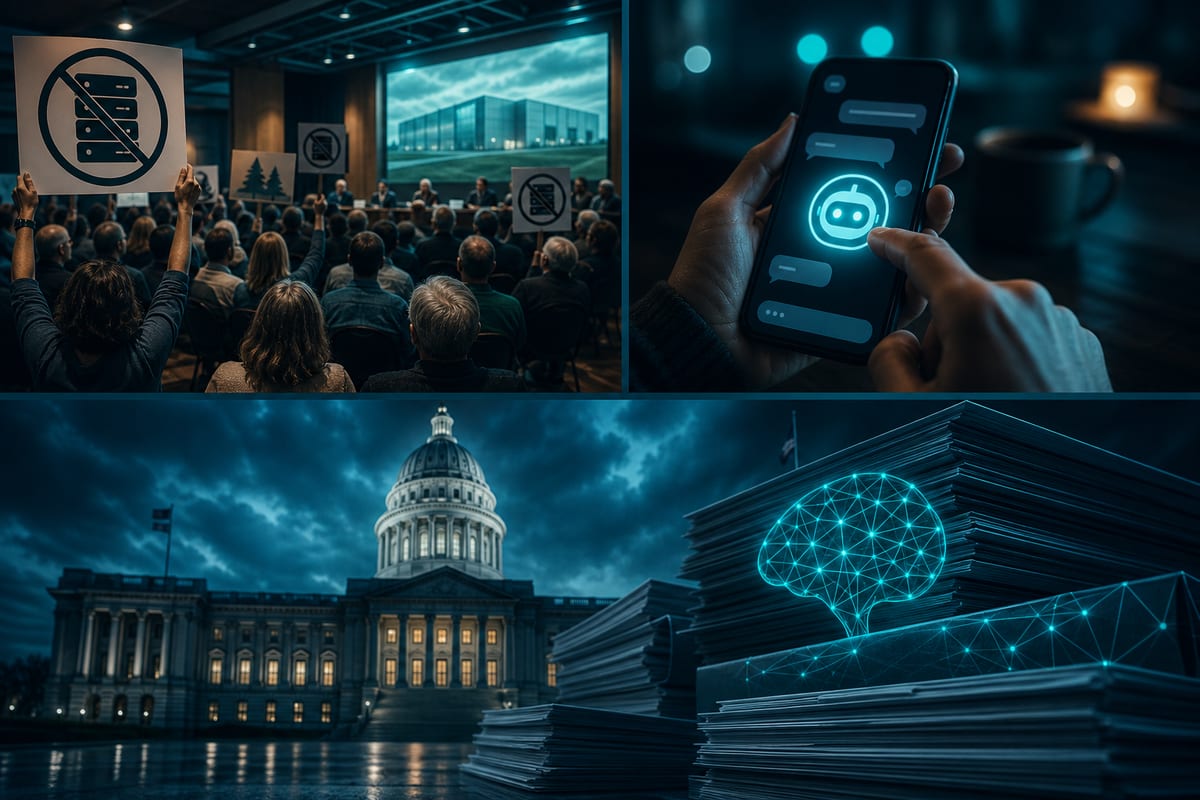
According to Stanford University, more than half of people worldwide report that AI products and services make them nervous. In the United States, a Gallup poll conducted in May shows that 71% of adults would oppose the construction of a new AI data center in their area, a higher proportion than the 53% opposed to a new nuclear power plant. In March, an NBC poll indicated that AI is less popular than ICE. According to the Pew Research Center, more American adults believe that AI will have a negative effect on them and society than a positive one, with particularly marked pessimism among young people.
Chatbot usage booming, from the U.S. to the OECD
ChatGPT reached one billion monthly users in May, according to Sensor Tower. Google DeepMind with Gemini had 950 million users in July. According to Pew, one in two adults in the United States now uses a chatbot, more than double compared to 2023, and one in four reports using it daily. Internationally, more than one in three adults in the 38 OECD member countries claims to have used generative AI tools in the past three months.
A North/South contrast and the weight of companies
Adoption is highest in the Global North, where pessimism is also more pronounced, while the Global South, where adoption is lower, tends to be more optimistic. Companies valued at several trillion dollars are difficult to evolve. Moreover, many actors promote the idea that AI heralds the greatest social and economic transformation in generations, and part of the rejection expressed targets the insistence of companies to impose AI in multiple uses.
From social media dependence to LLM orientation
In the past, billions of users flocked to Facebook and Twitter despite growing dissatisfaction with the companies, and Google search experienced a similar dynamic. On social media, leaving meant losing content and connections, creating a high exit cost. In the case of AI, however, there remain avenues for influence for users and public authorities. During the summer, the CEO of Springboards argued that there is no turning back with LLMs, but they can be directed towards something else. His startup is developing an LLM aimed at providing a greater variety of responses than mainstream models, while embracing a form of ambivalence towards AI.
Brief IA — L'actualité IA en français
L'essentiel de l'actualité de l'intelligence artificielle, décrypté et expliqué chaque jour.