AI Agents: Ten Key Concepts to Understand How They Work
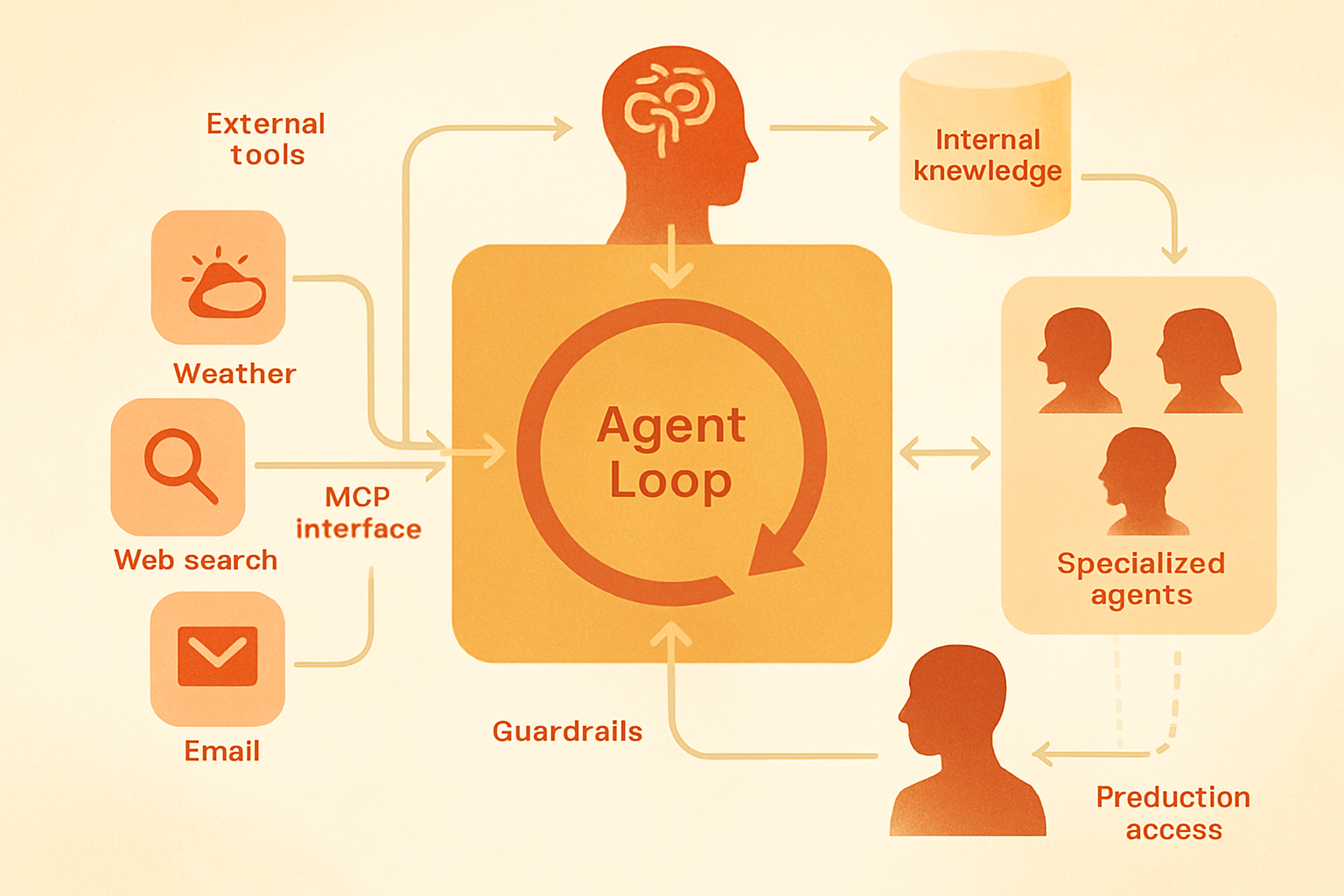
AI agents are presented as ubiquitous, but the words surrounding them are not self-evident. Ten concepts outline their concrete functioning, from the authorization to act to access to information, including task orchestration. This guide situates each of them without requiring technical prerequisites. It also explains why a model shifts to a tool, fragments a mission, or retains context.
Supervising Action: Human Approval and Explicit Limits
An agent's autonomy does not exclude control. For high-impact actions, an agent may prepare for execution and then require human validation before proceeding further. The safeguards specify what a system is allowed to do and where it must stop. They also serve to filter sensitive information and regulate access to production environments.
Connecting Agents: Tools, Protocols, and External Data
An agent relies on external functions to act: calling tools such as get_weather, search_web, or send_email depending on the needs. It can decide to combine multiple tools in a single sequence. RAG adds access to external information beyond what it learned during training. To standardize connections to services and data sources, MCP provides a common protocol that facilitates the integration of agents into various systems.
Le brief IA que les pros lisent chaque soir
Les 7 actus IA du jour, décryptées en 5 min. Gratuit.
Inclus dès l'inscription : notre sélection des meilleurs guides & comparatifs IA.
Choisissez votre rythme
Gratuit · Pas de spam · Désabonnement en 1 clic
The AI Agent Executes Cycles of Observe, Act, and Revise to Progress
The agent loop is based on an observe–act–revise cycle: without knowing the solution from the start, the agent chains steps based on intermediate results. To find the latest quarterly revenue, for example, it can locate reports, open the relevant document, extract the data, cross-reference it, and then respond. When the goal is too broad, decomposition transforms the request into manageable subtasks, such as evaluating a CRM to recommend. This logic extends to multi-agent systems, where several specialists share a complex mission.
What Makes an Agent: Objective, Process, and Concrete Examples
An AI agent pursues a defined goal by selecting actions, interacting with external systems, and adjusting its trajectory based on feedback. Unlike a chatbot that describes a method, it actually executes a process. For instance, it can be asked to identify three flights to London for under ₹60,000, compare these options, and produce the itinerary deemed best. This ability to act, observe, and adapt its sequence of operations constitutes its functional identity.
What the User Gains: Context, Memory, and Practical Reference Points
In the face of the proliferation of terms, understanding a few fundamentals makes the whole accessible. Ten notions cover the essentials without requiring one to be an engineer and serve as reference points in daily use. Agentic systems rely on a state for the current task and on memory to retain useful elements beyond a single step. These mechanisms explain why a model resorts to a tool rather than responding directly, why it segments a complex request, and how it can remember previous interactions.
Brief IA — L'actualité IA en français
L'essentiel de l'actualité de l'intelligence artificielle, décrypté et expliqué chaque jour.