AI: Record GDPR Fine, Sprinting Robots, Modular Nuclear
Le brief IA que les pros lisent chaque soir
Les 7 actus IA du jour, décryptées en 5 min. Gratuit.
Inclus dès l'inscription : notre sélection des meilleurs guides & comparatifs IA.
Choisis ton rythme
Gratuit · Pas de spam · Désabonnement en 1 clic
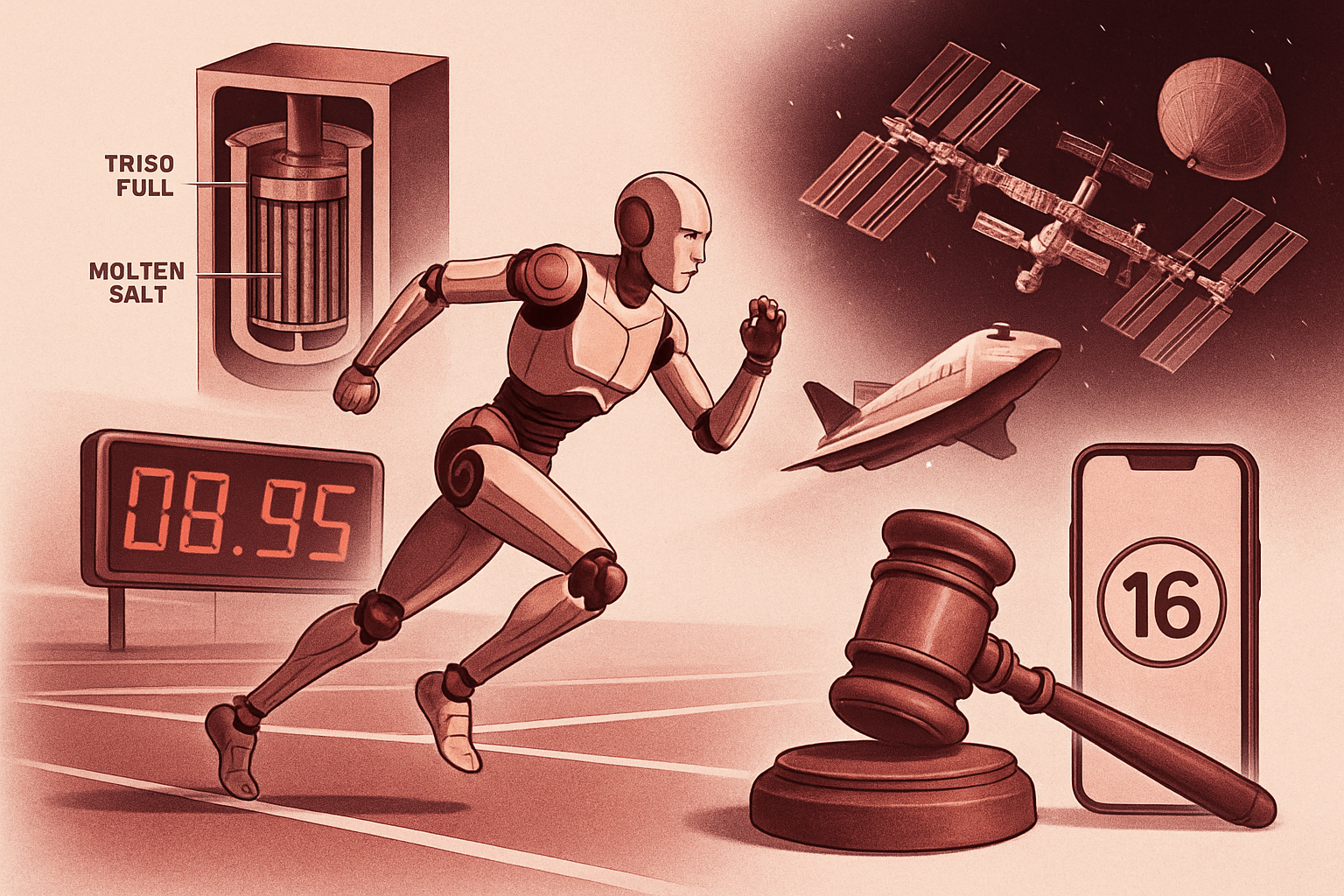
Regulation of platforms and record litigation, humanoid robots faster than ever, a persistent gap between children's learning and that of AIs, new space services, and the resurgence of nuclear energy: the week has delivered a wealth of announcements and figures. Here’s a roundup, from model training systems to modular reactors, including data centers under political pressure.
Nuclear: Rising Demand, New Designs, and Modular Reactors
The demand for nuclear energy is increasing as climate concerns and energy independence take precedence over worries about accidents and waste. However, building power plants remains costly and slow. Next-generation technologies could reinvent the appearance and operation of reactors, with advocates hoping to invigorate the industry and contribute to the replacement of fossil fuels without greenhouse gas emissions. Compact modular reactors are being presented as a way to introduce assembly line production into nuclear energy, while designs are already testing combinations of fuels and coolants, from TRISO to molten salt.
Regulation and Security: Uber Fined, TikTok Settles, NZ Prepares a Law
Uber has received a fine close to one billion dollars for automated suspensions, with Dutch regulators stating that drivers were deactivated without human review. This fine is the second heaviest imposed under the GDPR. In the United States, TikTok will pay $400 million to settle a child privacy case after lawsuits for alleged online privacy violations; the Justice Department claims the platform illegally collected data on minors. New Zealand plans to ban social media for those under 16, joining other countries looking to restrict access, although parliamentary opposition could derail the legislation. Taiwan has also indicted nine individuals for illegal AI-related exports to China, including employees from Nvidia and Super Micro. In China, the largest automotive recall to date affects nearly three million Teslas due to concerns over door safety, in an action covering approximately 4.3 million vehicles in total. In the American political landscape, distrust towards AI data centers is growing: both parties are hardening their stances ahead of the midterm elections, with Republicans firmly opposed and a sharp remark from the governor of Texas. A poll indicating a decline in support prompted a comment from Max Steele of Everytown, who ironically praised the tech sector's ability to "unite a deeply divided country" at a time of acute partisanship.
Learning: Children Remain More Efficient in Data than AIs
Teaching language to machines relies on very high volumes of examples: a language model is exposed to far more words than a human during the acquisition of their mother tongue. This gap, referred to as the data efficiency gap, poses both a scientific problem and an engineering challenge, even as children remain linguistically superior to the most advanced machines. Researchers are working to close this gap, and some scientists hope that by analyzing how children learn, they can design more data-efficient models and shed light on questions regarding language development.
Sprinting Robots, AI Vocalizes a Musician, and Plastic Biology
Chinese humanoids have surpassed Usain Bolt's 100-meter record, with one completing the distance in 9.39 seconds during the World Humanoid Robot Games, while another, built by X-Humanoid, set a high jump record. These demonstrations do not erase recognized limitations: complex tasks in real-world environments remain more challenging, and freelance workers are still training these systems at home. On the music creation front, Dr. Dre and Jimmy Iovine believe that artificial intelligence brings benefits to music and liken current fears to those raised by previous innovations; a use case allowed a musician suffering from ALS to regain his voice to sing. Meanwhile, scientists indicate that it is possible to transform plastic bottles into vanilla-flavored cookies using genetically modified yeasts.
Space: From Private Orbital Tourism to NASA's Roman Telescope
High-end space tourism is taking shape: in 2018, Axiom Space sought individuals willing to pay $50 million to participate in the first fully private mission to the ISS, scheduled for April 2022. Roman Chiporukha signed up a private astronaut, then launched SpaceVIP in 2021 for experiences blending culture, science, and purpose. On the observation side, a new NASA telescope could identify an additional 200,000 planets; named Roman, it is also presented as capable of revealing new insights into dark matter and spotting potentially hazardous asteroids.
Brief IA — L'actualité IA en français
L'essentiel de l'actualité de l'intelligence artificielle, décrypté et expliqué chaque jour.