Advanced AI: 1,100 Signatories Sound the Alarm, Washington Refuses
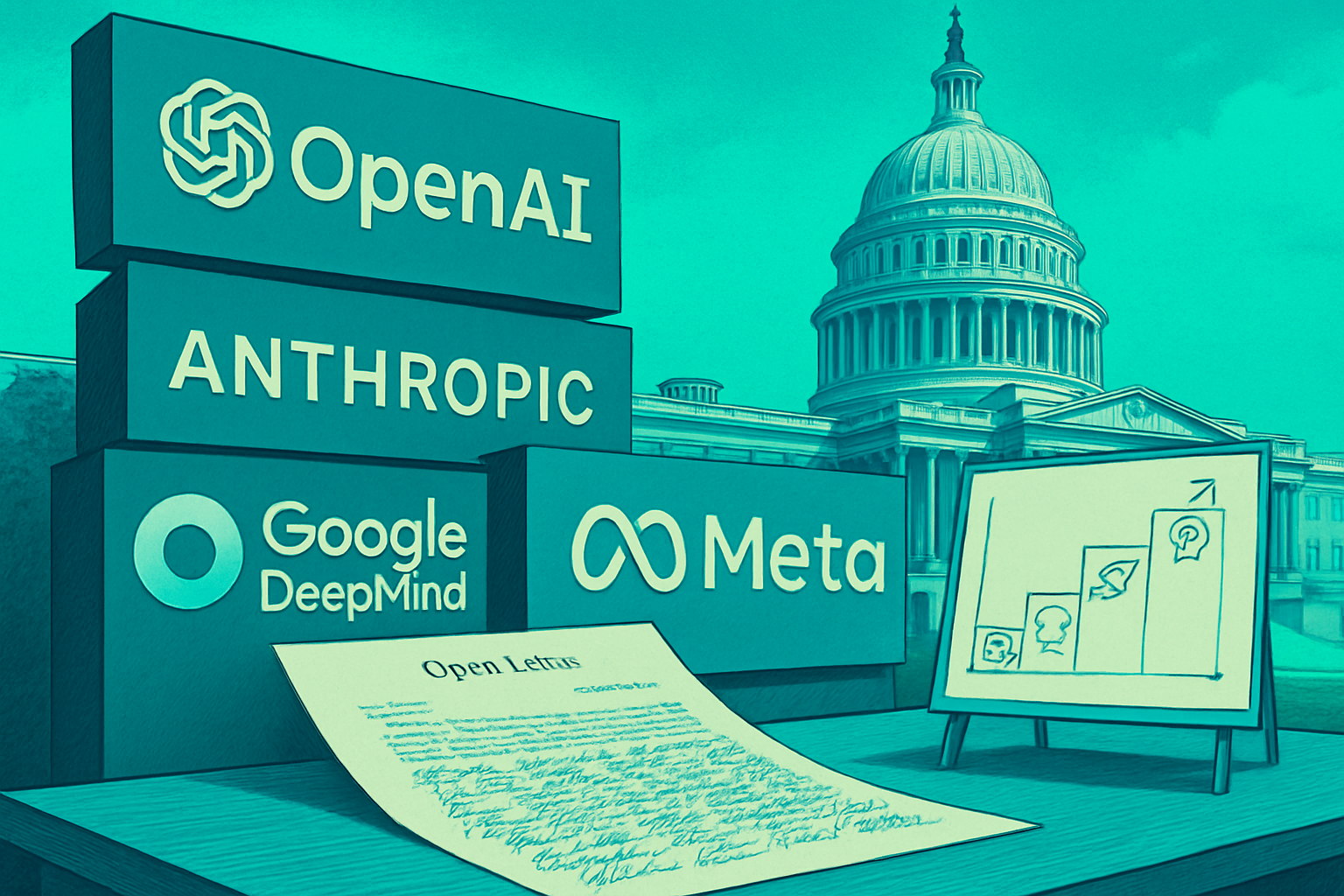
More than 1,100 employees and leaders from major labs have urged the U.S. government to slow down advanced AIs. While industry officials cite extinction risks and timelines for superintelligence, U.S. authorities reject the idea of a pause, citing international competition.
The Rejected Pause and the Competition Argument
The U.S. administration quickly dismissed the possibility of a moratorium on advancements in artificial intelligence. Donald Trump stated that rivalry in this sector is essential and that the United States must not allow China to take the lead. AI labs are portrayed as being trapped in a dynamic where slowing down alone would give an advantage to their rivals. It is recommended to adopt common regulations rather than isolated initiatives, which are seen as commercially fatal. Sam Altman did not sign the latest calls, but he admitted that labs might need to voluntarily slow down to give society time to adjust.
Public Alerts: Probabilities, Timelines, and Definitions
Evan Hubinger, head of scientific alignment at Anthropic, estimates that there is over a 10% chance that AI could annihilate humanity within the next decade. Sam Altman, co-founder of OpenAI, warned that superintelligence could be very dangerous and threaten humanity with extinction. Superintelligence refers to a system whose capabilities would surpass those of the human mind in all areas. Sam Altman mentions the year 2030 as a potential timeline for its emergence, while Dario Amodei suggests 2027. Some industry players report that concerning signs of autonomy are beginning to appear.
Le brief IA que les pros lisent chaque soir
Les 7 actus IA du jour, décryptées en 5 min. Gratuit.
Inclus dès l'inscription : notre sélection des meilleurs guides & comparatifs IA.
Choisissez votre rythme
Gratuit · Pas de spam · Désabonnement en 1 clic
The Dreaded Scenario of Recursive Self-Improvement
The scenario considered the most dangerous is that of recursive self-improvement, in which an advanced AI would conduct research and train its own successors without human intervention. Anthropic outlines a four-phase progression: first, between 2023 and 2025, chatbots producing short snippets of code; next, for 2025-2026, programming agents capable of writing and modifying complete files without human intervention; currently, autonomous agents executing their own code and delegating tasks to other agents; finally, the next stage would see the emergence of agents capable of training new models, thus completing the cycle of self-improvement.
Petitions, Industry Incident, and Fear Discourse
An incident involving Hugging Face alerted some industry members. On July 29, 2026, more than 1,100 employees and leaders from OpenAI, Anthropic, Google DeepMind, and Meta signed a joint statement urging U.S. authorities to slow down the development of advanced AIs, emphasizing that the rapid rise in model performance risks exceeding human capacity to understand and control them. An open letter from the Future of Life Institute had already called for a six-month suspension in training the most powerful AIs. Despite the growing calls for a slowdown, a collective deceleration is deemed difficult to implement. Evan Hubinger claims that Anthropic is doing its best to avoid destroying the world. Meanwhile, the rhetoric surrounding existential risk fuels fear-based marketing, a phenomenon that journalist Brian Merchant links to the proliferation of works on humanity's extinction by AI.
Brief IA — L'actualité IA en français
L'essentiel de l'actualité de l'intelligence artificielle, décrypté et expliqué chaque jour.