Inference AI: Memory and Storage Become Strategic
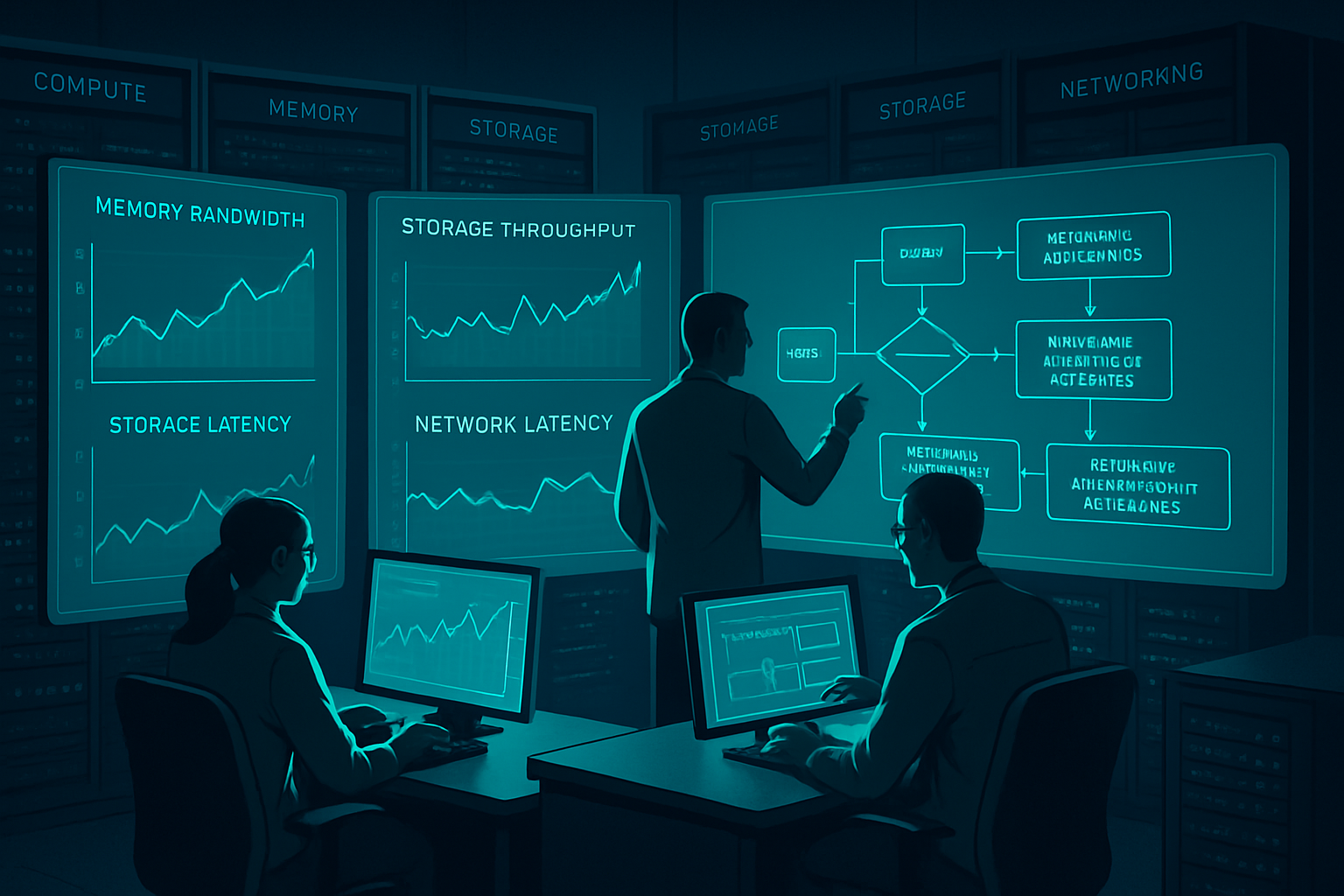
As AI moves into continuous production, data mechanics weigh as heavily as computing power. Memory, storage, and networking emerge as a unified system to manage for value, efficiency, and return on investment. Jim McGregor, an analyst at Tirias Research, outlines the choices that determine performance, reputation, and business model.
Infrastructure performance drives revenue and reputation
AI-dedicated data centers are now part of a corporate strategy, as they influence the conversion of use cases into revenue and the creation of competitive advantage. In sectors such as robotics, finance, healthcare, or customer-oriented services, latency is inseparable from value. Delays can impact security, responsiveness, or trust, making performance a matter of reputation. The best performance does not necessarily depend on a maximum computing footprint, but rather on a fine alignment between infrastructure investments and desired outcomes. This planning, at the intersection of data management and network bandwidth, becomes as much a business decision as an engineering topic, especially since bottlenecks can shift between computing, memory, storage, and networking. The most efficient organizations will be those that adjust each component to serve their AI workloads.
Supply flexibly and aim for measurable efficiency
Selecting hardware is not enough: one must avoid being trapped in quickly outdated assumptions. Jim McGregor emphasizes the need for flexibility in the face of rapidly evolving demands and technologies. Precisely defining the workloads to optimize helps avoid unnecessary spending and unaddressed bottlenecks. A modular architecture, covering computing, memory, storage, power, and cooling, allows for capacity adjustments in line with demand. Working with an ecosystem of suppliers and integrators reduces supply risks, as a single OEM or cloud provider is no longer sufficient to absorb constraints. The supply strategy must be continuously reevaluated. The goal is to optimize efficiency and return on investment rather than just peak performance, as some extreme configurations can be costly to operate. Efficiency, scrutinized publicly through energy and water usage, requires an adaptable architecture that delivers value and justifies its footprint.
Le brief IA que les pros lisent chaque soir
Les 7 actus IA du jour, décryptées en 5 min. Gratuit.
Inclus dès l'inscription : notre sélection des meilleurs guides & comparatifs IA.
Choisissez votre rythme
Gratuit · Pas de spam · Désabonnement en 1 clic
Data movement becomes the primary operational constraint
With the rise of advanced inference systems and agents, data movement has become the dominant constraint. Augmented generation through retrieval requires continuously scanning vast knowledge bases, which primarily demands immediate access to data. Jim McGregor stresses the efficiency of data movement, caching, and delivery throughout the architecture. Buying the fastest processors is not enough: inference is tied to memory bandwidth, caching, and storage proximity, as well as how these layers interact under real-world conditions. The most efficient infrastructure is a balanced system between computing, memory, storage, and networking, with bottlenecks potentially migrating from one layer to another.
Re-architecting for continuous inference and agentic AI
Integrating modern AIs into legacy infrastructures limits value. Custom architectures are deemed essential, as inference and agentic AI impose new requirements for latency, data movement, scalability, and utilization. Jim McGregor describes centers designed to support continuous, distributed, and increasingly real-time services, each with different system needs. Memory and storage must be treated as the core of the system and backed by a pipeline capable of ingesting, cleaning, transforming, storing, moving, and rapidly delivering data. Inference exerts sustained pressure different from training and requires continuous retrieval and caching. It is no longer just about aiming for performance, but about balancing efficiency, costs, and scale, starting from a precise understanding of workloads and optimizing the entire network, including memory and storage. These choices support real-time services and a smarter IoT edge.
AI is not a uniform workload: integrated management required
Jim McGregor reminds us that AI is not a uniform workload and that optimization must focus on a coordinated infrastructure between memory, storage, and networking. Continuous and distributed inference workloads necessitate designing systems for scale, resilience, and efficiency. For executives, the trade-off lies between cost, flexibility, and preparedness, with a goal of increased performance per watt, reduced footprint, and early elimination of bottlenecks. The era of inference is already expressed in real-time applications, from customer assistance to care, supported by infrastructure that also accommodates the IoT edge, where every latency and watt counts in the operational balance. Jim McGregor anticipates that the advantage will go to companies that treat computing, memory, storage, and networking as an integrated system with measurable return on investment. Supply becomes a strategy, and design a leadership topic, with a guiding question for every executive: how will AI transform the business model?
Brief IA — L'actualité IA en français
L'essentiel de l'actualité de l'intelligence artificielle, décrypté et expliqué chaque jour.