AI in 2030: Rising GDP, Cognitive Jobs Under Pressure
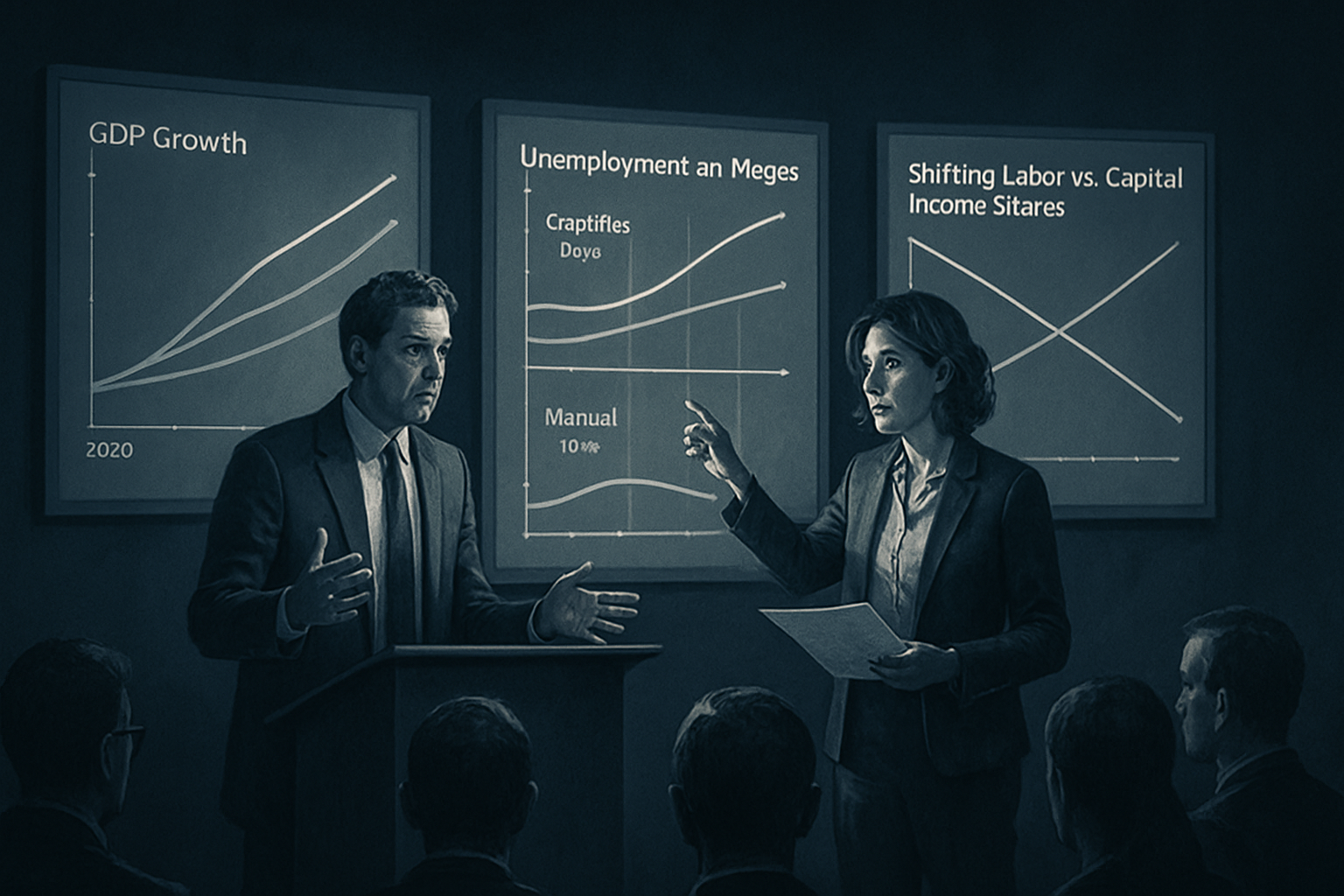
Three economic scenarios developed by The Anthropic Institute project a higher U.S. GDP by 2030, regardless of the pace of AI adoption. However, the trajectories differ significantly in terms of employment and income, with a decline in labor's share and wage pressures for cognitive jobs.
Capital would capture an increased share of wealth
The Anthropic model predicts a shift in the distribution of value between labor and capital. In the extreme scenario, labor's share drops to 45.2%, while capital receives 54.8%. The substantial scenario sets it at 56.1%, whereas currently, 60 cents of every dollar produced go to workers and 40 to capital holders. In the extreme trajectory, nearly all gains benefit asset owners, with total labor income remaining almost unchanged. Regarding wages, the substantial scenario anticipates an increase of nearly 6% for other jobs, while those in cognitive jobs stagnate slightly below their expected level without AI. In the extreme scenario, wages for cognitive jobs decrease by 11.5%, while those for manual jobs increase by 33.6%.
Cognitive jobs would be the most exposed
The model distinguishes so-called "cognitive" professions, considered particularly exposed to AI, from other jobs. In the substantial scenario, the number of people in cognitive jobs decreases by 3.9% compared to mid-2026, and their unemployment rate rises from 2.9% to 4.5%. In the extreme scenario, cognitive employment plummets by 21.5%, and unemployment in this group reaches 17.9%, a level that researchers compare to historical lows: just under 10% after the global financial crisis and around 8% during the Covid-19-related recession. Office jobs could be the most affected.
Le brief IA que les pros lisent chaque soir
Les 7 actus IA du jour, décryptées en 5 min. Gratuit.
Inclus dès l'inscription : notre sélection des meilleurs guides & comparatifs IA.
Choisissez votre rythme
Gratuit · Pas de spam · Désabonnement en 1 clic
Three growth rates, one common point: GDP increases
In all the scenarios considered, U.S. GDP in 2030 exceeds the trajectory it would have followed without AI. The modest scenario, comparable to the impact of the Internet, results in a GDP that is 1.6% higher and an annual growth rate of 2.4% compared to 2% without AI. The substantial scenario doubles the expected rate with 5.4% per year and a GDP that is 8.3% higher. The extreme scenario projects 15.4% annual growth for a GDP that is 32.4% higher, which would imply a doubling of the economy every four and a half years. Economists note that this last scenario would require AI capable of recursive self-improvement and rapidly adopted for intellectual work.
A model based on assumptions, surveys, and explicit limits
The study relies on an economic model built from assumptions regarding AI's ability to perform or create tasks, the speed of adoption by businesses, and productivity gains. The economy is broken down into tasks that AI leaves intact, assists, automates, or creates, depending on different adoption rates. The numerical projections are also based on a survey conducted with Morning Consult among 10,980 American adults, carried out from August 11 to 23, 2026. The authors emphasize the predictive and simplifying nature of the model, which isolates certain forces while excluding others that could become decisive.
Anthropic continues its work on labor and AI
Anthropic has conducted a series of investigations regarding the impact of AI on employment. In March, the company released a list of the professions most vulnerable to AI based on the practical uses of Claude, while not observing any increase in unemployment in the affected sectors at that time. This document, developed by The Anthropic Institute, the research center of the publisher of Claude, was made public on September 9, 2026, and forecasts growth in the wealth of the American economy by 2030, regardless of the speed of AI integration.
Brief IA — L'actualité IA en français
L'essentiel de l'actualité de l'intelligence artificielle, décrypté et expliqué chaque jour.