AI in the Workplace: The Gap Between Leaders and Employees Revealed
A Majority of Organizations Still in the Experimentation Stage
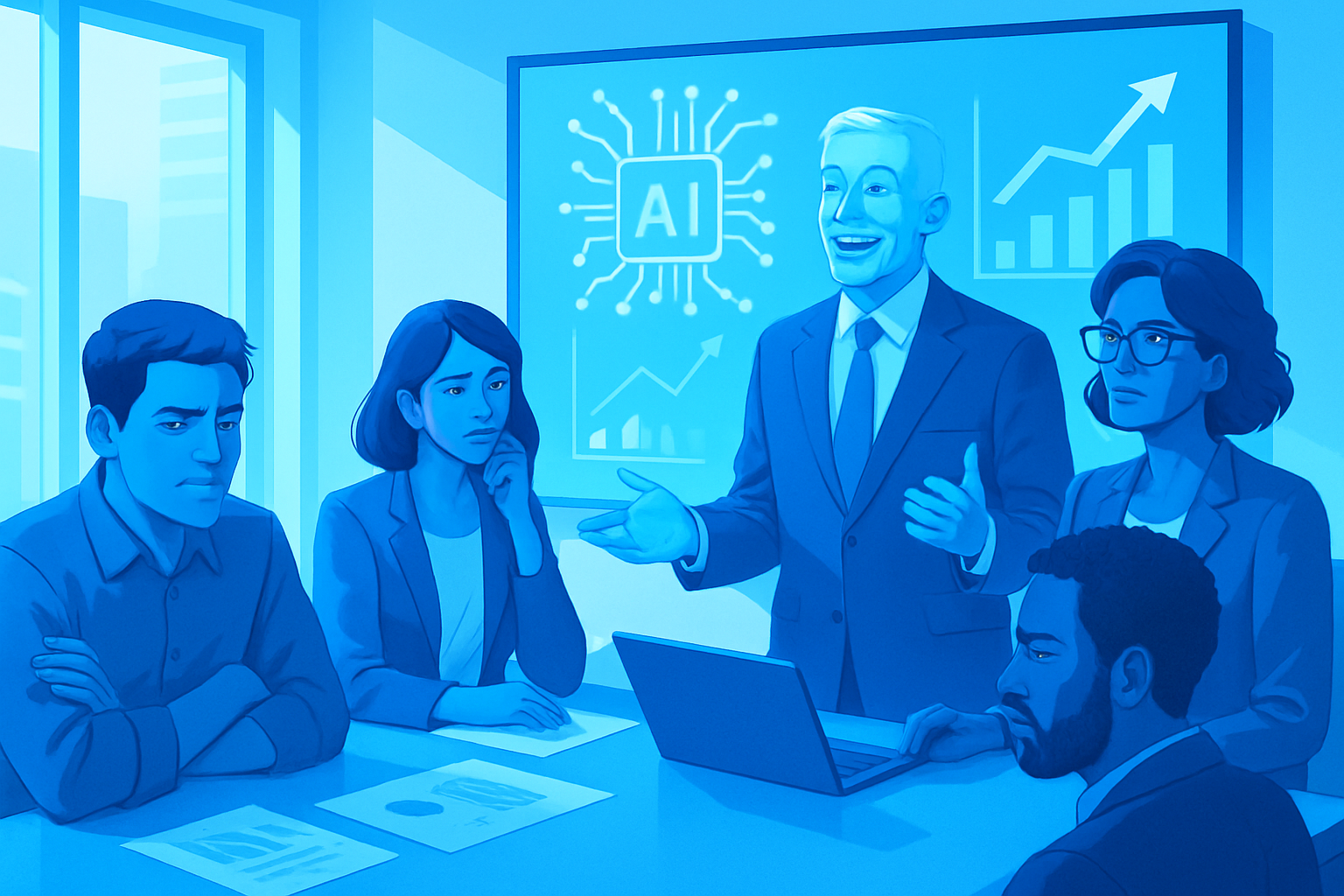
The introduction of generative AI into the business world is underway, but its adoption varies significantly from one company to another. A recent global study conducted by Notion with the help of the Qualtrics institute surveyed over 6,000 individuals across ten markets to assess the maturity of businesses regarding AI. The results highlight a significant gap between the optimism of leaders and the reality perceived by employees.
To evaluate this maturity, the report uses a four-level scale. These levels range from occasional use of AI as a brainstorming tool to full integration where AI autonomously manages complex processes.
The four levels of AI maturity identified in the report are as follows:
- Thinking Partner: AI is used to assist in writing, summarizing, or generating ideas.
- Connected Assistant: AI is integrated with company data to accelerate recurring tasks.
- Teammate: AI executes processes autonomously, under human supervision.
- System: AI manages complex processes end-to-end and continuously improves.
The authors of the study clarify that these levels are not sequential stages. A company can simultaneously be at different levels depending on its departments; for example, an engineering department at level 3 while marketing remains at level 2.
The majority of companies have not yet reached the final stage. According to the report, 88% of companies are at levels 1 and 2, where AI is primarily used to enhance individual productivity. Only 12% of companies have reached levels 3 and 4, where AI is integrated into recurring processes or operates autonomously.
Leaders More Optimistic Than Their Teams
One of the main takeaways from the study is the perception gap between leaders and employees. 60% of decision-makers believe their organization is ready to deploy AI agents, while only 36% of employees share this belief. A similar gap is observed in terms of confidence: 49% of leaders express being very or extremely confident in their company's AI capabilities, compared to just 23% of employees.
Trust is a major barrier to AI adoption. 71% of knowledge workers surveyed stated they would use AI more if they were assured of its reliability for important tasks. Meanwhile, half of the leaders admit they do not know exactly which tools are being used by their teams or suspect the use of unvalidated solutions, a phenomenon known as "shadow AI," which poses security issues.
Le brief IA que les pros lisent chaque soir
Les 7 actus IA du jour, décryptées en 5 min. Gratuit.
Inclus dès l'inscription : notre sélection des meilleurs guides & comparatifs IA.
Choisis ton rythme
Gratuit · Pas de spam · Désabonnement en 1 clic
What Distinguishes the Most Advanced Organizations
The most advanced companies in AI do not merely increase its usage. They first establish solid foundations. They more frequently integrate AI into their existing systems (+18 points compared to less advanced companies), strengthen their governance and oversight (+16 points), and systematically measure its impact using clear indicators (+15 points).
Their objectives also differ. Less advanced companies primarily use AI to improve efficiency, by accessing information more quickly (60%) or accomplishing more tasks (48%). More mature companies leverage AI to perform tasks that were previously impossible (+10 points) or to enhance the quality of their decisions (+7 points). The automation of repetitive processes and the flow of information between tools are progressing significantly, without replacing individual work.
These differences in integration manifest in daily operations. An American IT administrator, an advanced AI user, summarizes the situation by saying that his tools are like islands of AI, still requiring manual data transfer between systems that do not communicate with each other.
In France, A Confirmed Delay
In France, the gap is widening further. The country has proportionally fewer organizations that have reached advanced usage compared to the global average, and trust in these tools is lower among both decision-makers and employees. The discrepancy between investments made and their actual adoption by teams is just as pronounced as elsewhere.
The figures reflecting France's delay are as follows:
- 9% of French organizations are at levels 3 and 4 of maturity, compared to 12% globally.
- 32% of French decision-makers are confident in their organization's AI capabilities, compared to 49% worldwide.
- 19% of French employees share this confidence, compared to 23% elsewhere.
- 51% of French decision-makers observe a gap between investments and adoption, compared to 55% globally.
This delay is partly due to a lack of training, often cited by respondents. A French AI decision-maker in the customer relations sector, whose organization is still at the first level of maturity, expresses the desire for everyone to be trained in AI and know how to use it. This observation aligns with our annual survey on AI in business, which highlights real but highly uneven adoption across professions.
The study was conducted by Notion, which recently launched its own personalized agents. The central finding is that the main challenge is no longer ambition, but the alignment of teams. It remains to be seen whether organizations will slow down the pace of their investments to allow their teams to catch up.
Brief IA — L'actualité IA en français
L'essentiel de l'actualité de l'intelligence artificielle, décrypté et expliqué chaque jour.