AI in Business: Visibility and Control through Continuous Inventory
The security of AI environments primarily relies on visibility. However, 60% of organizations are unaware of the queries their employees make to GenAI tools, according to Cisco's 2025 index. To regain control against ghost AI and autonomous agents, three approaches emerge: continuous inventory, multi-level behavioral detection, and zero-trust access controls.
Limiting Damage: Minimum Access and Behavioral Detection
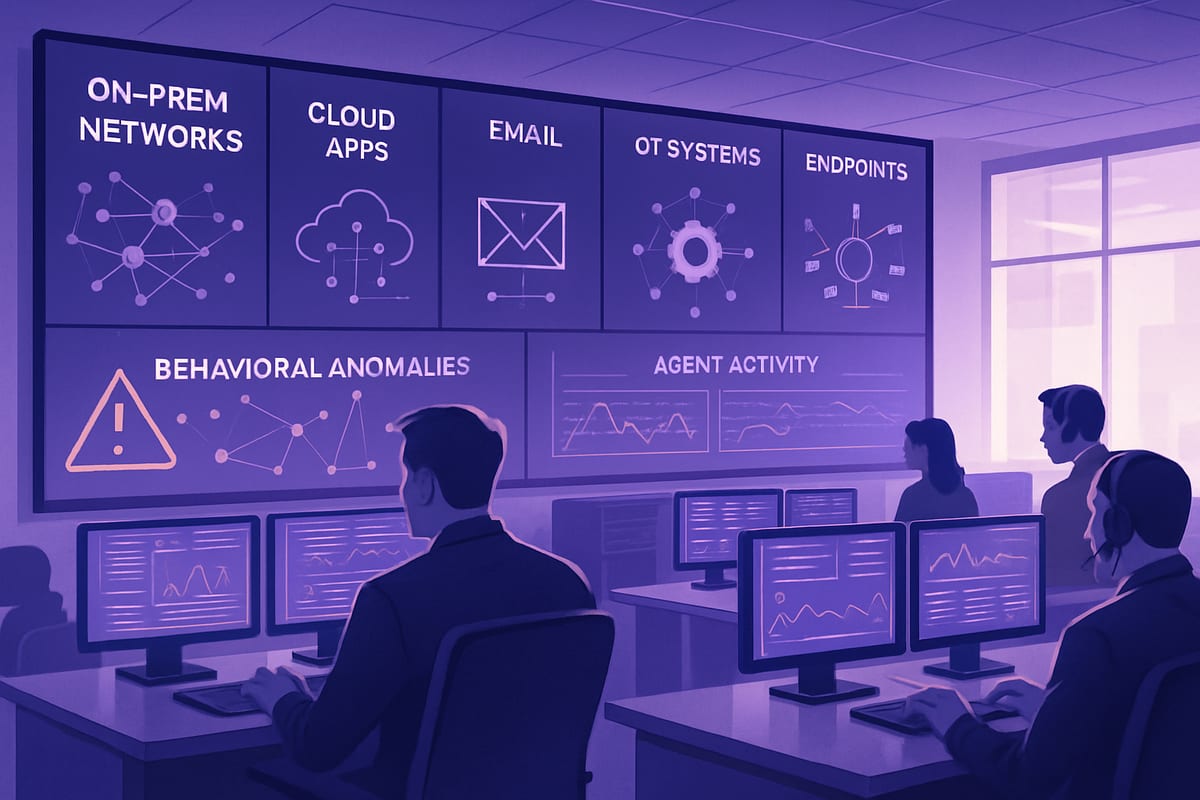
Restricting access to what is strictly necessary serves as a first line of defense: no system or agent should receive privileges based on presumed trust, but rather on verified need. Each AI agent should only obtain the rights essential for its task, in order to limit the impact of a compromise or undetected malfunction. This principle becomes crucial in environments where agents operate at machine speed and can propagate incidents before any human intervention, including when they interact with data, tools, and applications. On the detection side, applying AI to the security of AI is imperative: human review alone cannot keep up with volume or speed. Advanced behavioral analytics platforms detect unusual activity without being limited to attack signatures. Darktrace exemplifies this approach by claiming pioneering work since 2013 and combining multiple layers of AI to provide visibility across on-premises networks, cloud applications, emails, OT environments, and endpoints. Its method does not require prior assumptions about threats: the system learns about devices, users, and their interactions to model normal behavior, then connects subtle anomalies, where competing solutions focus on known attack patterns.
A Massive Blind Spot: 60% of Organizations Do Not See GenAI Queries
More than one in two organizations is unaware of what their employees are asking GenAI tools, according to Cisco's 2025 index. For security leaders, the extent of the gap between adoption and governance becomes hard to ignore: less visibility means less control over data movement, policy enforcement, and the identification of active tools or agents. When usage escapes official channels, IT loses track of the destination of sensitive information, with flows moving to unmonitored or uncontrollable areas. Current monitoring tools fail to adequately track AI activity, creating significant risks that call for specific strategies.
Le brief IA que les pros lisent chaque soir
Les 7 actus IA du jour, décryptées en 5 min. Gratuit.
Inclus dès l'inscription : notre sélection des meilleurs guides & comparatifs IA.
Choisissez votre rythme
Gratuit · Pas de spam · Désabonnement en 1 clic
Three Vectors of Risk: Public Chatbots, Embedded AI, and Autonomous Agents
Ghost AI encompasses the use of AI tools and applications without explicit validation. Unlike shadow IT, unauthorized subscriptions remain detectable by discovery tools, while AI usage often goes unnoticed. The first common scenario involves pasting a document or data into a public chatbot to expedite a task. This is generally not malicious, but the result is the same in terms of exposure. The second scenario involves AI functions added retroactively to approved SaaS software, which are difficult to distinguish from normal traffic. Finally, autonomous agents operate within systems, often deployed quickly without formal review: with unchecked access, they can modify data and systems at a speed that surpasses any human review.
Why Legacy Tools Fail to See AI
The lack of visibility stems from a structural limitation. Existing mechanisms were designed for software identified at known locations. Discovery tools recognize application subscriptions but often miss AI usage patterns. An application catalog cannot reliably classify or control the behavior of an agent operating within an application. This leads to blind spots that widen as AI adoption accelerates, regardless of the efforts or budgets allocated.
Moving to Continuous Visibility: Living Inventory and Product Priorities
A one-time audit is insufficient to track the continuous arrival of AI tools and functions. Teams should replicate the discipline applied to the cloud: a routine monitoring of each asset that feeds into a living inventory. This foundation allows for real-time comparison of new developments against expected behavior, rather than reconstructing the view after an incident. Visibility remains the fundamental step for safe AI innovation: organizations that combine continuous discovery and advanced detection empower themselves to secure their ecosystems. Decision-makers are encouraged to target platforms that cover all AI touchpoints and prioritize behavioral analysis over signature-based detection to identify threats in real time.
Brief IA — L'actualité IA en français
L'essentiel de l'actualité de l'intelligence artificielle, décrypté et expliqué chaque jour.