AI and Discoveries: Controversy Surrounding Anthropic's Lab
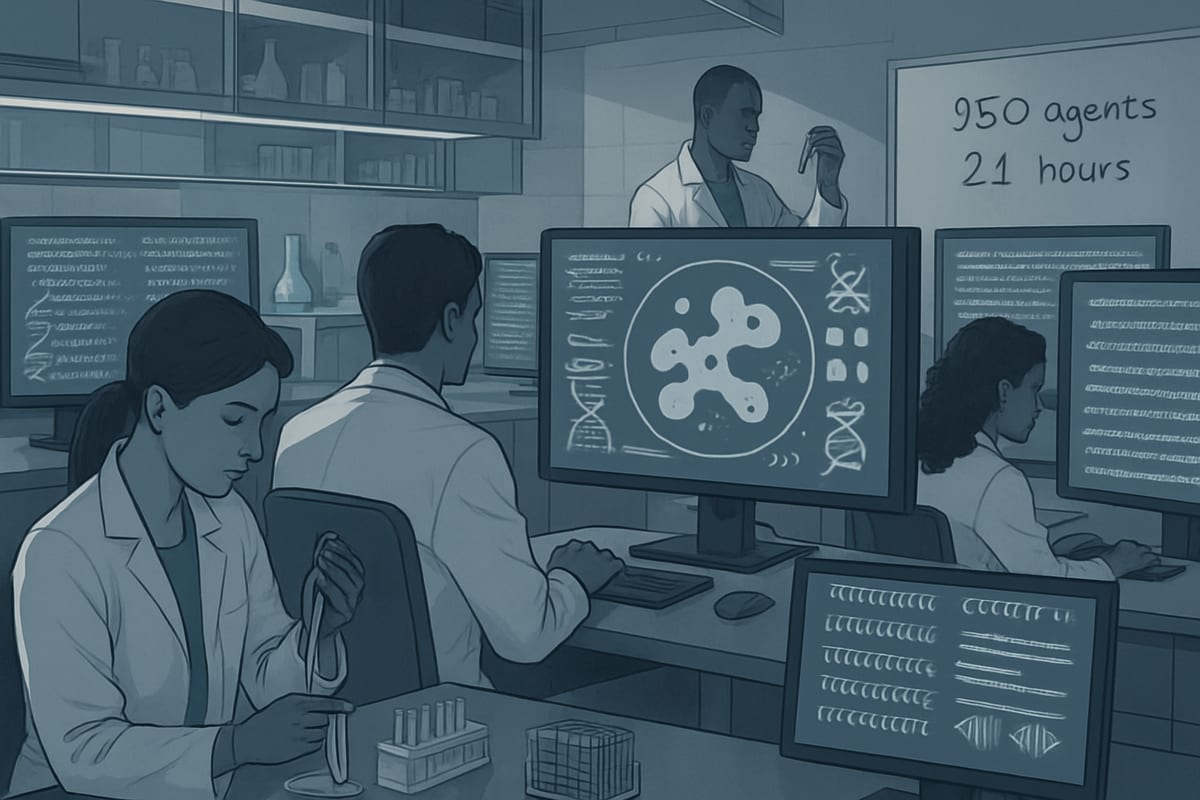
Anthropic claims that its agent-driven biology lab, Claude, has uncovered a novel genetic motif. Biologists are contesting the significance of this announcement, with one even asserting that they had already identified this motif. The debate echoes a previous incident involving OpenAI and a million-dollar math problem: what exactly constitutes a discovery made by AI?
A Motif Already Claimed and Public Reservations
Mario Rodríguez Mestre, a biologist at the University of Copenhagen, stated last weekend that his team had already spotted the specific motif mentioned in Anthropic's announcement. He noted that he had regular exchanges with Claude as part of his research and questioned whether Anthropic's team had utilized these discussions. Anthropic denies this and asserts that it did not learn about the motif from these exchanges. Mestre, for his part, announced that he would stop using Claude.
Anthropic's communication has also sparked critical reactions from biologists. A viral post, supported by the CEO of Eli Lilly, claims that identifying a group of genes and repetitions is often the easy part, while understanding the actual functioning of the system is where true discoveries emerge. Lucas Harrington, who wrote this post, suggests that AI companies should set high standards now so that if an AI indeed uncovers a fundamentally new biological mechanism, the significance of the event is recognized.
What Anthropic's System Actually Produced
Anthropic describes a setup of 950 agents that worked for 21 hours. The agents did not isolate a new DNA sequence but rather identified a repetitive motif located around a known enzyme. The company claims that this motif had not been cataloged before and compares it, in its communication, to patterns that preceded the emergence of CRISPR, a technology that has transformed science and medicine.
Le brief IA que les pros lisent chaque soir
Les 7 actus IA du jour, décryptées en 5 min. Gratuit.
Inclus dès l'inscription : notre sélection des meilleurs guides & comparatifs IA.
Choisissez votre rythme
Gratuit · Pas de spam · Désabonnement en 1 clic
The announcement is part of a lab launched earlier this year, where Claude agents analyze and formulate hypotheses while human scientists conduct experiments. Anthropic presents this result as the first discovery stemming from this setup.
Filtering Hundreds of Thousands of Leads Remains Scientific Work
Narrowing down from 200,000 candidates to just a few options to explore constitutes recognized scientific work. The fact that a general-purpose conversational assistant can participate in this selection is remarkable, even if the process remains guided by humans who also carry out the experimental protocols. However, some AI companies present their systems as discoverers rather than mere tools. For some, this stance is deemed incompatible with a scientific practice based on collaboration and the complementarity of tools.
The OpenAI Precedent on a Million-Dollar Problem
Earlier this month, OpenAI announced that its agents had managed to solve a math problem with a reward of one million dollars. A few weeks later, an article questioned the relevance of the chosen problem while acknowledging the validity of the solution. The result obtained might not be what mathematicians consider a priority. Meanwhile, a mathematician accused models of having used part of his work without credit, fueling the idea among some that OpenAI may have cheated or, at the very least, that the solution mattered little. These controversies are part of a declared race between OpenAI and Anthropic to outdo each other.
What "Discovery" Means for Judging AI's Contribution
In the practice of biological research, isolating a DNA sequence linked to an enzyme is just one step. It is then necessary to elucidate the exact function of the enzyme and determine how to manipulate it for a useful application. It is in these subsequent steps that many scientists draw the line between promising sorting and actual discovery.
Brief IA — L'actualité IA en français
L'essentiel de l'actualité de l'intelligence artificielle, décrypté et expliqué chaque jour.