AI and Writing: Distinguishing Useful Effort from Accessory
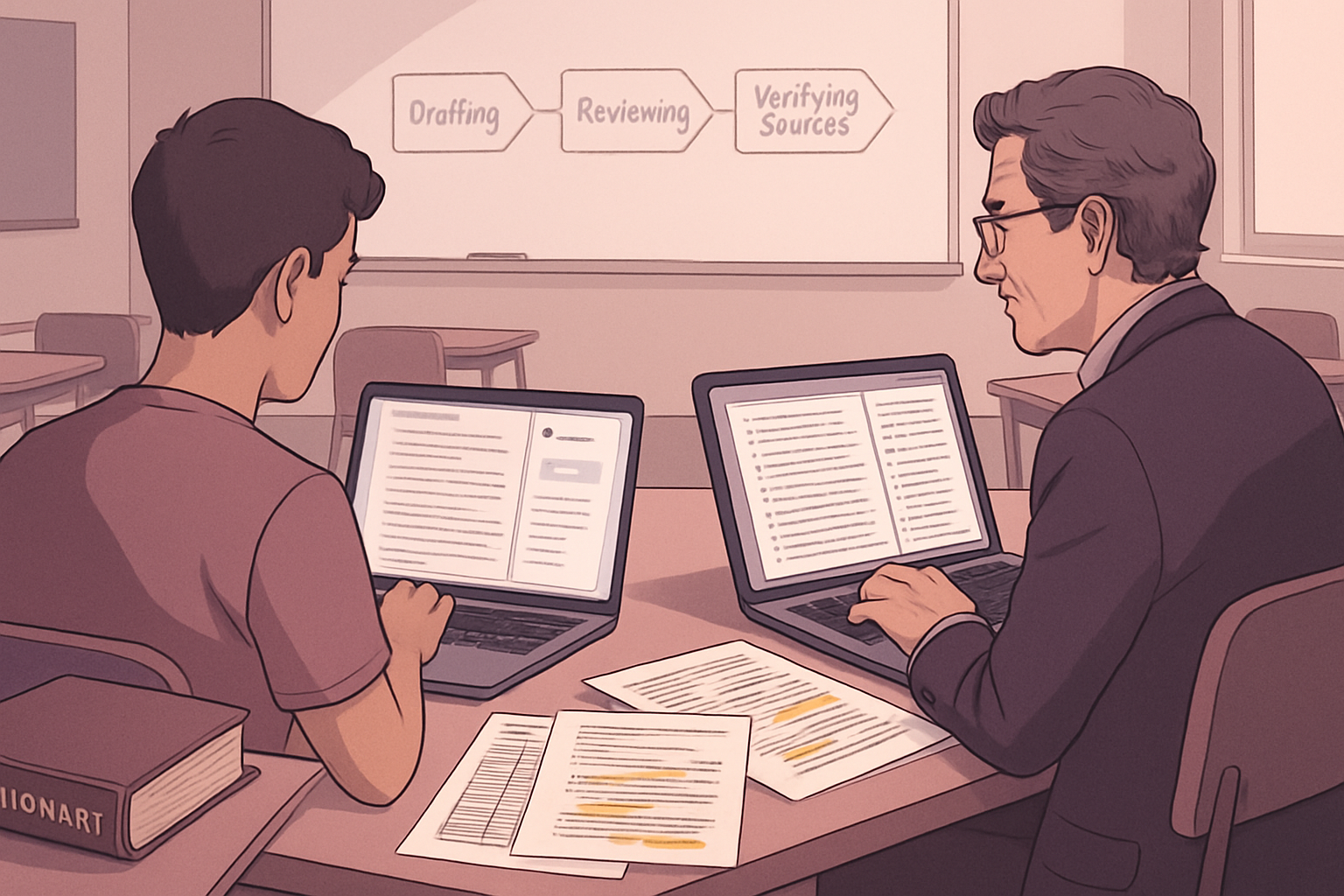
AI assistance does not eliminate intellectual work; it shifts it. Between increased productivity in professional writing and disrupted academic assessments, the boundary between formative difficulty and unnecessary friction becomes crucial. The challenge is not to preserve struggle but to identify what it truly contributes.
Measured Gains in Professional Writing, According to Research
Experimental research has found significant productivity gains thanks to generative AI in professional writing tasks, with faster completion and higher quality output. Under favorable conditions, this technology can enhance productivity and intellectual capabilities. However, it can also exacerbate existing problems and make their detection more difficult, as the mere presence of AI does not allow for a judgment of the intellectual value of a piece of work.
Reading and Writing: Interfaces with Their Own Friction
Reading and writing are presented as interfaces that allow interaction with written language, which is itself described as a technology made of symbols and conventions. Their friction can be evaluated like that of any interface: a confirmation before deletion can be useful, while repeated inputs or unnecessary screens add obstacles without value. Walter Ong characterized writing as a technology that restructures thought.
Formative Effort or Incident: How to Draw the Line
Friction that develops or exercises a capability is said to be constitutive, while friction that accompanies a task without developing it is termed incidental. Whether something falls into one category or the other depends on the individual, the task, and the targeted skill. Researchers have shown that certain desirable difficulties enhance learning and retention, as they effectively contribute to the learning process. Interpreting a complex argument involves necessary effort, while spelling or formatting may contribute little for an experienced author, yet remain formative for a learner.
From Longstanding Tools to Generative Agents
For many years, dictionaries, word processing software, spell checkers, search engines, and citation management tools have helped mitigate some writing-related obstacles. Generative AI, on the other hand, stands out by closely mimicking human reasoning: it can interpret, organize, revise, synthesize, translate, and produce text, and can even provide an interpretation of the meaning of a source, whereas a citation manager is limited to adhering to format. Whether these interpretations are accurate is a different question from the ability to generate them.
Le brief IA que les pros lisent chaque soir
Les 7 actus IA du jour, décryptées en 5 min. Gratuit.
Inclus dès l'inscription : notre sélection des meilleurs guides & comparatifs IA.
Choisissez votre rythme
Gratuit · Pas de spam · Désabonnement en 1 clic
Delegating to AI Shifts Work Toward Judgment
Having AI correct spelling involves little intellectual relinquishment, whereas asking for the reconciliation of contradictory arguments delegates a significant portion of intellectual work. The use of AI shifts part of the work from production to judgment: soliciting multiple interpretations, comparing them, questioning their assumptions, verifying their claims, rejecting some, and determining one’s own position. This entails choices about what to delegate, what to trust, what to verify, and whether the generated text aligns with the intended purpose.
Education: A Weakened Indicator, Assessments to Rethink
Reading and writing have long served as indicators of broader capabilities. However, polished prose or a good summary are not sufficient to prove reasoning or understanding, and AI weakens this link by making it possible to produce a convincing synthesis without mastery of the content. This disconnect poses a problem in education, as the finished text becomes a less reliable indicator of the author’s capabilities. Researchers are already rethinking assessment, including the possibility of using the process of interaction with AI as a trace of reasoning. The utility or loss of learning depends on individual achievements and needs, with AI potentially removing incidental friction for one person while taking away a portion of learning for another.
Critiquing Uses Without Confusing Tool and Intellectual Value
Poor prose, unsubstantiated claims, fabricated citations, and avoidance of material deserve criticism, just as they did before AI. AI can amplify these issues and complicate their detection, but focusing solely on preserving familiar practices resembles ludditism. Systematically equating AI assistance with intellectual failure amounts to defending mechanisms rather than questioning the objectives of reading and writing. It is not necessary to preserve difficulty for its own sake: the goal is to determine which capabilities are truly valued, what forms of effort develop them, and what is sacrificed when AI facilitates a task. Knowing that AI was involved does not clarify whether it helped express an idea or replaced the expected reflection.
Brief IA — L'actualité IA en français
L'essentiel de l'actualité de l'intelligence artificielle, décrypté et expliqué chaque jour.