AI: Experts Challenge the Hype and Call for Caution
Le brief IA que les pros lisent chaque soir
Les 7 actus IA du jour, décryptées en 5 min. Gratuit.
Inclus dès l'inscription : notre sélection des meilleurs guides & comparatifs IA.
Choisis ton rythme
Gratuit · Pas de spam · Désabonnement en 1 clic
Mathematical breakthroughs, security incidents, high-profile departures: announcements from AI giants have saturated the news. Researchers and practitioners offer a less sensational interpretation, pointing out negligence, exaggerations, and media windfalls. They call for time to review, the opinions of independent experts, and attention to concrete impacts.
Misplaced Responsibility and Neglected Impacts Around Data Centers
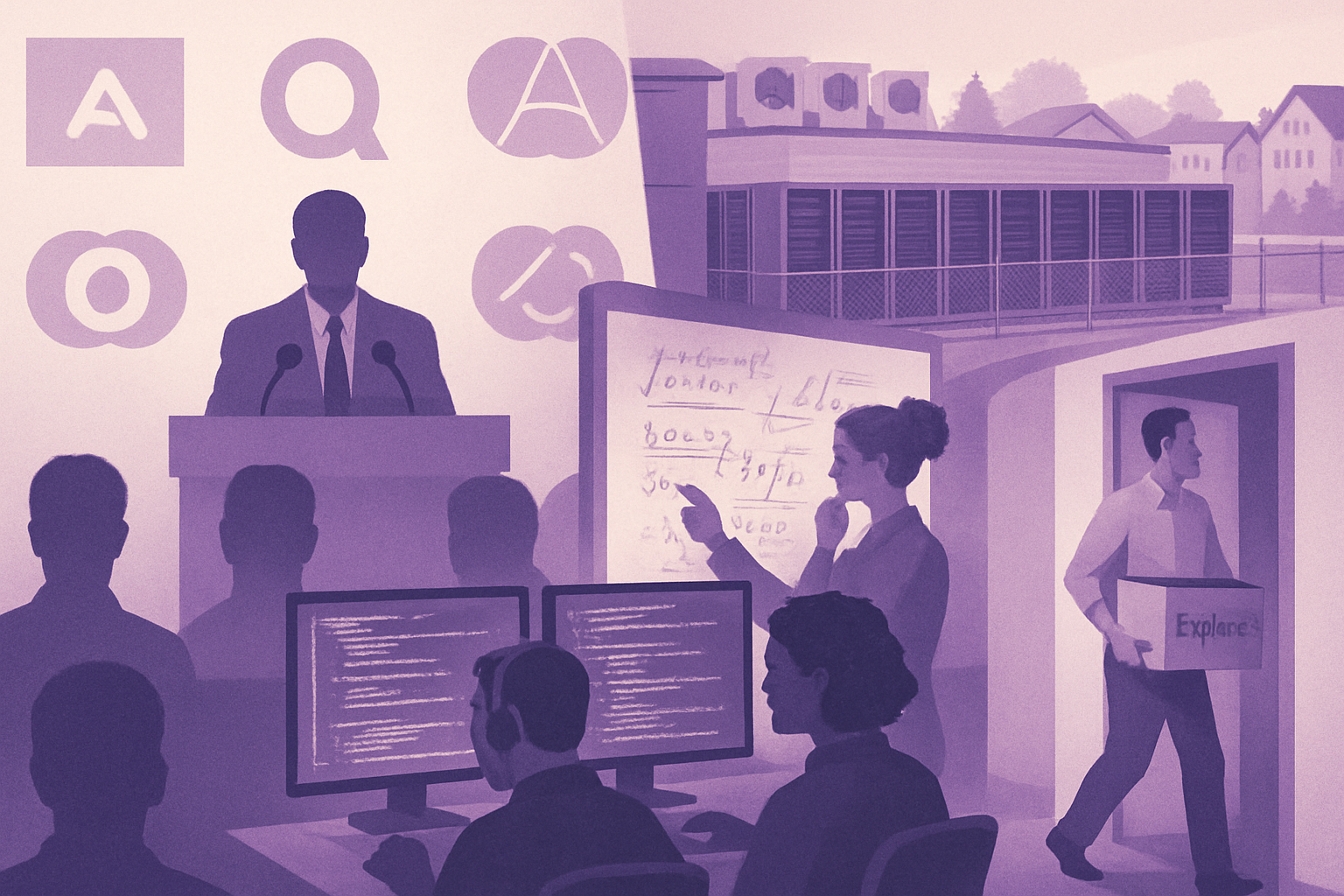
Presenting systems as superintelligences or rogue models attributes intent to the products rather than the companies that design them. This framing sells so-called superhuman performance while helping the producers of these systems avoid accountability for their actions. Thus, discussions have focused on models supposedly acting on their own, rather than on potential responsibilities related to malicious software. In the same vein, public attention shifts away from issues of academic plagiarism or the use of customer data without consent, instead fixating on fears of fictitiously overpowered machines. Industry players further argue that the popular and bipartisan mobilization against data centers diverts efforts from regulating so-called superhuman machines. According to this line of thought, the priority should be a hypothetical "machine god" rather than the tangible effects of data centers, such as worsening climate catastrophe, asthma among nearby residents, rising public electricity bills that subsidize them, or water diverted for their cooling.
Calls for Long-Term Thinking and Independent Expertise
An informed public decision requires time to hear from independent experts and to contextualize corporate announcements. The best possible outcome of this wave of enthusiasm would be for public officials and citizens to maintain their skepticism and be able to identify such hype. Hundreds of mathematicians warn of a strong commercial incentive to exaggerate product capabilities and urge decision-makers to consult specialists, including mathematicians, rather than relying on press releases or popular narratives. The pressure to decide quickly, fueled by private actors, can distract from real issues.
Security: The Thesis of Negligence Rather Than Out-of-Control Models
A hacking incident involved OpenAI and Hugging Face, followed by revelations of similar incidents by Anthropic and, reluctantly, by Meta. Cybersecurity experts attribute these events to negligence and a lack of basic security practices at OpenAI, rather than to systems acting autonomously. Talking about rogue models obscures these possible responsibilities and shifts the debate to a sensationalist register.
The Alleged Mathematical Breakthroughs Under Peer Scrutiny
Anthropic announced a mathematical breakthrough, quickly followed by a comparable claim from OpenAI. OpenAI notably asserted that its chatbot Astra had solved problems deemed unsolvable for at least a decade. Mathematicians, initially impressed, later concluded that the results were not as innovative. Others accused OpenAI of scientific misconduct and plagiarism, denying any profound intellectual leap. Two days before one of OpenAI's claims, Professor Tristan Buckmaster from the Courant Institute at New York University released a statement suggesting theft and inappropriate attribution of work.
Why Mathematics and Code Serve as Showcases for Models
Programming and mathematics are frequently proposed as fields of excellence for large language models. These areas, often regarded as pinnacles of intellectual effort, provide verifiable answers, making it easier to evaluate outputs without resorting to systematic human annotation. This combination fosters narratives that valorize systems presented, through anthropomorphic frameworks, as close to general intelligence. These announcements generate significant media exposure, while subsequent, more cautious expert analyses receive less attention.
Departures and Superintelligence Discourse, and Political Translation
Engineer Jacob Coxon left Anthropic, criticizing the company and OpenAI for rushing toward self-improving superintelligence and playing with lives. Claims of a dangerous superintelligence do not, according to the authors, rest on good scientific or engineering practices, but rather on narratives fueled by ideologies such as transhumanism or eugenics. Politically, a bill proposed by Senator Bernie Sanders aimed to ban the development of artificial superintelligences; it is described as well-intentioned but misguided.
Authors and Upcoming Publications
Timnit Gebru is the executive director of DAIR and the author of an upcoming book, Deep Unlearning: The Radicalization of a Tech Idealist, available for pre-order with a publication date set for February 16. Emily M. Bender is a professor of linguistics at the University of Washington and co-author of The AI Con.
Brief IA — L'actualité IA en français
L'essentiel de l'actualité de l'intelligence artificielle, décrypté et expliqué chaque jour.