Generative AI: Uses, Trust, and Adoption in the Workplace
The widespread adoption of AI tools does not always come with a nuanced understanding of how they work. Amid fragile trust, slowly evolving search habits, and already structured prompt practices, a recent overview details what users are actually doing, what they expect, and where they encounter obstacles. It also reminds us that, despite the enthusiasm, the majority of working individuals surveyed say they do not use AI at work.
At Work, a Majority Claims Not to Use AI and Mastery Remains Uneven
Of approximately 5,000 employed Americans surveyed, 81% reported not using AI at work, two years after the emergence of consumer-grade tools. Despite a high adoption rate in many groups, the learning curve remains significant. When mental models are inaccurate or the vision of potential is limited, usage can disappoint. AI literacy involves both knowing how to formulate prompts and critically evaluating the results, and frequent practice does not guarantee competent use. Users also struggle to understand how personalization systems transform their actions into recommendations. In China, new users of generative AI chatbots have found it challenging to grasp the functionality of the tools.
Searching with AI: Specific Expectations, Stubborn Habits, and Costly Verification
Large language models offer a new way to seek answers in a domain long dominated by search engines. Some aspects of information retrieval are facilitated, but it remains difficult to judge the truthfulness and reliability of responses. AI assists those who do not know the right terms, but many users do not employ it effectively and retain deeply ingrained habits. Chatbots discourage error verification, with very polite outputs and high interaction costs. Nevertheless, users expect aggregated, concise, and context-sensitive responses. In China, search is organized around social mobile applications, while the ways of formulating prompts and interacting with AI resemble those observed in the West. For complex questions, AI is favored for exploration and synthesis; for needs where accuracy and trust are critical, traditional search remains the benchmark.
Le brief IA que les pros lisent chaque soir
Les 7 actus IA du jour, décryptées en 5 min. Gratuit.
Inclus dès l'inscription : notre sélection des meilleurs guides & comparatifs IA.
Choisissez votre rythme
Gratuit · Pas de spam · Désabonnement en 1 clic
Users Place Their Trust in AI Perceived as Intelligent
The more AI seems to understand its interlocutor, the more trust it garners, and users attribute human-like qualities to it. Trust increases when a system appears intelligent rather than sentient, while the expression of emotions can diminish trust for factual tasks. The ELIZA effect illustrates how quickly human traits are projected onto artificial systems, often reflecting the user's personality. In the face of overconfidence risks, it is recommended to use only verifiable or recognized true information. Four levels of anthropomorphism are described—courtesy, reinforcement, role-playing, companionship—and adding personality or emotions to LLMs, which are already designed to humanize, increases the risk of misplaced trust.
Prompts and Conversations: Six Types of Exchanges and Recurring Structures
Users often frame the expected responses by incorporating format and structure constraints into their prompts. They rely on common structural elements and six types of exchanges: search requests, filtering, exploration, sculpting, expansion, and targeting. Two models describe task-related conversations, accordion editing and apple picking, to account for back-and-forth interactions and successive selections. In image generation, a typical four-step process is found: ideation, production, refinement, and export.
Functioning and Key Concepts: From Iterative Agents to Flattery Biases
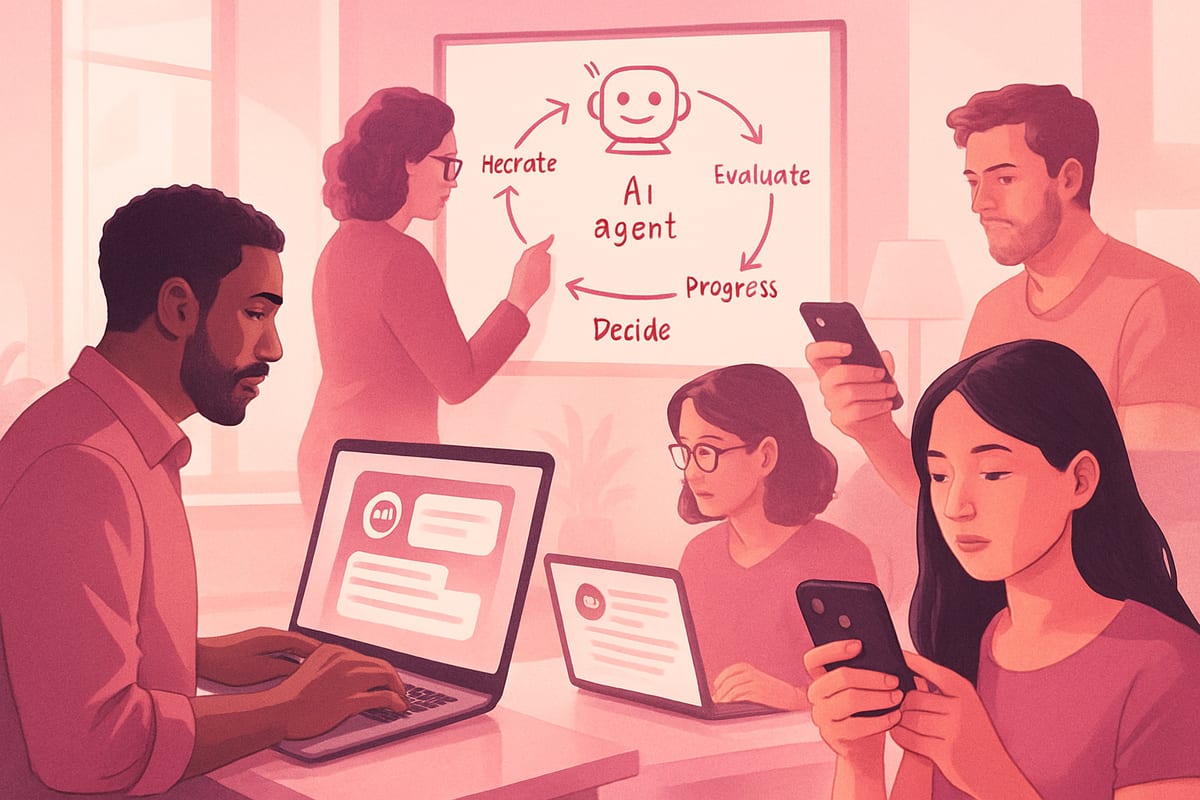
Educational resources offer a glossary of AI and present an intention-based interface paradigm, described as the first new one in 60 years. They explain in non-technical terms how large language models process inputs and generate responses, and describe a multi-phase training process during which these models learn the language and develop a style. Hallucinations are identified as a phenomenon difficult to correct, to be considered from the design stage, especially since these models prioritize user satisfaction over accuracy verification. The concept of an agent is clarified: a system that acts iteratively, evaluates its progress, and chooses its next steps, aiming for reliability, adaptability, and precision. Two design approaches coexist: with a generative interface, the system chooses what to produce; with vibe coding, the user explicitly requests what should be built.
A Podcast Episode Shares Insights on Benefits and Risks
In a podcast episode, Susan Farrell shares initial reflections on the potential advantages and disadvantages of AI systems.
Brief IA — L'actualité IA en français
L'essentiel de l'actualité de l'intelligence artificielle, décrypté et expliqué chaque jour.