Medical AI: ALICE and FieldCare GPT in Field Testing
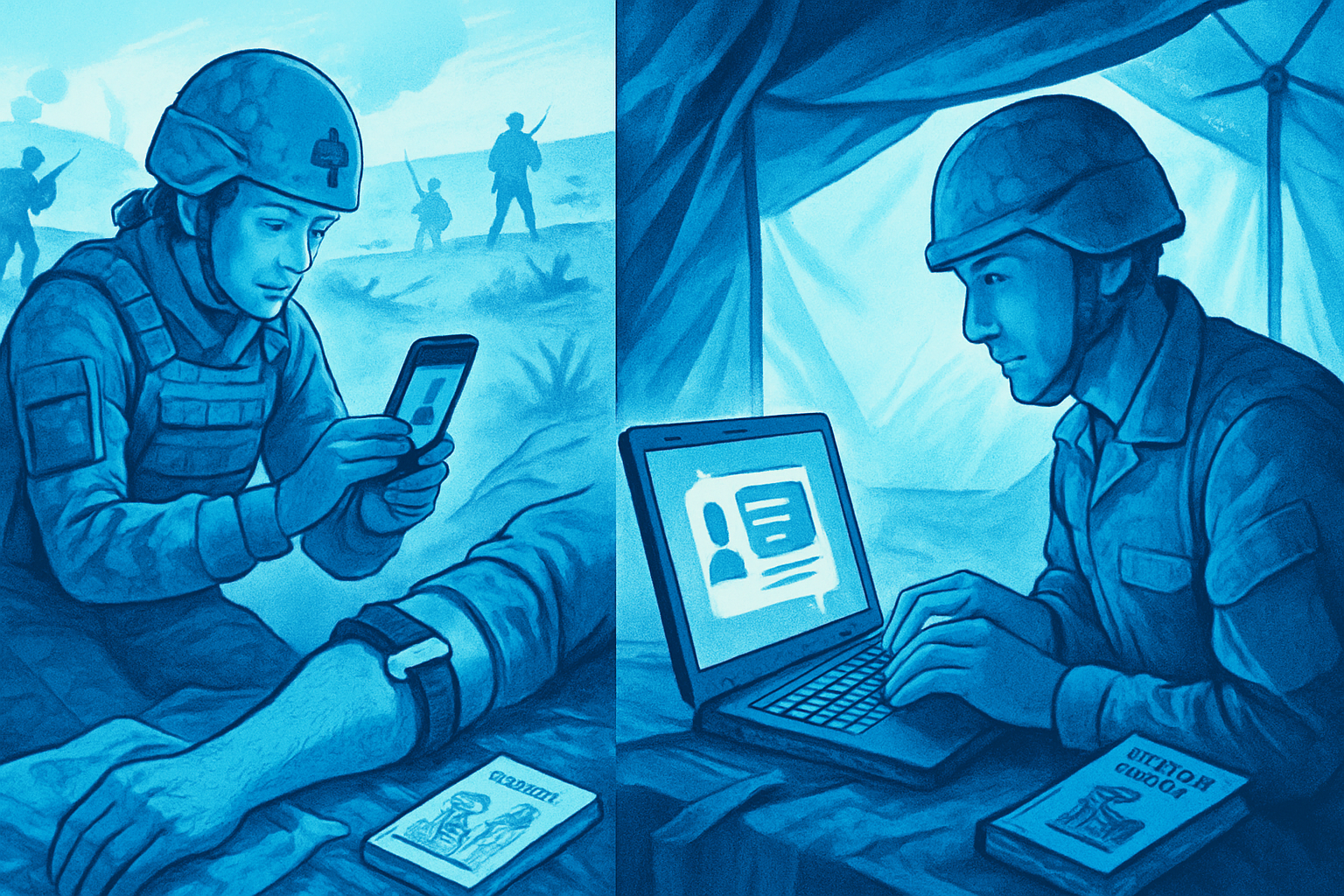
Two ground-level AI projects aim to guide trauma care when neither a doctor nor evacuation is available. In Ukraine, ALICE relies on photos and voice instructions; in Pittsburgh, FieldCare GPT operates entirely offline. Doctors and researchers frame these uses as decision aids and are conducting multiple trials before any deployment.
Trials Already Conducted and Others in Preparation
FieldCare GPT has already been tested with 200 prompts related to combat injuries and presented to military personnel. Researchers are preparing more practical evaluations with service members to observe how ordinary users interact with the tool and identify its shortcomings. On the Ukrainian side, ALICE is in the testing phase in facilities close to the front, where doctors are identifying gaps to be addressed. According to Nam Tran, the technology is available, and the focus now is on meeting the needs of soldiers. Roman Kuziv, the designer of ALICE, confirms that trials are ongoing.
Decision Aid, Not Replacement for Medical Personnel
Designers emphasize that these applications do not replace medical staff or training, even though soldiers may need to care for themselves or comrades in the absence of medical attention and evacuation. Complex procedures, such as controlling massive bleeding or applying a chest seal, can be considered by non-medics, but only as a last resort. Stacy Shackelford, a professor of emergency medicine and surgery, highlights the difficulty of teaching decisions like the removal of a tourniquet, which requires clinical judgment, and emphasizes both the benefits of knowledge input and the limitations for inexperienced users. She views these systems as useful decision-making assistants in training and within a physician's practice, while believing they are preferable to having no assistance at all for a non-medical person with basic first aid knowledge.
Le brief IA que les pros lisent chaque soir
Les 7 actus IA du jour, décryptées en 5 min. Gratuit.
Inclus dès l'inscription : notre sélection des meilleurs guides & comparatifs IA.
Choisissez votre rythme
Gratuit · Pas de spam · Désabonnement en 1 clic
An Offline Chatbot Based on Military Medical Texts
Developed at the University of Pittsburgh, FieldCare GPT is designed to operate without a connection and provide quick responses derived from military medical references such as the Ranger Medic Handbook and TCCC guidelines. Nam Tran explains that, in the absence of the Internet and sometimes radio, troops need an accurate system capable of extracting knowledge from texts on combat injuries. The chatbot operates locally on a high-performance laptop; the team is working to make it a mobile server for smaller terminals, which currently cannot support the tool without significant compromises. Image analysis is deliberately excluded at this stage, as it is demanding under degraded conditions. Technical discretion is also sought, as electromagnetic signatures can be detected and exploited by the enemy.
ALICE Guides Through Photos and Voice Instructions
Designed by Ukrainian surgeon Roman Kuziv, ALICE uses Google’s Gemini platform to guide the user after taking a photo of the injury. The application offers distinct modes for medical and non-medical personnel, along with voice instructions to follow the protocol under stress. Among the intended uses is the reassessment of tourniquets, which are often poorly tracked in the chaos of combat, even though such decisions go beyond simply knowing the time of application. Kuziv notes that battlefield stress leads to self-care errors; the image-based approach and follow-up questions aim to bring the user closer to the correct protocol. In contrast, FieldCare GPT prioritizes text and offline autonomy.
The Landscape Has Changed: Unit Dispersion and Delayed Evacuations
Operational conduct has increased the dispersion of teams, distancing the injured from care points. Travis Polk, who leads military medicine research in Pittsburgh, describes a "tactical gap" where care must be delivered where soldiers are rather than quickly moving patients. He believes that, on the Ukrainian front, the guarantee of rapid evacuation no longer exists, unlike many situations observed during the two decades post-September 11 in the Middle East. The U.S. military is accordingly preparing to keep the injured on-site longer, sometimes for days or weeks, with care provided by doctors or, if necessary, by non-medical soldiers.
Brief IA — L'actualité IA en français
L'essentiel de l'actualité de l'intelligence artificielle, décrypté et expliqué chaque jour.