Physical AI: Data, Automotive, and Critical Thresholds
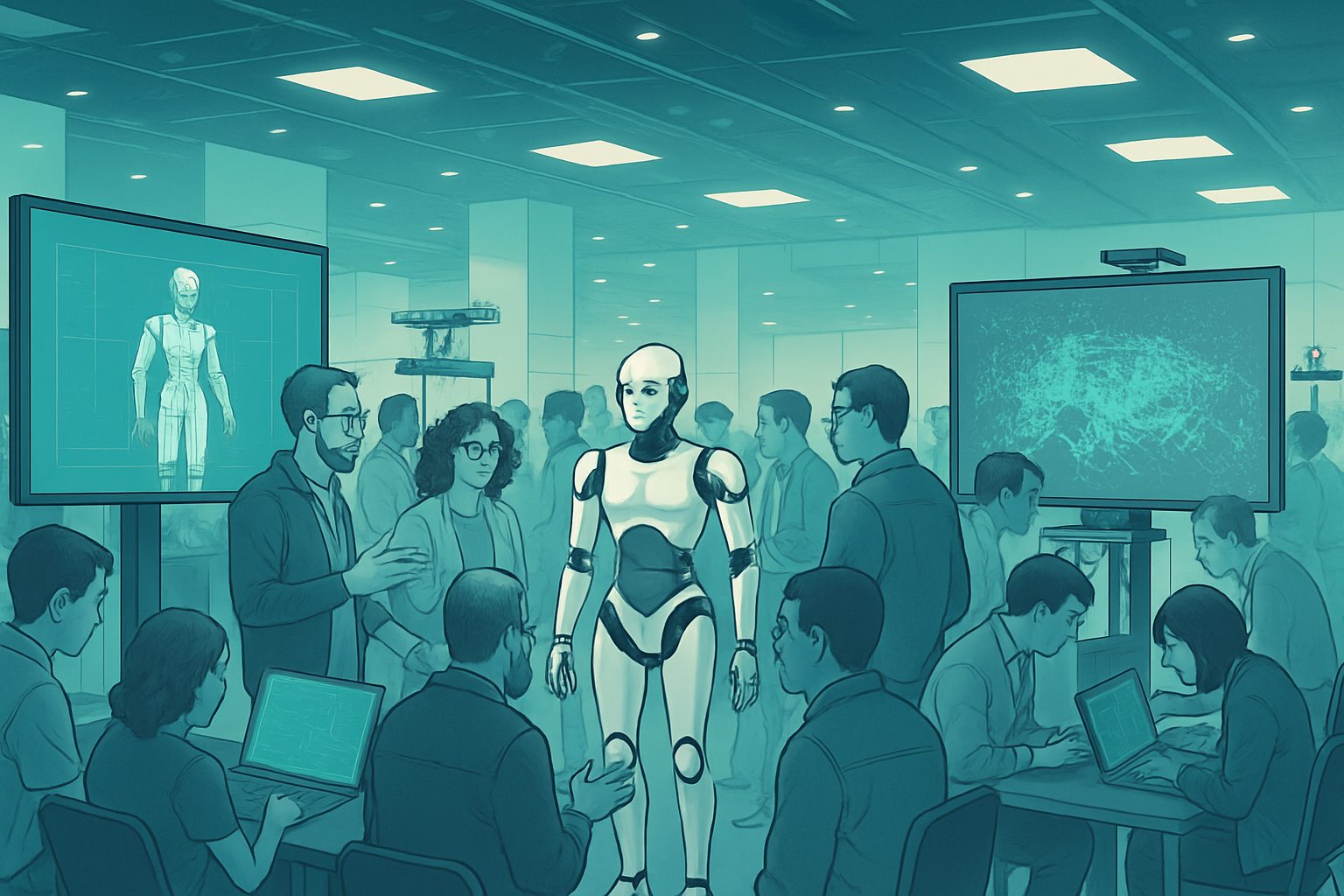
The heart of the matter is not a spectacular prototype but the thresholds and tools that will make robotics useful at scale. Leaders and engineers disagree on what will be groundbreaking, from $1000 autonomy to reliable manipulations at 80%. Meanwhile, the industry is gearing up to overcome a data bottleneck, while the stock market reminds us of the uncertainty involved.
Three Definitions of the Turning Point: Consumer, Reliability, and Distribution
Sam Altman places a possible equivalent of ChatGPT for embodied AI a few years away. For Alex Kendall (Wayve), the trigger will be consumer-oriented: the largest current robotic deployments are household vacuums, and a significant milestone would be achieved with hands-free driving for under $1000 in hardware in a car. Wayve is already licensing models to manufacturers to aim for this goal, which Kendall describes as a multi-billion dollar opportunity and a springboard towards a general embodied AI model. Théophile Gervet (Genesis AI) sets the threshold elsewhere: a manipulation that works right out of the box, commanded in natural language, for basic gestures like pushing, pulling, closing a laptop, or cleaning a table, with 80% reliability or more. Adrian Macneil (Foxglove) dismisses the idea of a unique "ChatGPT moment" in robotics, reminding us that ChatGPT's peak was due to its distribution channel (zero to one million active users in a week), which is much simpler than distribution in the real world. He anticipates rather an "Apple II" or "IBM PC" moment: being able to buy a domestic robot that starts performing useful and fun tasks.
Data and Tools: An Identified Bottleneck and a New Product
Managing dense visual and lidar streams complicates iteration. This week, Foxglove announced a product built on Nvidia Cosmos's open-weight world model: it allows natural language queries to explore data and build assessments and simulations, with the stated goal of accelerating sorting and debugging. The sector describes a "data crisis" due to the lack of high-quality training datasets: generalist robots remain distant, and end-to-end approaches have yet to produce reliable commercial performance. In response, teams are looking to diversify or generate their data, testing alternative training regimes, and refining reinforcement learning. Harry Mellsop (Antioch) places physical AI at a "GPT-2" stage that will require more data and computation, including GPUs optimized for ray tracing to produce faithful simulations. At the booths, Avala also claims to be tackling this crisis as an infrastructure provider.
Le brief IA que les pros lisent chaque soir
Les 7 actus IA du jour, décryptées en 5 min. Gratuit.
Inclus dès l'inscription : notre sélection des meilleurs guides & comparatifs IA.
Choisis ton rythme
Gratuit · Pas de spam · Désabonnement en 1 clic
The Automotive Sector as a Bridgehead and Tool Reservoir
Autonomous vehicles are at the forefront, aided by data collection from human driving and a central task of avoiding contact rather than manipulation. Many software building blocks come from this field: Foxglove was founded by former Cruise employees, General Motors' autonomous driving initiative. Automotive groups bet that these ML investments will allow them to compete with dedicated humanoid manufacturers: Tesla is already attempting this with Optimus, while Wayve and Uber have launched humanoid labs. For Alex Kendall, the starting point should be vehicles: data infrastructure, simulation, and ML operations should be shared, even if the world model will diverge post-training based on embodiment. He believes it is premature to lock in a hardware platform while sensors and components are evolving rapidly, advocating for a more agnostic model.
Targeting Verticals: Where Robots Deliver and Under What Conditions
In specific use cases, robots are already operating in the field: Gritt builds solar farms, Agility operates in industrial environments, and Bedrock pilots excavators autonomously. At Bedrock, Kevin Peterson says they start from excavation to define "manipulation in the real world," with the ambition of building an intelligence layer covering multiple construction machines. This vertical refocusing is appealing for its revenue and deployment data, even if this data may lack diversity to advance generalist models, while remaining key to creating value. Théophile Gervet emphasizes that a generalist robot with 80% success is of no interest to any client, and that the lack of sector focus destroys value; he also warns that a specialized player built on a "GPT-2" foundation risks being overtaken by a competitor on a "GPT-4" basis.
Market Signals and Community: Turbulent IPO, Growing Conference
The contrast is stark between enthusiasm and stock market reality. Unitree, touted as China's leading robot manufacturer, saw its valuation peak at $66 billion after a significant IPO, before losing nearly half its value this week, with analysts pointing to a lack of productive know-how despite physical advancements. In venture capital, physical AI is attracting rounds reaching billions to transpose the recipes of large language models to robotics. On the ecosystem side, the Actuate conference has tripled in size since 2023 and claims 1500 participants, organized by Foxglove, which positions itself as a tool provider for managing and visualizing data for embodied AI teams.
Brief IA — L'actualité IA en français
L'essentiel de l'actualité de l'intelligence artificielle, décrypté et expliqué chaque jour.