AI on Campus: Transparency and Human Decisions
As enthusiasm for AI among 14–29-year-olds declines in the United States, academic and association leaders describe how to innovate without alienating university communities. On the agenda: a framework for student rights, genuine involvement of teachers, and clear rules to keep humans in control of sensitive decisions.
Sensitive Decisions: Rules to Keep Humans in Control
At George Fox University, Sean Campbell's team defines categories of decisions that must remain human: any question related to academic status, financial aid, admissions, or academic integrity involves a responsible person and a student who can inquire about how the decision was made. Campbell recommends prioritizing the impact on missions over technological appeal, demonstrating concrete effects on education, retention, and job satisfaction, while clarifying the current limitations of the tools. He warns that in the absence of trust, teachers may use personal ChatGPT accounts with student data, depriving IT of the necessary visibility.
Involving Teachers Rather Than Deciding Behind Closed Doors
Teacher participation remains limited: 31% report being genuinely involved in shaping their institution's AI policy, according to a 2026 survey. Sean Campbell advises IT leaders to clarify their motivations when promoting a platform, clearly distinguishing the best tool for the job from a tool that is already funded. For Jean-François Coget, skepticism is not resistance but signals concerns that need to be addressed. He believes that trust is built through transparency, participation, and evidence, and recommends that institutions specify the tools used, the protection of information, the permitted or prohibited usage scopes, and responsibilities, while opening spaces for teachers, staff, and students to question and guide practices.
Le brief IA que les pros lisent chaque soir
Les 7 actus IA du jour, décryptées en 5 min. Gratuit.
Inclus dès l'inscription : notre sélection des meilleurs guides & comparatifs IA.
Choisis ton rythme
Gratuit · Pas de spam · Désabonnement en 1 clic
A Rights Framework to Guide AI Decisions
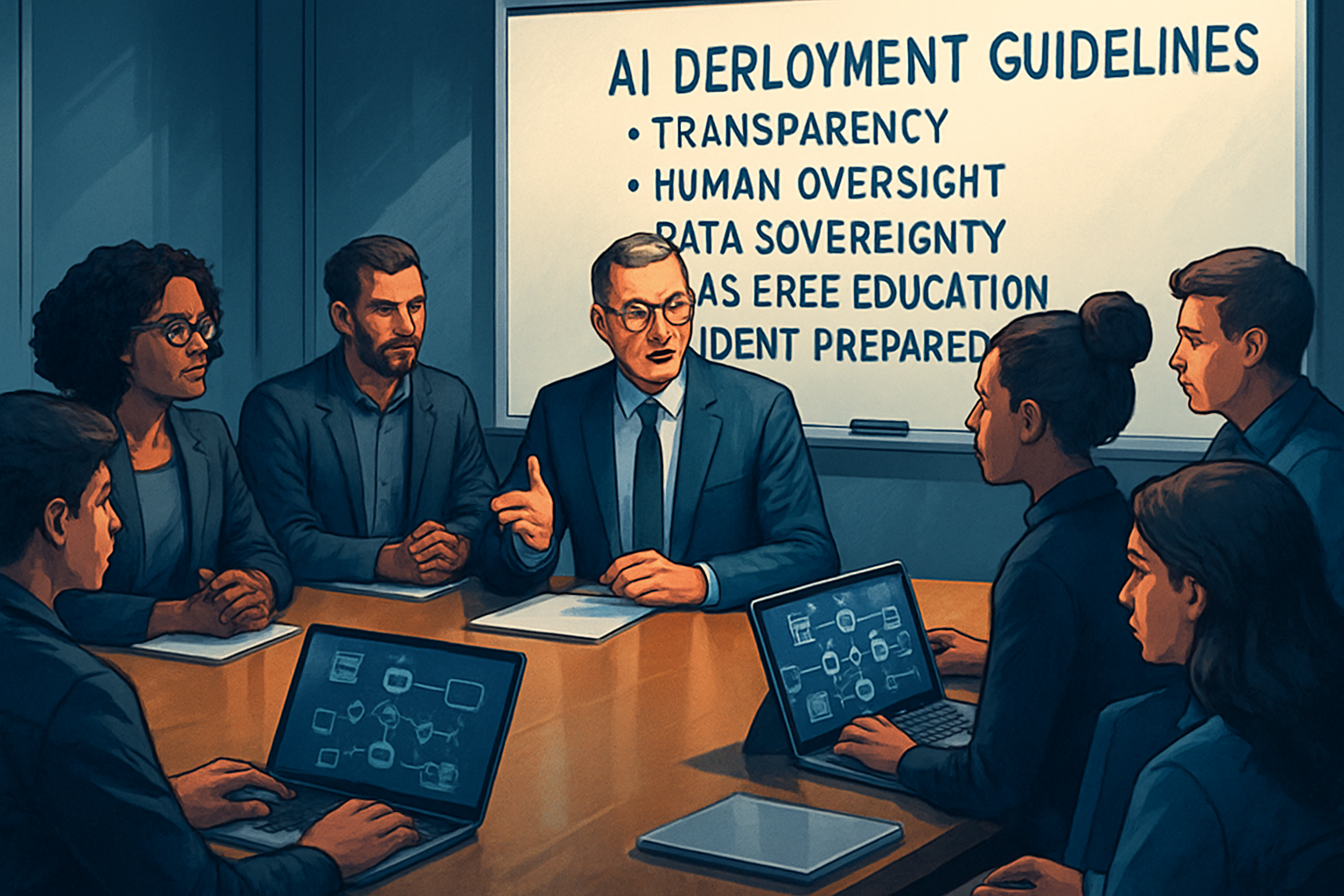
In April 2026, Student Defense published a Student AI Bill of Rights listing five non-negotiable protections: the right to transparency regarding AI use in assessments, human oversight of high-stakes decisions, student data sovereignty, education free from algorithmic bias, and preparing students to work with AI as informed citizens. This framework is presented as a starting point to help institutions decide where and how to use AI and to better communicate with their community.
Empowering Users to Reduce Anxiety
Roger Lam, founder of Ordify AI, links skepticism to a lack of transparency and fear of processes imposed without accountability. He describes effective approaches: governed and low-stakes environments where AI extends the workflow instead of replacing it, and where everyone can see the system's logic and guide it. According to him, this combination of agency and readability helps reduce anxiety. Ordify AI collaborates with the University of Wisconsin-Parkside, among others.
Student Expectations Centered on Humanity, Enthusiasm Declining
Aaron Ament, president of Student Defense, warns of a potential gap between AI-related transformations and student expectations, which remain tied to human relationships with professors. Replacing these interactions could deprive the institution of essential elements, such as detecting struggling or high-potential students; thus, AI must add value without substituting key components of the human experience. Recent figures confirm a more tense context among 14–29-year-olds in the United States: enthusiasm at 22% (down 14 points since 2025), hope at 18% (down 9), anger at 31% (up 9), and stable anxiety at 42%. At the same time, most institutions are asking their IT leaders to deploy AI tools campus-wide.
Brief IA — L'actualité IA en français
L'essentiel de l'actualité de l'intelligence artificielle, décrypté et expliqué chaque jour.