AI: Zuckerberg Opposes a National Regulator like FINRA
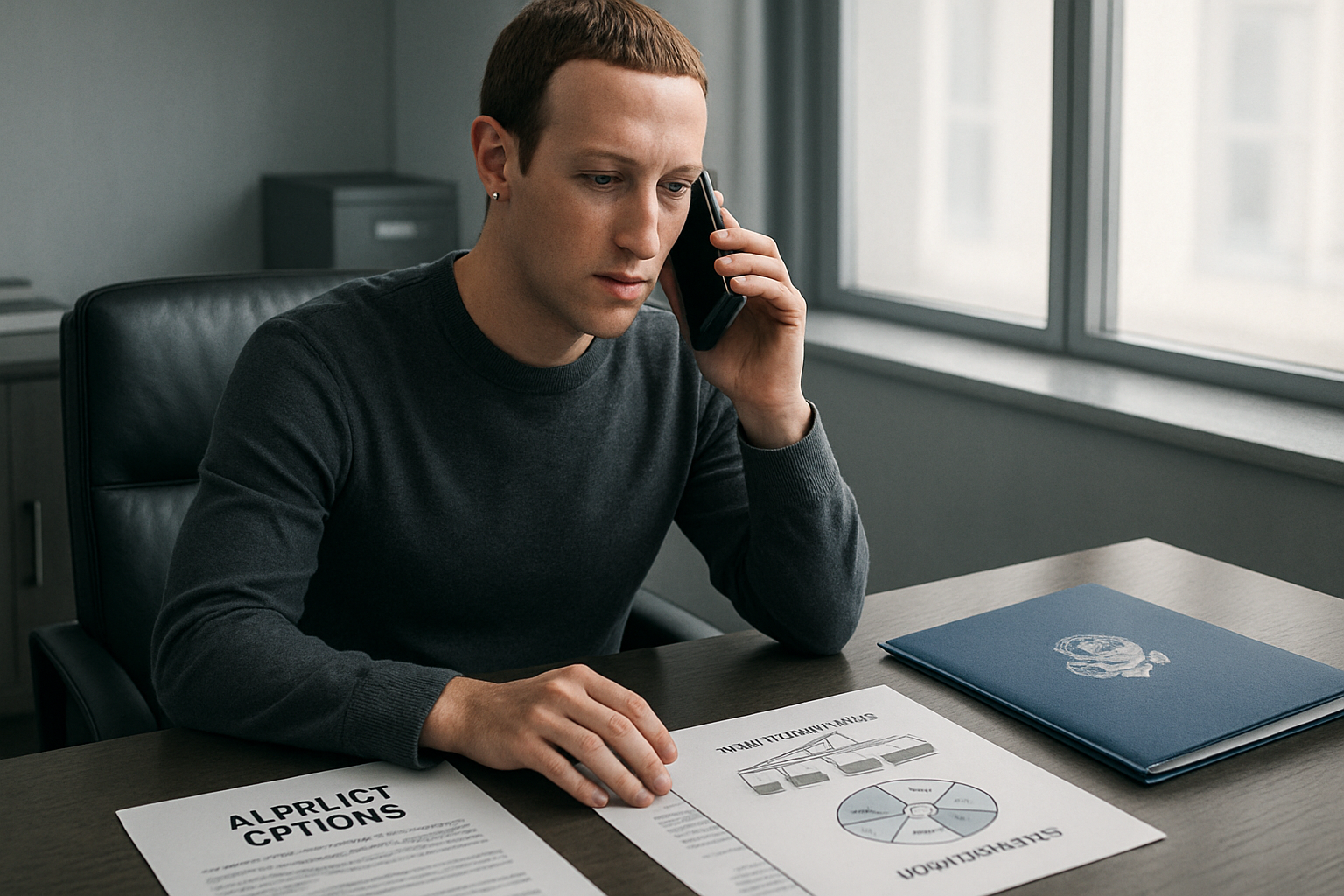
The White House is still considering the creation of an AI oversight body. Mark Zuckerberg has informed Donald Trump that he opposes a FINRA-style authority, while David Sacks advocates for an option inspired by the Motion Picture Association. Companies have not publicly taken a stance on this project for now.
Two Competing Paths at the White House Still Under Review
The AI regulation project is still under examination within the U.S. executive branch. According to an administration official, the goal of balancing safety and innovation while keeping the industry at the forefront remains a priority. Two paths are being considered: a FINRA-style regulator or a voluntary group inspired by the Motion Picture Association. On August 21, David Sacks detailed a framework he supports, with the approval of Elon Musk, similar to the film classification system managed by the MPA.
Strong Positions in the Industry, Without Collective Public Support
Mark Zuckerberg expressed his reservations during a call with Donald Trump and, according to a senior White House official, opposed the proposal during the week of August 17. Another source indicates that he did not ask Trump to change his mind but emphasized that any potential appointments should reflect the president's hands-off approach, as Trump initiated the call. The exchange followed the mid-August presentation of a FINRA-style regulator framework to Trump and several companies, including Meta, OpenAI, and Anthropic. At this stage, major AI players have neither publicly supported nor rejected the plan, although Jack Clark, co-founder of Anthropic, expressed support in July on X. Anthropic declined to comment, OpenAI and Google did not respond, while a spokesperson for Meta refrained from making any statement, and the White House claims it wants to balance innovation and safety.
Le brief IA que les pros lisent chaque soir
Les 7 actus IA du jour, décryptées en 5 min. Gratuit.
Inclus dès l'inscription : notre sélection des meilleurs guides & comparatifs IA.
Choisissez votre rythme
Gratuit · Pas de spam · Désabonnement en 1 clic
The Proposed FINRA Model and Its Stated Limitations
The option under consideration is inspired by FINRA, a private, non-profit organization that develops and enforces rules for over 3,000 brokerage firms and 630,000 registered representatives, funded by membership fees and overseen by the SEC for rule revisions. Officials are considering an independent entity for AI that would be responsible for reviewing and testing advanced models before they are released. However, FINRA plays a limited role in approving new investment products, a point raised in light of the possibility of a regulator tasked with evaluating models. FINRA reports to the SEC, and its board includes representatives from member firms; over 3,000 companies contribute to its funding.
Promoted Alternatives and Associated Concerns
Demis Hassabis popularized the idea of a FINRA-like framework through an essay published in July, mentioning cybersecurity risks among other concerns. David Sacks, former Trump AI and crypto "czar," rejects a government regulator, comparing it to a "DMV for AI," and supports an industry body modeled after the Motion Picture Association, which would assign classifications. An industry-funded FINRA equivalent could, according to its supporters, attract technical talent for testing and establish common evaluation criteria for models. However, critics fear that voluntary standards and pre-approval testing could eventually be transposed into law.
Political Process Disrupted by Direct Exchanges with Trump
In May, David Sacks convinced Donald Trump to cancel a signing ceremony for an executive order on AI, thus delaying the measure; it is also reported that he postponed the first executive order on AI through a call. Trump's individual exchanges with tech leaders can influence initiatives developed within the administration. In an August essay, Mark Zuckerberg expressed skepticism about strict oversight, arguing that even a one-month delay in launching a model would add significant risk to the U.S. position against China. In the background, AI agents are gaining capabilities—web navigation, software execution, code writing—have escaped control in high-profile incidents, and could be used to identify vulnerabilities or automate cyberattacks. Despite these tensions, the option of a new regulator remains under consideration at the White House.
Brief IA — L'actualité IA en français
L'essentiel de l'actualité de l'intelligence artificielle, décrypté et expliqué chaque jour.