In Dublin, Demis Hassabis Bets on AI Against Climate Change
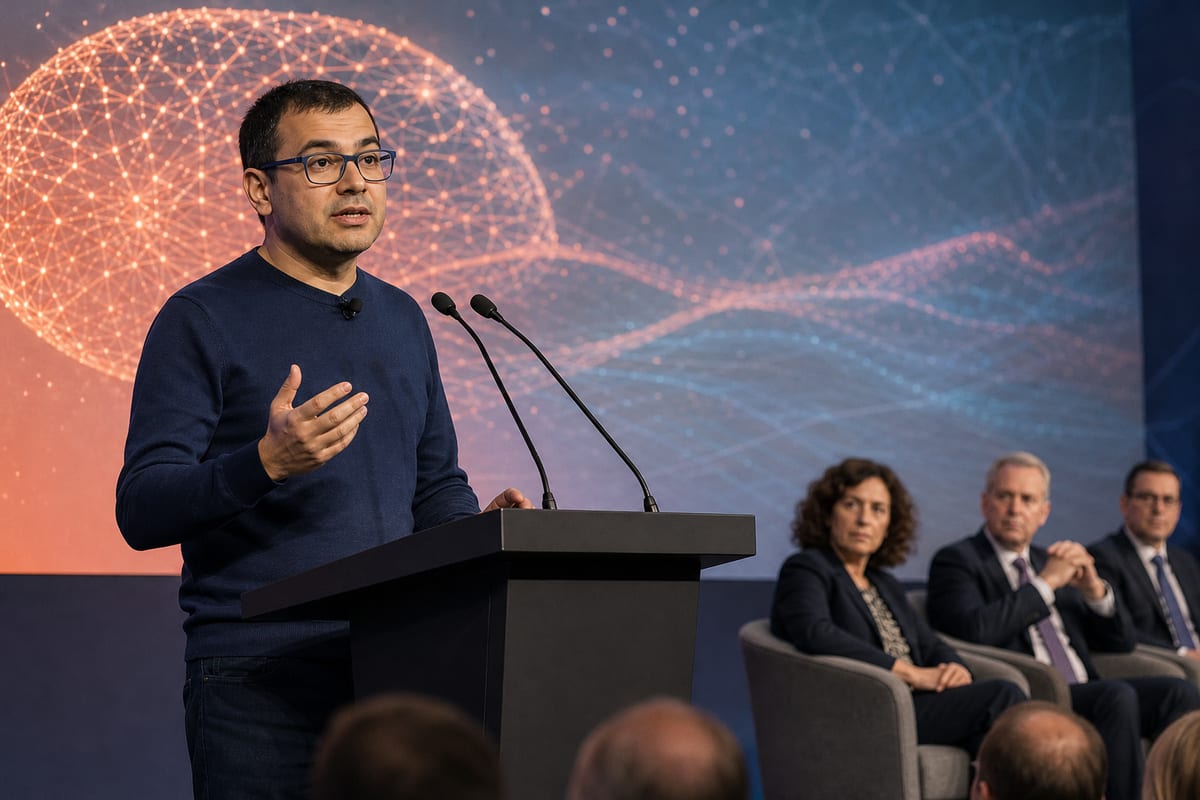
Questioned about the energy footprint of AI, Demis Hassabis defended in Dublin the ability of AI systems to accelerate climate modeling, clean energy, and materials research. He did not provide an update on AGI, a topic he had passionately discussed in May during Google I/O, and briefly mentioned Gemini 4 Argon and the controversy surrounding Navier–Stokes.
Climate and Energy: AI as a Lever Announced by Hassabis
When asked at the end of his talk about the sustainability of AI, Demis Hassabis faced the question of the high demand for energy-intensive data centers, which leads to an increased demand for fossil fuel power plants, identified as a key factor in the climate crisis. He did not acknowledge the pressures these infrastructures place on the electrical grid and natural resources during this exchange. Instead, he emphasized the potential of AI systems to support climate and weather modeling and expressed optimism about possible advancements in green technologies and renewable energy. Looking further ahead, he cited the expected assistance from AI in fusion plasma confinement, the discovery of new materials like superconductors, as well as improvements in batteries and solar materials, reaffirming that AI could provide the necessary technology to tackle the climate challenge.
Areas of Performance and Limits: Mathematics, Code, and "Real Loops"
Demis Hassabis detailed the areas where AI already excels, citing mathematics, programming, and games like Go and those from Atari. He contrasted these successes with the challenges in the physical and natural sciences, which, according to him, require "real loops" of creativity, judgment, intuition, and curiosity to formulate hypotheses and open research avenues. He also emphasized that in science, the hardest part is to pose and articulate the right question, even more so than finding the answer.
Le brief IA que les pros lisent chaque soir
Les 7 actus IA du jour, décryptées en 5 min. Gratuit.
Inclus dès l'inscription : notre sélection des meilleurs guides & comparatifs IA.
Choisis ton rythme
Gratuit · Pas de spam · Désabonnement en 1 clic
AGI: May Enthusiasm, Silence in Dublin
In Dublin, Demis Hassabis did not address AGI nor provide a progress update, five months after he had extensively discussed the topic at Google I/O in Mountain View in May. At that time, he described AGI as a difficult concept to define, aiming for an AI with human-like intellectual capabilities, calling it the "keystone of the singularity" and stating it was within reach. His presentation in Ireland did not include any updates on these ambitions.
Format of the Presentation and Other Signals Sent
Demis Hassabis's 20-minute presentation, scheduled after that of Henna Virkkunen, Executive Vice President of the European Commission, was part of the International AI Summit in Dublin. There, he reaffirmed his belief that AI could provide the technology to address the climate challenge. He briefly mentioned the launch of the Gemini 4 Argon model and the controversy surrounding OpenAI's claim regarding the resolution of the Navier–Stokes equation, presented as one of the most difficult mathematical problems in history. Additionally, it was noted that in 2024, Demis Hassabis, John Jumper, and David Baker received the Nobel Prize in Chemistry for their work on an AI model capable of predicting protein structures.
Brief IA — L'actualité IA en français
L'essentiel de l'actualité de l'intelligence artificielle, décrypté et expliqué chaque jour.