AI Engineering 2026: Towards a Simplified Toolkit
Le brief IA que les pros lisent chaque soir
Les 7 actus IA du jour, décryptées en 5 min. Gratuit.
Inclus dès l'inscription : notre sélection des meilleurs guides & comparatifs IA.
Choisis ton rythme
Gratuit · Pas de spam · Désabonnement en 1 clic
The AI Engineering Toolkit
Looking at the architecture diagrams of generative AI applications developed two years ago, one can observe a notable complexity. These systems relied on a massive vector database, sophisticated slicing algorithms, and an abstract orchestration framework. Each tool required custom API wrappers, and even the simplest tasks depended on expensive, cutting-edge models. This approach was more focused on prototyping than on production.
Today, as highlighted in the document From Python to AI Engineer: A Self-Study Roadmap, the role of the AI engineer has evolved. We are no longer frantically connecting APIs to test a language model's ability to summarize a PDF document. We are now building deterministic systems around non-deterministic engines.
With foundational models incorporating reasoning and state management capabilities, the tools needed to support them have diminished. The "kitchen sink" approach has been replaced by a set of standardized and streamlined primitives. Here is the minimal toolkit, ready for production, that an AI engineer will need by mid-2026 to build, evaluate, and deploy autonomous systems. Each layer addresses a distinct problem, and together they form a coherent stack.
Orchestration: Graphs and Event Loops
Orchestration is the starting point. Without reliable control over how your agent reasons and navigates, nothing else in the stack matters.
For production agent systems, it is crucial to have visibility into the execution graph, state transitions, and error management. Frameworks that obscure the underlying prompts or make it difficult to intercept a tool call are suited for prototyping, not for a deployed system.
As detailed in The Complete AI Agent Decision Framework, the industry has shifted towards two main paradigms.
- Using code-oriented graph frameworks: For complex, stateful applications, cyclic graphs are the norm. Instead of writing fragile loops to manage the agent's reasoning, you define nodes (agents or tools) and edges (conditional routing logic). State is automatically maintained across the graph, allowing you to pause execution, request human approval, and resume computation without losing context.
Tools like LangGraph and Burr illustrate this paradigm. LangGraph is a low-level code-oriented graph framework that gives you explicit control over state and transitions. The concern with highly abstract frameworks is the opaque orchestration that prevents you from seeing or intercepting what the model is doing.
- Using event-driven visual orchestration: For workflow automation and data pipelining, visual orchestration has proven to be much more maintainable than thousands of lines of standard Python. As explored in Automations with n8n: A Self-Study Roadmap, modern visual builders treat AI models as first-class citizens. You can visually map a webhook to a classifier agent, route the output to a Python execution node, and write to a database—all with built-in retry logic and observability.
The rule of thumb for 2026: If the task requires complex conversational memory and multi-turn planning, build a graph in code. If it’s an event-triggered asynchronous workflow, use a visual orchestrator.
Once your orchestration layer is in place, the next question is how your agents actually connect to the outside world.
The Universal Connector: Model Context Protocol
Until recently, giving an AI agent access to a new tool meant writing a custom Python wrapper, defining a JSON schema, managing API authentication, and hoping the model correctly interprets the arguments. Each new integration was its own little project.
The adoption of the Model Context Protocol (MCP) has significantly reduced this engineering burden.
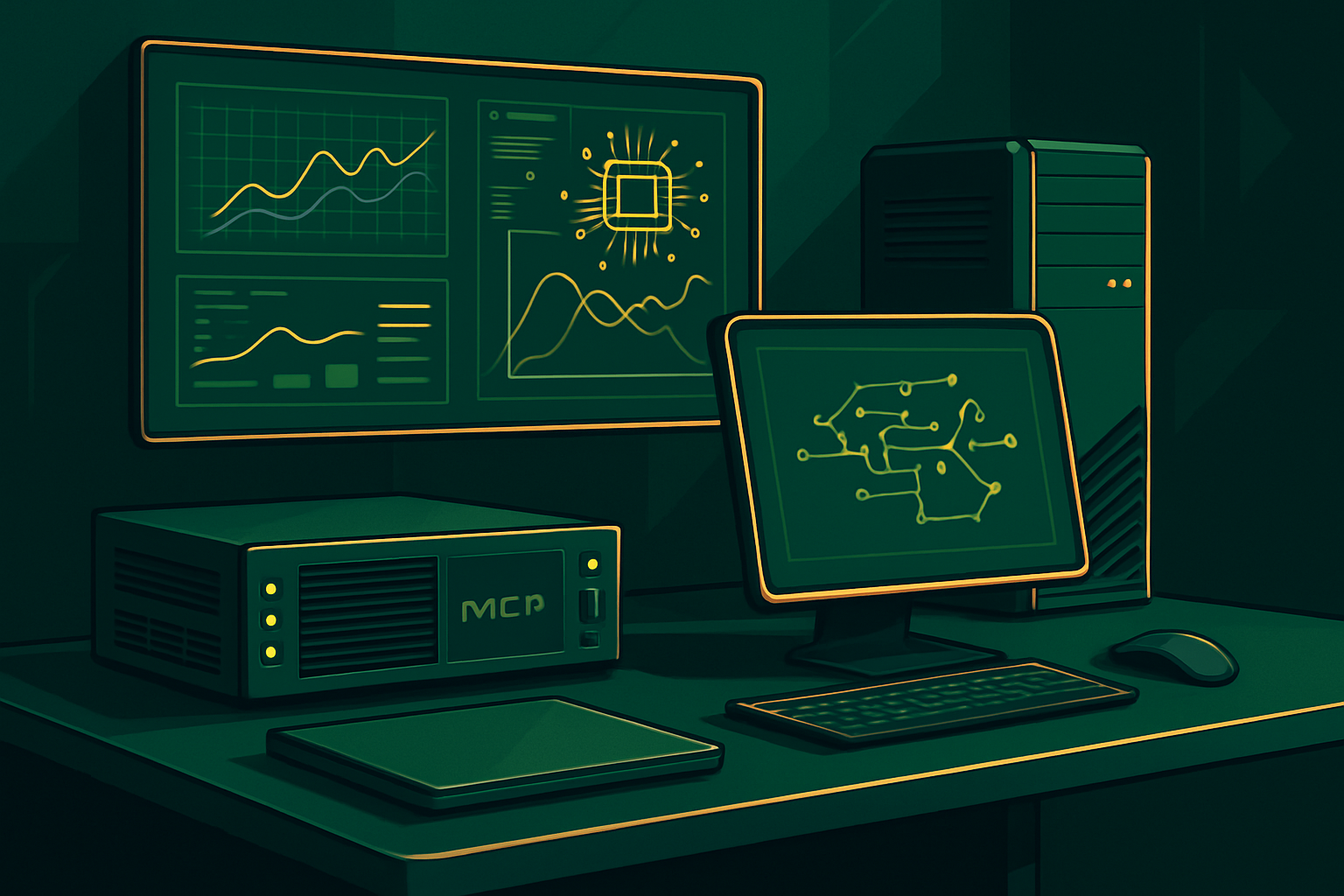
The MCP is to AI models what USB-C is to hardware: an open standard that allows any AI agent to connect to any data source or tool via a consistent interface. Instead of writing custom integrations, you set up an MCP server for your database, your Slack workspace, or your GitHub repository. Your agent connects to the MCP client and immediately understands the tools and context available to it.
This shifts the engineering effort from integration to governance. A well-configured MCP setup separates the runtime environment from the reasoning engine, moving credential management to the server side rather than embedding it in your agent's system prompt. The integration surface decreases, even though underlying security considerations require attention on the server side.
Local Inference and Small Language Models
You shouldn't be paying a cloud provider for tokens while writing unit tests. The modern workflow in AI engineering starts entirely offline.
As described in Introduction to Small Language Models: The Complete Guide for 2026, small language models (SLMs) have reached a quality threshold where models with fewer than 10 billion parameters consistently outperform the leading models of 2024 on targeted tasks. This shift makes local development not only cost-effective but truly productive.
The local stack:
-
Inference engine: Tools like Ollama or MLX (for Apple Silicon) allow you to run quantized models locally with a single command.
-
The workflow: Build your orchestration logic using a fast and current local generation model such as Qwen3, Gemma 3, or Phi. Debug your tool calls, refine your system prompts, and test your error handling with zero latency and zero cost.
-
The pivot: Since local inference engines now expose OpenAI-compatible API endpoints, moving to production requires changing only the base URL and API key. The rest of your code remains the same.
This last point deserves emphasis. Portability between local and cloud inference means you can move quickly during development and then switch to a production model without touching your orchestration code. But once you're ready to deploy, unmeasured iteration is just guesswork—that's why evaluation comes next.
The Evaluation Engine: CI/CD for Prompts
This is probably the most important addition to the 2026 toolkit, and it's also the one that teams most often overlook until something breaks in production.
As warned in 7 Important Considerations Before Deploying Agentic AI in Production, probabilistic outputs require statistical testing. You cannot validate an AI application by running a few manual queries and seeing if the response seems correct.
Modern AI engineering requires an evaluation framework—like Promptfoo, LangSmith, or Braintrust—integrated directly into your CI/CD pipeline.
When you change a system prompt or update an underlying model, the evaluation engine automatically runs a suite of tests containing hundreds of edge cases. As detailed in Agent Evaluation: How to Test and Measure Agentic AI Performance, this suite relies on grading "LLM-as-a-Judge": a secondary model capable of evaluating the agent's output against a strict rubric—for example, "Did the agent correctly use the tool refund_api without hallucinating a transaction ID?"
Setting a threshold like a 95% success rate as a gate is a good starting point, although the right threshold depends on your use case and risk tolerance. Prompt engineering is no longer an art; it is a measurable and version-controlled engineering discipline.
This discipline extends to the outputs produced by your agent. If you cannot trust that the outputs arrive in the form your downstream code expects, your evaluation pipeline has nothing reliable against which to test.
Application of Structured Output
We used to spend a lot of time instructing models: "Please return ONLY valid JSON. Do not include markdown formatting. Do not say 'Here is your JSON'." That era is over.
This is a solved problem. The 2026 toolkit relies on two complementary approaches, and it’s worth understanding the difference before choosing one.
-
Using Constrained Decoding: Libraries like Outlines and vLLM Guided Decoding intercept the model's generation process at the token level. By providing a Pydantic model as a schema, the generation engine restricts the model to produce only tokens that match your exact structure. If you specify an integer field, the model is prevented, at the sampling stage, from producing anything else.
-
Using Validation and Retry: Instructor works differently: it wraps the model's function call interface and validates the output against a Pydantic schema after generation. When the model's response fails validation, Instructor automatically retries with the added error context. This approach is slightly less strict than token-level enforcement but works with any OpenAI-compatible API without requiring a specialized inference backend.
Both approaches eliminate downstream parsing errors that could cause agent pipelines to fail. Choose constrained decoding when you have full control over the inference stack; choose Instructor when building against hosted APIs.
Advanced Development Workflows: Git Worktrees
The way we manage code has adapted to the reality of AI development. Experimentation is inherently messy: you often need to test a new prompting technique against a different model version while debugging a broken tool call in your main branch.
As covered in Git Worktrees for AI Development, relying on standard branch switching creates friction when running local models or maintaining large context files. Git Worktrees allow you to check out multiple branches of your repository in separate directories simultaneously. You can run an evaluation suite on your experimental agent branch in one terminal while fixing a bug in the main branch in another, without losing the state of your local model or your environment variables.
This is a small workflow change with a significant impact on the fluidity of your transition between experimentation and stabilization.
Conclusion
Looking at these six tools together, a pattern emerges: each of them addresses a specific source of friction that made early GenAI development painful, and each of them...
Brief IA — L'actualité IA en français
L'essentiel de l'actualité de l'intelligence artificielle, décrypté et expliqué chaque jour.