AI Engineers: Critical Questions on RAG Systems
The Challenges of AI Engineer Interviews
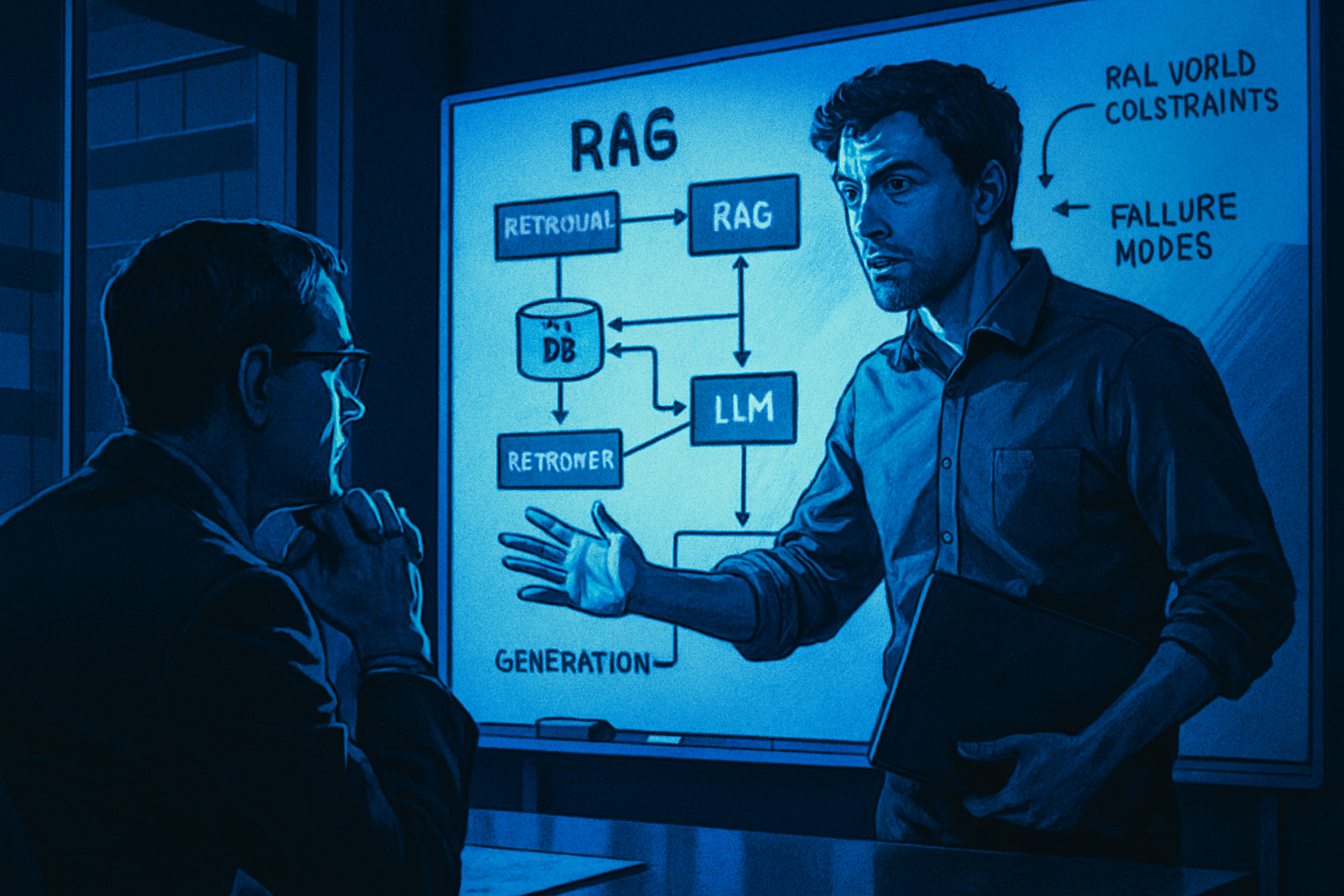
Last month, a friend attended an interview for a senior AI engineer position, armed with an impressive portfolio of RAG (Retrieval-Augmentation-Generation) projects and a Medium article-level understanding of agents. During the interview, he showcased his expertise by drawing an efficient retrieval pipeline on a whiteboard and confidently explained the concept of cosine similarity. However, when the interviewer posed an unexpected question about managing conflicting retrieved documents, his response of simply adjusting the prompt was insufficient, and he did not get the job.
Designing RAG Systems: A New Requirement
The article highlights that questions focused on RAG systems in interviews are no longer limited to theoretical knowledge. Recruiters now assess candidates' ability to make sound and defensible choices in the face of real constraints and failure modes. Engineers must demonstrate their capability to design robust and efficient systems.
Common Interview Questions
Seven frequently asked questions during interviews for AI engineer positions:
- Designing a complete RAG system: Candidates should be able to design an end-to-end RAG system, including a comprehensive evaluation.
Le brief IA que les pros lisent chaque soir
Les 7 actus IA du jour, décryptées en 5 min. Gratuit.
Inclus dès l'inscription : notre sélection des meilleurs guides & comparatifs IA.
Choisis ton rythme
Gratuit · Pas de spam · Désabonnement en 1 clic
-
Differentiating between RAG and agentic RAG: Understanding the differences and knowing how to manage routing based on complexity is crucial.
-
Creating a secure agent: Building an agent that adheres to strict and immutable security rules is essential.
-
Role of the orchestrator vs LLM: Clarifying the responsibilities between the orchestrator and the large language model (LLM) is a key skill.
-
Live debugging: Knowing how to separate retrieval and generation failures to debug hallucinations or infinite loops is indispensable.
-
Cost and latency management: Candidates must master techniques such as batching, caching, routing, context reduction, and avoiding unnecessary multi-agent overhead to control costs and latency.
-
Evaluating RAG/agents: It is important to assess systems before and after production, distinguishing between retrieval and generation metrics, as well as the success of agent tasks, tool accuracy, and step efficiency.
Preparation and Concrete Tools
Throughout the article, the importance of naming specific tools and metrics is emphasized. Candidates should be prepared to address failure cases with observable traces at each step. Rather than relying on theoretical definitions or prompt adjustments, it is crucial to prepare with real projects and solid evaluation foundations.
Brief IA — L'actualité IA en français
L'essentiel de l'actualité de l'intelligence artificielle, décrypté et expliqué chaque jour.