Instagram: AI Revolutionizes Engagement Without Replacing Humans
Le brief IA que les pros lisent chaque soir
Les 7 actus IA du jour, décryptées en 5 min. Gratuit.
Inclus dès l'inscription : notre sélection des meilleurs guides & comparatifs IA.
Choisis ton rythme
Gratuit · Pas de spam · Désabonnement en 1 clic
The Impact of AI on Instagram Content
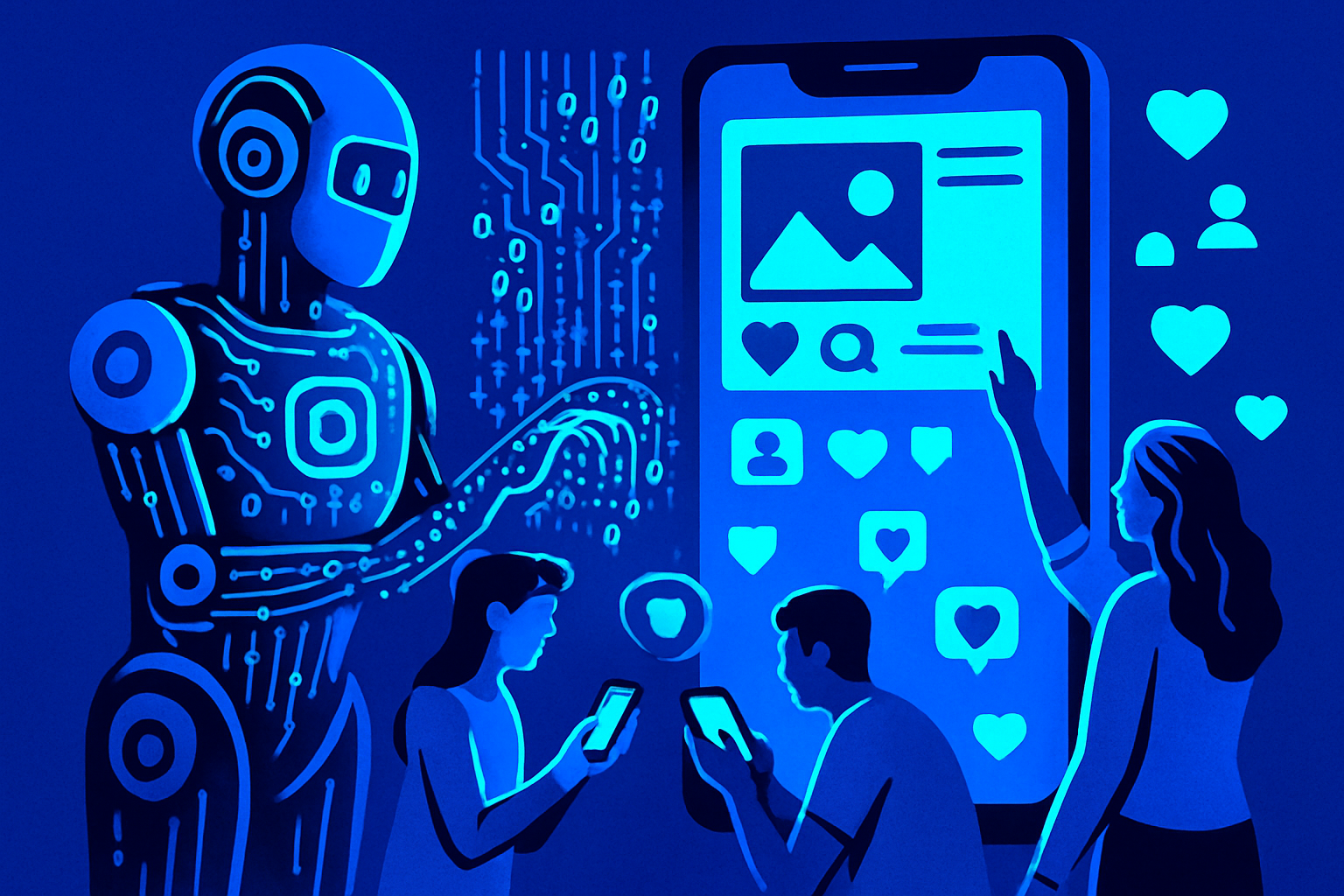
Every element you see on Instagram, whether it's a post, a Reel, or a suggestion on the Explore page, is now orchestrated by an artificial intelligence system. With a user base exceeding three billion, this is not just a technical detail, but the very core of the platform's algorithm.
However, a crucial aspect emerges: while AI controls the distribution of content, it favors what appears authentically human. According to Adam Mosseri, the head of Instagram, the platform highlights "content created by real humans" rather than that generated by machines. The question then arises: does AI replace the human element or preserve it?
The truth is that neither is entirely correct. AI has taken over the mechanisms of engagement, but humans retain the meaning and depth of these interactions.
The Role of AI in Engagement on Instagram
AI plays a central role in deciding the content displayed on Instagram. However, it is human interactions that determine the success and growth of this content. By 2026, the engagement rate on Instagram is estimated to be only 0.7%, making each interaction more valuable than ever.
Instagram does not operate with a single algorithm. Each feature, whether it’s the feed, Reels, Stories, or the Explore page, has its own algorithm. These systems predict what each user will enjoy based on their past behaviors. Thus, two people can open Instagram simultaneously and see completely different content.
The Signals That Influence Reach and Engagement
Three main signals influence reach and engagement on Instagram: watch time, likes per reach, and shares per reach. When a user shares a post with a friend, it generates trust points. While an algorithm can predict your preferences, it cannot simulate the genuine interest of a person choosing to share content.
The initial interaction with a post or a Reel is also crucial. A Reel that quickly captures attention within the first 30 minutes after its publication is more likely to go viral than one that grows slowly over several days. This "engagement speed" is a key indicator for the algorithm, which favors immediate and authentic reactions.
With the evolution of AI, Instagram is becoming increasingly effective at detecting fraudulent behaviors. Fake followers, automated comments, and coordinated engagement groups are identified and penalized. The algorithm that personalizes your experience is also a powerful tool against artificial engagement practices.
Task Automation on Instagram
Thanks to the integration of AI, users can now spend more time on strategy, growth, and creativity, rather than on repetitive tasks. In the past, building a presence on Instagram required writing captions, resizing images, planning video variations, and scheduling Reels at opportune times—time-consuming tasks.
Today, AI-based automation tools accomplish these tasks in just a few minutes. Brands can use AI to write captions, generate visuals in line with their branding, adapt a video to multiple formats, and even predict which audience segment will respond best to a post.
This automation allows creators to focus on aspects that require a human touch: strategy, voice, storytelling, and judgment calls. However, there is a limit to this automation. Instagram suspends accounts that repost content too frequently. Automation can speed up production, but it cannot replace human thought, and Instagram's AI system is designed to detect this difference.
AI and Customer Communication on Instagram
AI chatbots handle the initial response to direct messages, but complex or sensitive conversations are still entrusted to a real person.
Direct messages have become one of the most active communication channels on Instagram. Instead of sending emails, users prefer to send DMs to businesses, expecting a quick response. A study from Harvard Business School found that AI chatbots enabled human agents to respond about 20% faster to customer DMs.
This increased efficiency helps businesses interact more effectively with their customers. There are two types of chatbots:
- Rule-based bots, which trigger a predefined response when certain keywords are detected, such as "order status" or "size chart."
- AI agents, which genuinely understand customer requests, hold natural conversations, and respond to unusual questions using brand information.
Over time, more advanced AI agents can handle almost all customer requests, whether it's checking an order status, issuing a refund, or resolving a dispute, all using real-time data. This was previously the domain of a support team with high-level communication skills, but it can now be done at any time, in any time zone.
This integration of AI helps Instagram position itself as a preferred marketplace for customers, beyond just a social media app. However, every serious version of these chatbots includes an essential feature: the transfer to a human. When the conversation becomes complex, emotional, or critical, the AI hands off to a real person. This transfer is not a weakness but a protection of human rights. No company should use AI as a one-size-fits-all solution.
Future Perspectives
AI will continue to expand its influence in production and support, while Instagram will strengthen its rules on what is considered authentic.
The integration of AI into production and support systems is already well underway. At the same time, Instagram's algorithm focuses on promoting authentic content.
Some trends are already emerging:
- DM automation is not limited to answering questions. True customer service resolves issues. Thus, more advanced AI systems help businesses connect directly to what matters to them.
- An increased emphasis on authentic content. Instagram's commitment to "real" content is not just a statement. Expect more filters, detection systems, and penalties for accounts that rely excessively on AI.
The key skill will be knowing how to manage this correctly. As more brands use AI for captions, responses, and content, the real difference will lie in the effective management of these tools.
In summary, tools are constantly improving. The brands that succeed will not just be those that use them, but those that use them well, adapting the tone to their voice and brand values.
Ultimately, brands that understand the system will use one to protect the other. AI has not removed the human touch from Instagram; rather, it helps humans manage work more efficiently.
AI now manages ranking systems, produces multiple drafts, and answers basic questions, while humans step in during moments that truly build trust. This combination: AI for scale and humans for meaning is exactly what Instagram's algorithm is designed to reward in 2026.
Brief IA — L'actualité IA en français
L'essentiel de l'actualité de l'intelligence artificielle, décrypté et expliqué chaque jour.