Integrating AI into Business Software Without Replacing It
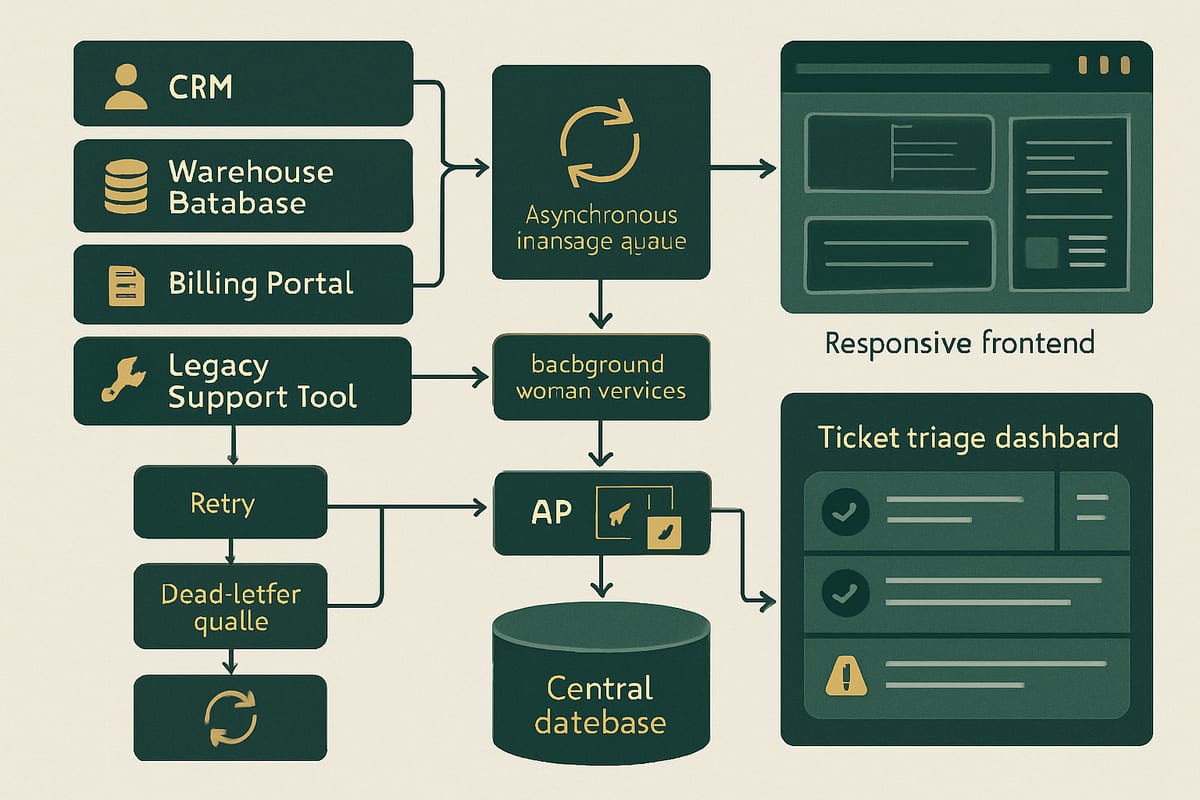
Rather than developing custom models or rewriting their tools, many teams can integrate AI into their existing systems. A precise operational approach outlines eligibility conditions, preferred architecture, and pitfalls to avoid, from controlling token costs to disaster recovery plans in case of API failures.
Securing Usage: Limits, Failures, Costs, and Recurring Pitfalls
Limiting computational footprint and costs involves sanitizing and truncating inputs to contain token usage. The fallibility of models necessitates trust checks and human intervention when needed. API downtimes are managed with retries and dead-letter queues. Common pitfalls include using chatbots where simple buttons would suffice, exposing credentials, and over-engineering through overly heavy frameworks. It is also advisable to avoid these integrations for tasks requiring deterministic precision or when no usable API is available.
Le brief IA que les pros lisent chaque soir
Les 7 actus IA du jour, décryptées en 5 min. Gratuit.
Inclus dès l'inscription : notre sélection des meilleurs guides & comparatifs IA.
Choisissez votre rythme
Gratuit · Pas de spam · Désabonnement en 1 clic
Recommended Architecture: Asynchronous, Strict Validation, and Responsive Frontend
A production-ready architecture favors an asynchronous queue model over blocking HTTP requests. Raw inputs are first stored and then enriched by background workers via LLM APIs configured to return strictly structured output. The produced JSON is validated before any use. Database updates occur without degrading the responsiveness of the frontend.
When AI Integration Makes Sense, and How to Position It
Most SMEs do not need custom neural networks or to rewrite their tools: they already have CRMs, data warehouses, billing portals, or legacy support systems. In this context, adding AI capabilities to existing systems is often preferred. Concrete cases include ticket triage, with categorization as urgent feedback, routing by department, summaries, and indicators for human review. Integrations are particularly justified in the face of high volumes of unstructured text, repetitive data entry performed by staff, and the presence of clear relational schemas. To gain buy-in, the work is framed in terms of workflow automation and measurable operational value.
Brief IA — L'actualité IA en français
L'essentiel de l'actualité de l'intelligence artificielle, décrypté et expliqué chaque jour.