Jensen Huang: AI Will Create Jobs Instead of Destroying Them
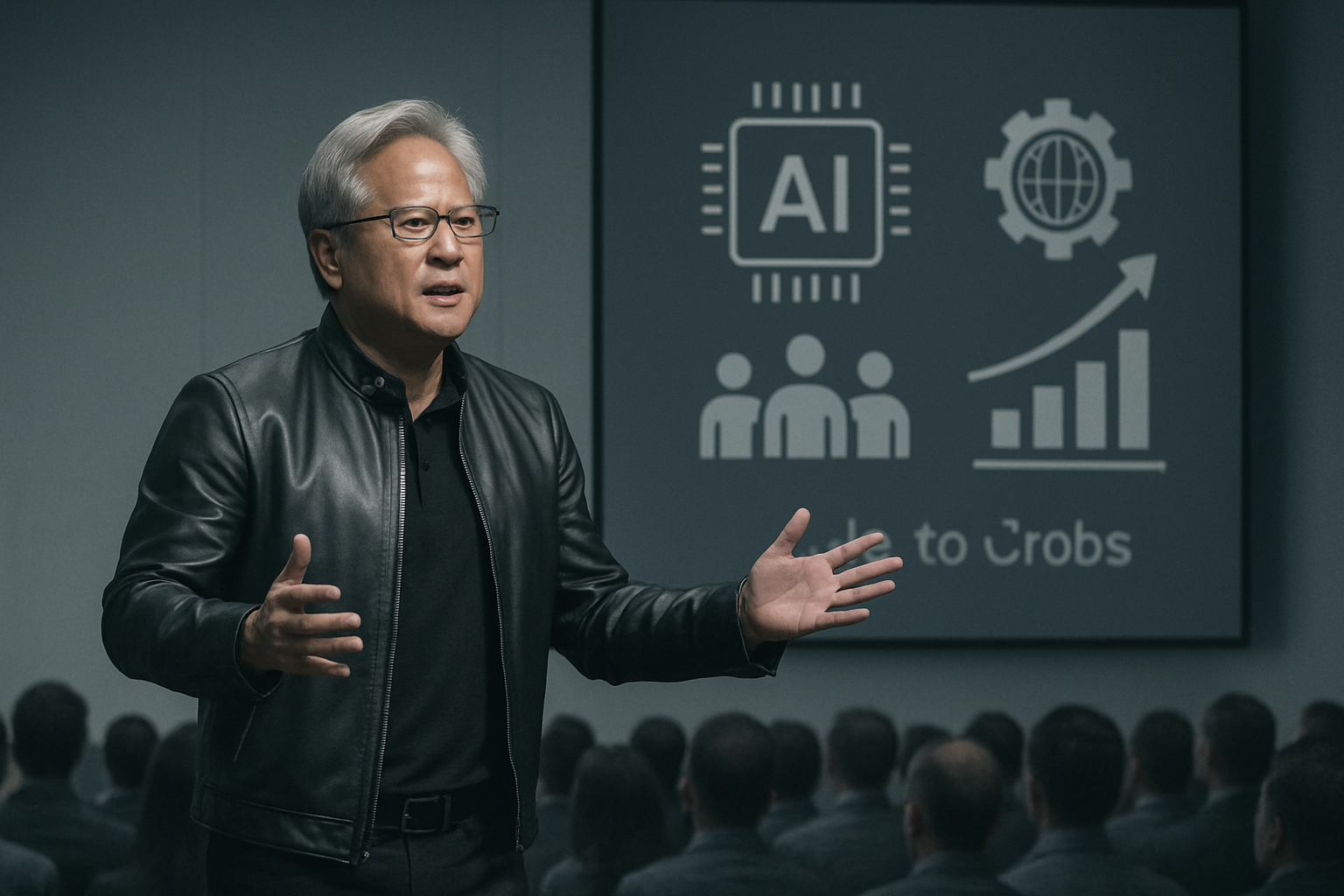
Jensen Huang Defends the Positive Impact of AI on Employment
Jensen Huang, the CEO of Nvidia, recently spoke out to defend an optimistic view of the impact of artificial intelligence on the job market. According to him, far from destroying jobs, AI is poised to generate a multitude of new professional opportunities. Huang clarified that while AI has the potential to automate certain "tasks," it will not eliminate jobs as a whole. He stated that the perception that AI destroys jobs is "exactly the opposite."
Transforming but Growing Sectors
Huang illustrated his point by mentioning several sectors, including radiology, law, and software engineering. These industries, although disrupted by AI, continue to grow. The Nvidia CEO does not share the fears of a "massacre of white-collar jobs" often mentioned. During Y Combinator's Startup School, he emphasized the distinction between "tasks" and "jobs," highlighting that AI could eliminate the former without affecting the latter. "Every job is going to change, and there will be a multitude of new jobs," he stated.
Task Automation: A Concrete Example
To illustrate his viewpoint, Huang provided the example of certain specific tasks. For instance, workers who make phone calls, receive complaints, and respond using information from databases. According to him, these tasks are likely to be automated. The customer service sector is particularly sensitive to this disruption. Recently, Uber laid off 10% of its employees in this area, citing the impact of AI as the main reason.
The Distinction Between Tasks and Jobs
Huang emphasized that tasks are not synonymous with jobs. "A person's work has a purpose, and that purpose involves many tasks," he explained. Taking radiologists as an example, he noted that if the reading of radiological scans is automated, it does not mean that radiologists no longer read these scans. In fact, jobs in radiology continue to grow, as the number of patients waiting is high. "Doctors and hospitals can now admit many more patients," he added.
Le brief IA que les pros lisent chaque soir
Les 7 actus IA du jour, décryptées en 5 min. Gratuit.
Inclus dès l'inscription : notre sélection des meilleurs guides & comparatifs IA.
Choisissez votre rythme
Gratuit · Pas de spam · Désabonnement en 1 clic
Software Engineering and the Impact of AI
Software engineering is another field radically transformed by AI. Many developers have evolved from writing code to using AI code editors like Claude Code and Codex. Here, coding is the automated "task," but jobs in software engineering continue to increase. "The number of ideas, ambitions, and aspirations is so high," Huang emphasized. "If we can automate the task of programming, we could hire more software engineers to accomplish more."
The Example of the Legal Startup Harvey
Huang also mentioned the legal startup Harvey, which raises concerns about the potential elimination of paralegal jobs. However, he noted that this role is actually experiencing significant growth. This expansion is not without ambiguity, as the Bureau of Labor Statistics forecasts "little or no change" for this role between 2024 and 2034.
A Vision in Contrast with Other Experts
This optimistic perspective contrasts with that of Dario Amodei, CEO of Anthropic, who had predicted that by 2025, AI could eliminate 50% of entry-level white-collar jobs. Although Amodei has since revised his opinion, stating that AI will enhance productivity, he still believes that job loss could be "intrinsic" to AI. Huang, however, remains convinced that increased productivity will lead to economic growth, thereby generating more jobs. "It's a classic example of productivity increase leading to growth," he stated. "Increased growth generates more jobs."
Brief IA — L'actualité IA en français
L'essentiel de l'actualité de l'intelligence artificielle, décrypté et expliqué chaque jour.