JEPA-Anything Expands LeCun's JEPA from Physics to the Liver
Le brief IA que les pros lisent chaque soir
Les 7 actus IA du jour, décryptées en 5 min. Gratuit.
Inclus dès l'inscription : notre sélection des meilleurs guides & comparatifs IA.
Choisis ton rythme
Gratuit · Pas de spam · Désabonnement en 1 clic
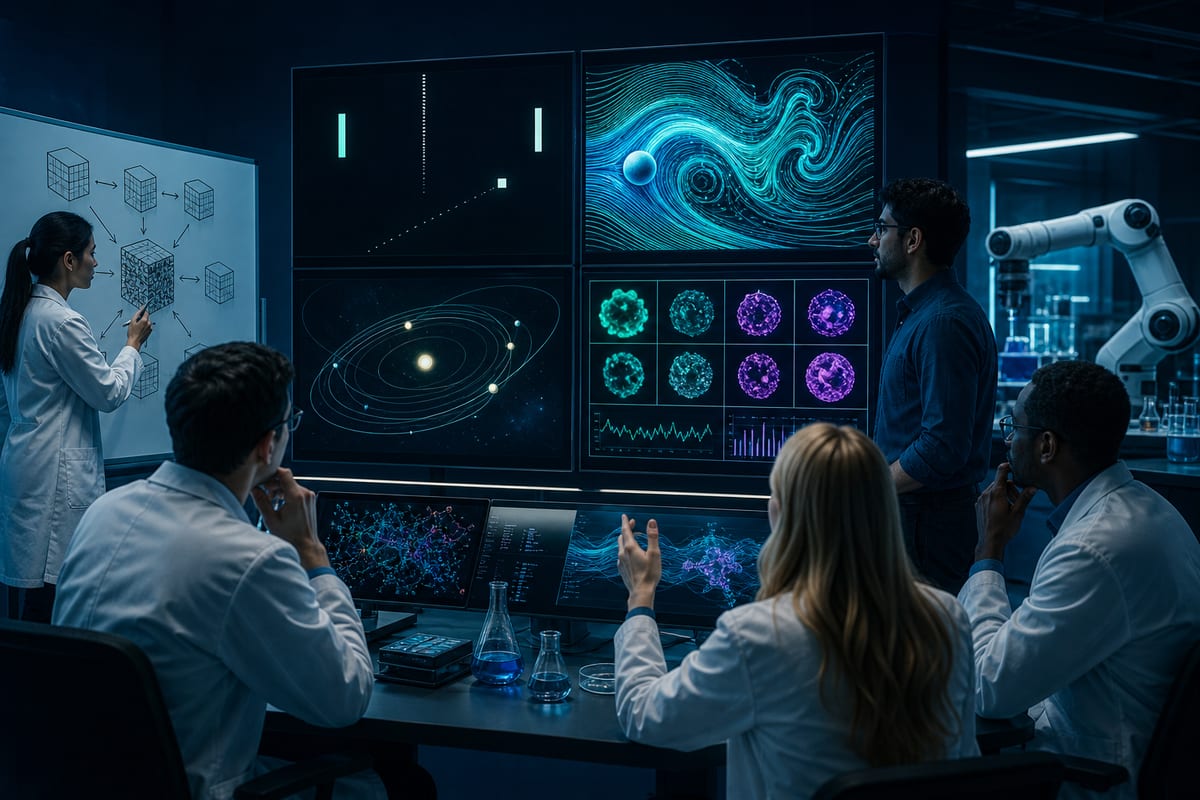
PhAI Labs and researchers from Stanford, Oxford, and Princeton present JEPA-Anything, a modular variant of JEPA tested across seven domains. The model shows gains in physical dynamics, suggests a therapeutic combination against liver cancer, and comes with public code, while raising concerns about causality and reliability for guiding experiments.
Reliability Still Open, Public Code, and Focus on Experimental Agents
It remains to be determined when this type of model becomes sufficiently reliable to guide the design of experiments. They also clarify that a clear separation of learned components does not guarantee that they reflect true causal relationships. Their long-term goal is to enable AI agents to propose and classify experiments using JEPA-Anything, and then integrate the results to improve the model. The code and models are publicly accessible. Meanwhile, Google DeepMind already has Co-Scientist, a multi-agent system that plans experiments and operates laboratory equipment, although sample loading remains manual. In October 2025, Google DeepMind also tested an AI-generated cancer hypothesis with its C2S-Scale 27B model based on Gemma: the proposal around silmitasertib was confirmed in human cell models.
Biology: An IL-18 and CD73 Blocking Combination Tested Up to Mice
In the biomedical sector, scientists have relied on partial predictions derived from sources such as gene expression, protein quantities, and CRISPR screening results. The most promising candidate combined IL-18, a molecule that stimulates immune cell activity, with an inhibition of the enzyme CD73, which tumors use to block nearby immune responses. This combination was evaluated on liver cancer cells cultured with immune cells, on organoids, and on tumor tissues from three patients, as well as in mice. In organoids and tissues, this duo destroyed more tumor cells than either component alone, while increasing the activation of T cells and natural killer cells. The authors note that the study does not allow for conclusions about therapeutic application.
Physical Dynamics: Measured Gains from Pong to the Burgers Equation
JEPA-Anything was compared with a standard JEPA version featuring the same architecture, trained on an identical dataset and under equivalent conditions. In a simplified version of the Pong game including targeted interventions, the reduction in prediction error reached 35%, and 13% for combinations of interventions that had not been seen during training. The model outperformed the baseline in ten tasks covering physics, robotics, and weather forecasting. On the Burgers equation, a separate evaluation showed an error reduction of nearly half. This benefit persists over 50 prediction steps but drops to about 3%. The method also shows the best performance in simulations involving water, quartz, acetaminophen, and benzene, including after 100 steps. The most significant progress concerns equations describing physical flows, while the difference with the standard JEPA remains minimal for pixel dynamics.
Principle: Predict in Parts, Then Recompose a Global State
The JEPA method does not aim to faithfully reproduce the original data but to anticipate a synthetic representation of an absent or future state, excluding elements considered ancillary. The use of a single prediction channel favors the detection of simple patterns at the expense of more elaborate structures. JEPA-Anything addresses this limitation by factoring the prediction: the upcoming state is divided into parts processed by distinct predictors, each encouraged to capture a different aspect, before recomposing into a global state. In this variant, the state is explicitly divided into four orthogonal factors. This factorization aims to reveal regularities that standard approaches may miss.
Multi-Domain Ambition: Seven Target Spaces and a Common Principle
The team has extended the JEPA architecture to operate across seven very different domains, seeking to demonstrate that a single principle can apply from physics to medicine and robotics. Universal models aim to predict the evolution of varied systems, while current practices still rely on discipline-specific models. The project, led by PhAI Labs with Stanford, Oxford, and Princeton, is based on Joint-Embedding Predictive Architectures. In a separate exercise, the model, trained on simulated orbits without providing physical quantities, learned a pattern corresponding almost exactly to Kepler's third law: a power relationship close to -1.5, estimated here at -1.4991. The researchers clarify that they evaluated only a single training run and retained the one with the lowest error.
JEPA Lineage: From 2022 to V-JEPA 2, LeJEPA, and AMI Labs
Launched in 2022 by Yann LeCun as an alternative to generative models, the JEPA lineage has seen several significant developments. In June 2025, Meta unveiled V-JEPA 2, a video model with 1.2 billion parameters, capable of controlling robotic arms in novel environments without additional learning. In November 2025, Yann LeCun and Randall Balestriero introduced LeJEPA, a theoretical foundation designed to maintain learning stability without resorting to classical methods. Yann LeCun continues this approach with AMI Labs, which raised over a billion dollars in March 2026 to develop global models.
Brief IA — L'actualité IA en français
L'essentiel de l'actualité de l'intelligence artificielle, décrypté et expliqué chaque jour.