Jev from TypeSafe AI Makes Quick Decisions with Calibrated Confidence
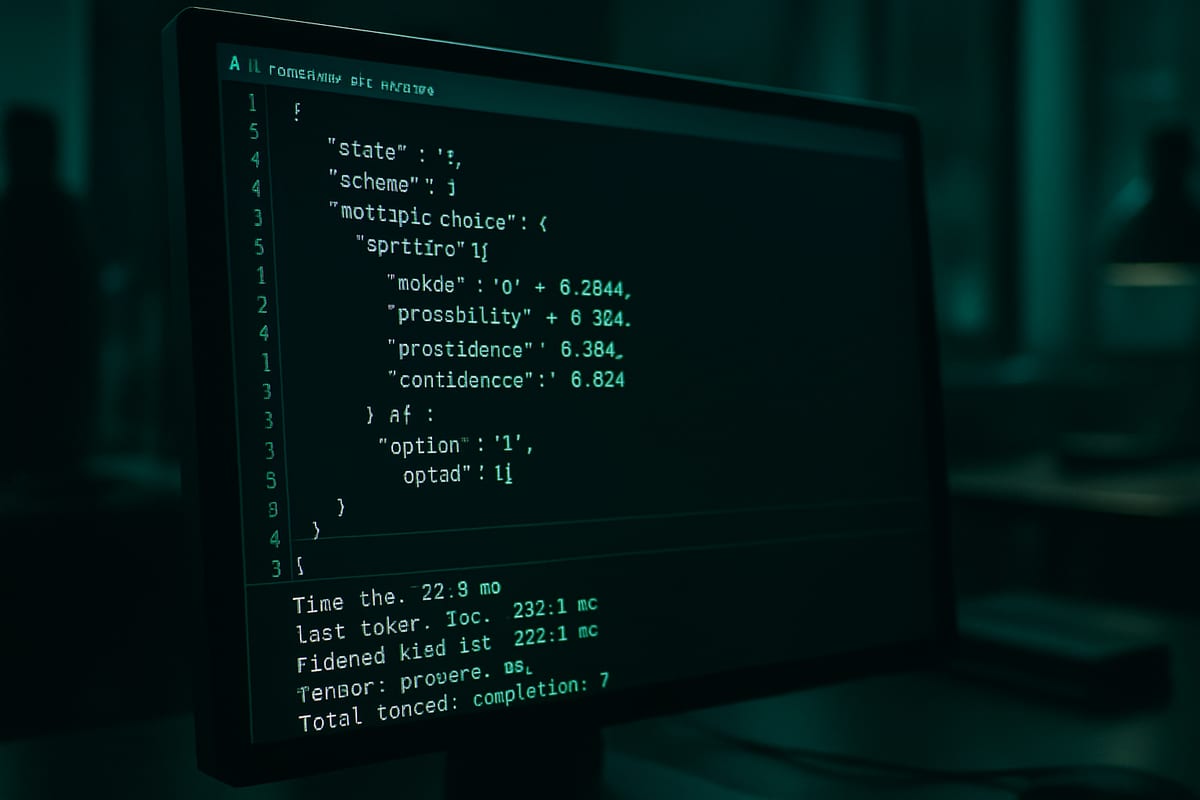
TypeSafe AI has launched Jev, a "System One" model that makes decisions among defined options and provides probabilities. External tests report good calibration of its confidence and latency gains in certain cases, but emphasize the crucial importance of the response schema. The model is also distinguished by its billing limited to input tokens.
Measured Confidence and Design Pitfalls Revealed by Tests
A Japanese benchmark dated September 18, 2026, reports that four chat models displayed a confidence error ranging from 0.078 to 0.163 on a scale of 0 to 1, while Jev was between 0.002 and 0.047. These measurements pertain to calibration, meaning the gap between the stated confidence and the actual frequency of correct answers. Another signal comes from a PriorBench case where 30 messages did not match any expected category: in the absence of an explicit option to indicate this, Jev still selected a category each time, with a confidence of at least 0.99. This result serves as a reminder that a model can perfectly adhere to the expected format while making a poor decision if the proposed choices are incomplete. It follows that a schema must offer a non-matching output when no category fits, and that comparisons from specific benchmarks should not be generalized without caution.
A Mechanism Opposed to the Autoregressive Decoding of LLMs
Conversational models generate their responses token by token using autoregressive decoding. In contrast, according to TypeSafe, Jev does not employ this generation loop: it evaluates all allowed choices in a single pass and simultaneously returns their probabilities. For tasks where possible answers are known in advance, this approach eliminates sequential generation and, once the input is read, results in a direct evaluation of a fixed set of options.
Le brief IA que les pros lisent chaque soir
Les 7 actus IA du jour, décryptées en 5 min. Gratuit.
Inclus dès l'inscription : notre sélection des meilleurs guides & comparatifs IA.
Choisissez votre rythme
Gratuit · Pas de spam · Désabonnement en 1 clic
Closed Questions, Constrained Schema, and Options Up to 255
Jev behaves like a multiple-choice system: it is provided with context, a question, and a list of allowed answers. The model then provides a selection, the corresponding probability for each possibility, and a confidence level. In the API, the transmitted context is referred to as the state, and each question relies on a schema that specifies what constitutes a valid answer. For a closed question, up to 255 options can be specified, with the model constrained to remain within this structure and exclude any option not provided for by the schema.
Intellectual Origins and Place in the Ecosystem
The vocabulary of "System 1" and "System 2" comes from the work of Daniel Kahneman, with the former designating quick and intuitive judgments and the latter a slower and more deliberate reflection. The name Jev refers to William Stanley Jevons, who formulated in 1865 the idea that became known as the Jevons Paradox regarding efficiency and consumption. Technically, BERT-type classifiers have categorized texts for years, with labels generally fixed during training, while LLMs have brought flexibility through JSON output and constrained decoding. "System One" models seek a middle ground with flexible prompts and predefined outputs. An open model, Laya, explored a similar idea in 2025. After two years of private development, TypeSafe AI launched Jev in September 2026. In the days that followed, independent benchmarks emerged, providing early signals on areas of efficiency and the task dependency of results.
Reported Costs and Performance, Depending on Contexts
TypeSafe AI charges only for the input tokens for Jev, at a rate of $0.042 per million, with no associated cost for output tokens. On the performance side, a PriorBench test on 400 items credited Jev with 95.9% accuracy compared to 77.2% for keyword-based rules. A test published by Dan Shipper reported an average of 0.35 seconds per verification for Jev, compared to 8.83 seconds for Fable 5.1 at high effort. However, these results depend on the context, with latency varying based on input length, hardware, network, and model parameters. Jev must read the entire input anyway, making long documents more costly and slower than brief messages. The major difference then lies in Jev returning a probabilistic choice among defined answers rather than generating text.
Brief IA — L'actualité IA en français
L'essentiel de l'actualité de l'intelligence artificielle, décrypté et expliqué chaque jour.