John Nosta: Does AI Threaten Radical Creativity?
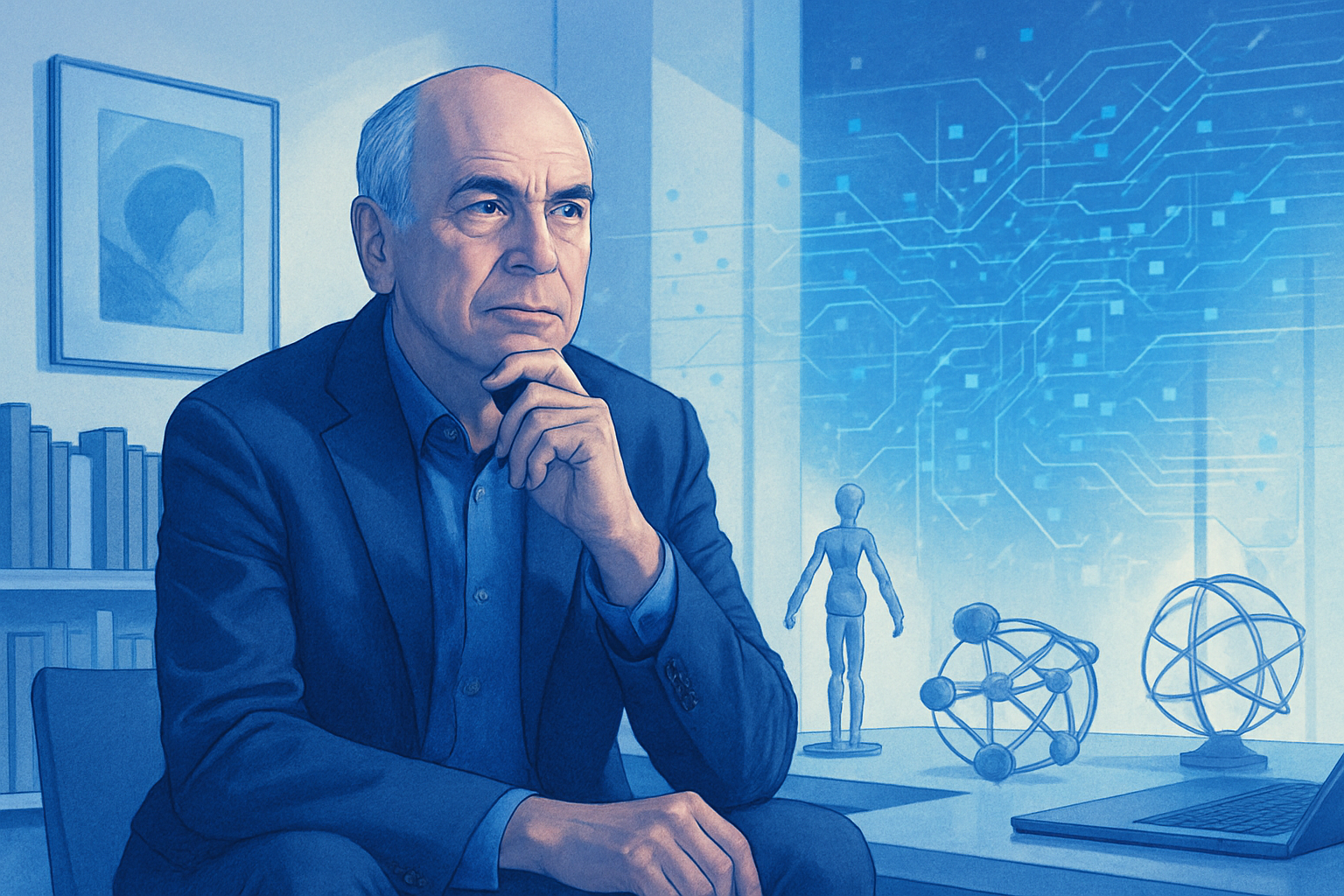
John Nosta's Warning on the Impact of AI on Innovation
John Nosta, a prominent innovation theorist, has recently voiced his concerns about the growing influence of artificial intelligence on creative thinking. According to him, this technology could gradually eradicate original thought, which has historically driven major scientific and artistic advancements. Nosta, who founded NostaLab, cites iconic figures such as Albert Einstein, Isaac Newton, and Pablo Picasso as examples of unconventional thinkers whose ideas changed the world.
Nosta explains that the computational capabilities of AI tend to eliminate these creative anomalies. While AI has become extremely effective at generating coherent texts, answering complex questions, and producing ideas at record speed, he worries that this efficiency could stifle original thought—the kind that has historically enabled humanity's most significant discoveries.
The Bell Curve of Human Thought
To illustrate his point, Nosta compares the distribution of human thought to a bell curve. The majority of individuals fall in the center of this curve, while those responsible for major innovations are found at the extremes, which he refers to as the "tails." He argues that training large language models on recursive data—data generated by the AI itself—alters this curve. He claims that we are losing these extremes, leading to a mediocre uniformity.
Nosta shared these reflections during an interview with Business Insider, emphasizing that the loss of these "tails" means we are heading toward intellectual homogeneity, where originality is diluted in a mass of mediocrity.
Le brief IA que les pros lisent chaque soir
Les 7 actus IA du jour, décryptées en 5 min. Gratuit.
Inclus dès l'inscription : notre sélection des meilleurs guides & comparatifs IA.
Choisissez votre rythme
Gratuit · Pas de spam · Désabonnement en 1 clic
The Importance of Anomalies for Innovation
Nosta insists that innovation depends on those individuals who dare to think differently. He questions the place of strange ideas and people capable of seeing what others do not. According to him, AI systems, by favoring consensus, make it more difficult for unconventional thoughts to emerge.
He does not believe that AI will completely eliminate creativity, but he fears it will make originality rarer by encouraging people to adopt similar thought patterns. For Nosta, society needs these anomalies to progress.
Contrasting Perspectives on the Impact of AI
The evidence regarding AI's impact on creativity is currently mixed. Some studies suggest that excessive reliance on AI can steer users toward more conventional ideas, while others show that technology can stimulate creativity when used to explore new possibilities.
Chris Best, CEO of Substack, expressed the idea that AI could flood the Internet with mediocre content, but it could also provide new creative opportunities for independent creators. Jill Kramer from Mastercard views AI as a driver for human creativity, helping to generate insights and broaden research that fuels new ideas.
AI as a Partner in the Creative Process
For Nosta, the solution is not to reject AI but to use it as a partner in an iterative intelligence process. This approach, supported by AI researchers like Vivienne Ming, encourages the use of AI to challenge and enrich human thought rather than replace it.
Ming stated that AI is most valuable when used to create "productive friction," prompting people to rethink their ideas. Nosta emphasizes the importance of preserving originality by maintaining human habits that AI cannot replicate, such as curiosity and the willingness to think differently.
He concludes by asserting that the true treasure of innovation lies in these "tails" of the bell curve, where the boldest and most original ideas can be found.
Brief IA — L'actualité IA en français
L'essentiel de l'actualité de l'intelligence artificielle, décrypté et expliqué chaque jour.