MIT: An AI Controls Your Muscles to Play Piano Without Learning
Le brief IA que les pros lisent chaque soir
Les 7 actus IA du jour, décryptées en 5 min. Gratuit.
Inclus dès l'inscription : notre sélection des meilleurs guides & comparatifs IA.
Choisis ton rythme
Gratuit · Pas de spam · Désabonnement en 1 clic
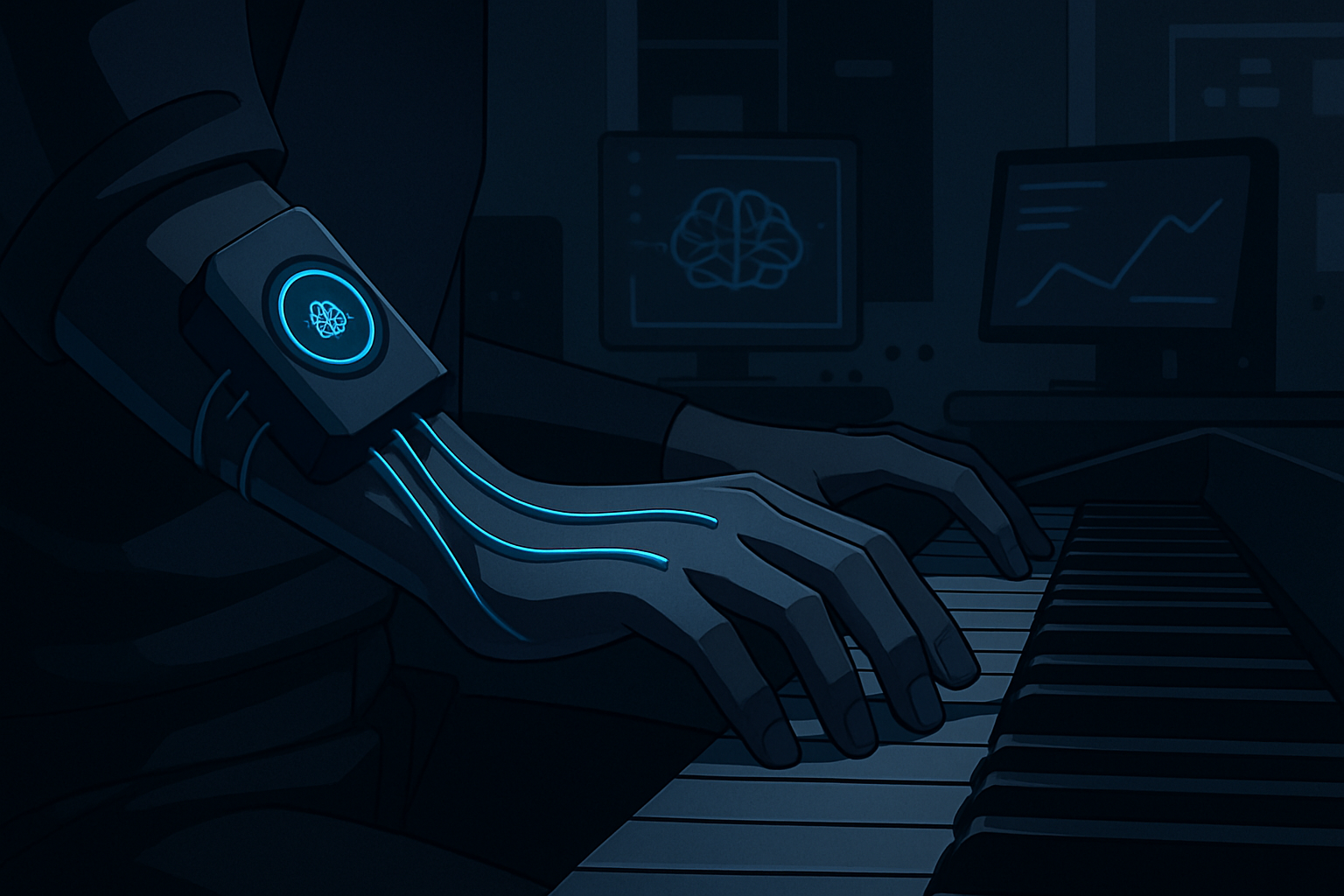
The MIT Media Lab has unveiled a revolutionary prototype named Human Operator, which allows users to play the piano without any prior knowledge. This device utilizes multimodal artificial intelligence coupled with electrical muscle stimulation (EMS) to directly activate the user's hand muscles.
Designed in just 48 hours during the Hard Mode 2026 hackathon, Human Operator won the Learn Track category. This project, presented as a tool for "human augmentation," aims to accelerate the learning of technical gestures by enabling users to feel the correct movement. However, it is currently limited to a few simple gestures, with no evidence of sustainable learning or effectiveness in rehabilitation.
How does Human Operator work?
Human Operator acts as a "physical assistant" with the ability to see and hear. The user wears a device that integrates a small camera and a microphone, capturing what the user sees and says. The system focuses on the hand and forearm, guiding precise movements of the fingers and wrist.
The image and voice command are sent to a multimodal AI, capable of simultaneously processing text, sound, and images. This AI analyzes the scene, interprets the request, and generates a "motor program" describing the action to be performed. This program is then converted into electrical signals by an Arduino microcontroller. EMS electrodes placed on the forearm and hand send brief impulses, triggering the contraction of the relevant muscles.
Applications and limitations
The MIT team envisions several potential applications for Human Operator:
-
Accelerated learning: Users could directly feel the correct movement, such as finger positioning on a piano or surgical gestures.
-
Motor rehabilitation: A similar technology could guide patients by adjusting muscle stimulations during rehabilitation exercises.
-
Accessibility: Ultimately, this system could assist individuals with motor difficulties in executing precise gestures.
However, these applications remain theoretical for now. Current demonstrations are limited to a few simple gestures performed over short durations in an experimental setting. Nevertheless, Human Operator illustrates a significant advancement in human-machine interfaces, where AI not only assists but directly triggers movement by acting on the muscles.
Brief IA — L'actualité IA en français
L'essentiel de l'actualité de l'intelligence artificielle, décrypté et expliqué chaque jour.