Kimi K3 from Moonshot AI: China Challenges AI Giants
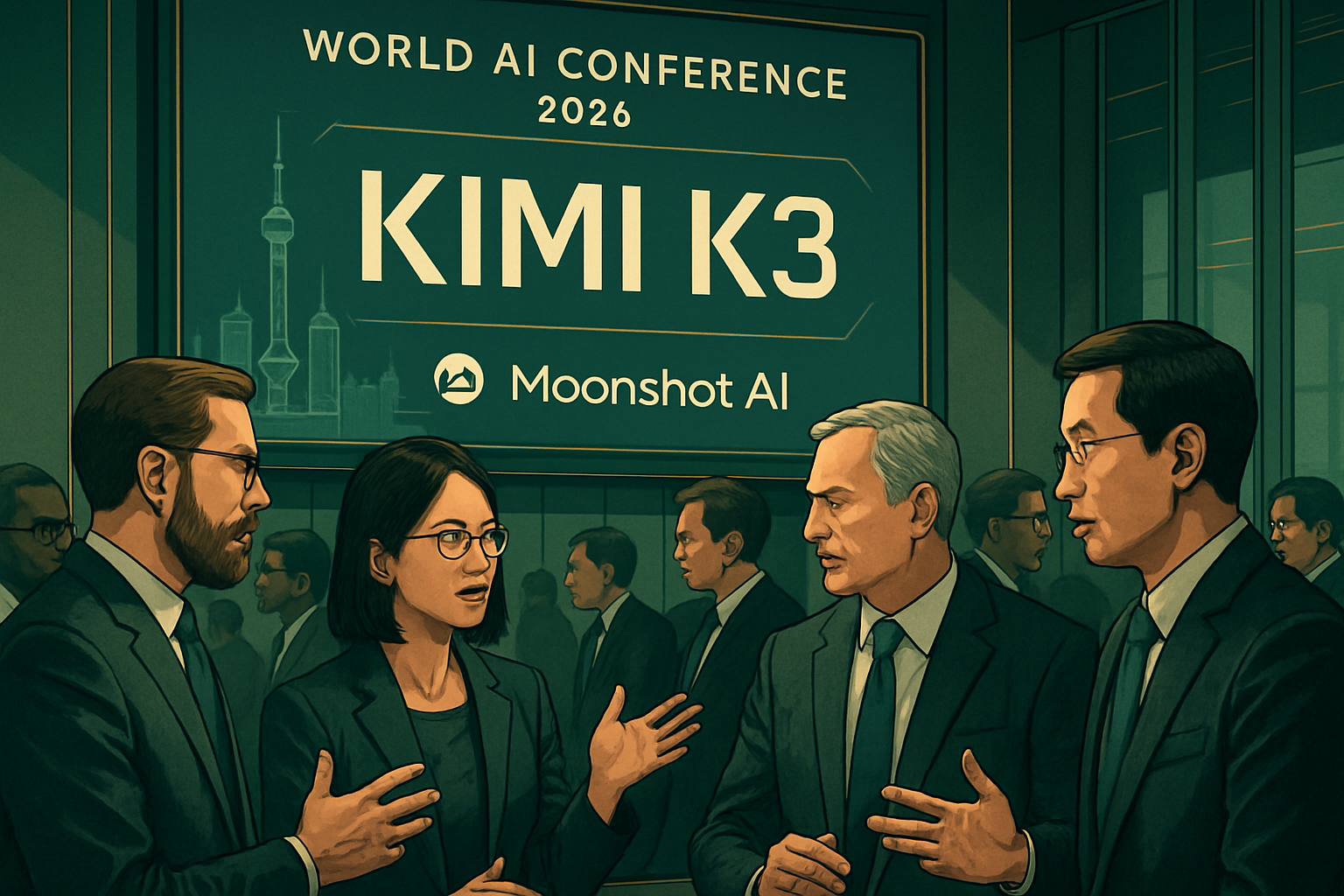
Moonshot AI and the Launch of Kimi K3
The Chinese startup Moonshot AI recently unveiled Kimi K3, an artificial intelligence model that is making waves in the tech sector. Kimi K3 is touted as the largest open-weight AI system globally. Although Moonshot admits that their model does not yet compete with the most powerful proprietary systems like Claude Fable 5 from Anthropic or GPT-5.6 Sol from OpenAI, it nonetheless outperforms second-tier models like Claude Opus 4.8 and GPT-5.5 in performance tests, including programming and agent tasks.
In less than 24 hours after its launch, Kimi K3 topped the frontend programming leaderboard on Arena, surpassing all major American models. It also climbed to third place on the Intelligence Index from Artificial Analysis. This launch, coinciding with the 2026 Global AI Conference in Shanghai, illustrates how Chinese labs are rapidly closing the gap with leading American systems. This advancement has also impacted AI-related markets: Moonshot, backed by giants like Alibaba and Tencent, is valued at around $31.5 billion, although this remains a fraction of the trillion-dollar valuations of Anthropic and OpenAI.
Reactions from Industry Experts
David Sacks and His Skepticism Towards U.S. Regulations
David Sacks, who previously led AI initiatives at the White House, expressed his reservations about the warnings issued by Anthropic. In a post on X, he described the launch as "concerning." Sacks highlighted that this is the first time a Chinese model has reached the top spot in frontend programming, with Kimi K3 achieving remarkable scores on other benchmarks. He criticized the U.S. for its restrictive approach, particularly in blocking new data centers and imposing state regulations, while insisting that federal agencies approve cutting-edge models in advance. According to him, this approach could cause the U.S. to lose its lead in the AI race, as the rest of the world will not necessarily follow the same rules.
Aaron Levie and the Impact on Businesses
Aaron Levie, CEO of Box, hailed the launch as a "huge win" for companies developing AI-based solutions. In a message on X, he congratulated the Kimi team, stating that it was "truly amazing" to see such a level of performance from open models. Levie emphasized that frontier-level intelligence, at a lower cost, directly expands opportunities for companies to automate various workflows, which are often hindered by high token costs.
Le brief IA que les pros lisent chaque soir
Les 7 actus IA du jour, décryptées en 5 min. Gratuit.
Inclus dès l'inscription : notre sélection des meilleurs guides & comparatifs IA.
Choisissez votre rythme
Gratuit · Pas de spam · Désabonnement en 1 clic
Ethan Mollick and His Caution
Ethan Mollick, a professor at the Wharton School, issued a "note of caution" regarding the general enthusiasm. A specialist in the effects of AI on work, he reported on X that Kimi K3 had made errors during a complex statistical audit of some of its previous academic work by incorrectly applying statistical methods. Mollick shared a detailed critique of K3's audit, generated by the competing model GPT-5.6 Pro from OpenAI, which identified errors in K3's basic statistical approach.
Jason Calacanis and His Bold Predictions
Jason Calacanis, investor and co-host of the "All-In Podcast," asserted that the pace of progress in AI is accelerating. "It's happening, folks," he wrote on X, sharing an Arena ranking showing Kimi K3 leading in frontend programming, ahead of Claude Fable 5 from Anthropic and GPT-5.6 Sol from OpenAI. He argued that the field has progressed more rapidly over the past 30 days, with open-source models "stacking up" while leading labs refine their offerings. Calacanis predicted that things would "get crazy" when open-source AI reaches robotics, autonomous driving, and life sciences, claiming that 2026 will be the year of AGI, followed by superintelligence in 2027 or 2028.
Russ Salakhutdinov and the Win for Open Source
Russ Salakhutdinov, a professor at Carnegie Mellon University, called the launch a "great victory for the open-source community." In a post on X, Salakhutdinov congratulated his former student Yang Zhilin, founder and CEO of Moonshot, recalling a 2019 post celebrating Yang's thesis defense. Yang completed his PhD at Carnegie Mellon in just four years, during which he contributed to influential research, including Transformer-XL and XLNet, which helped shape the architecture of modern language models.
Gary Marcus and His Call for Investigation
Gary Marcus, a long-time critic of the AI industry's economics, had a more direct reaction. "Congress should investigate. Seriously," Marcus wrote on X, citing a Goldman Sachs chart showing that capital expenditures by major American cloud providers are expected to reach around $1 trillion by 2027, approximately eight times the projected spending of their Chinese counterparts.
Gavin Baker and the Inflection Point for AI
Gavin Baker, director of investments at Atreides Management, described the launch of Kimi K3 as a "turning point" for AI. He stated that Kimi K3 is bad news for closed AI startups like OpenAI and Anthropic but represents a net benefit for almost all other companies worldwide. "Anything that reduces margins and increases competition at the model level is good for every other layer of AI: energy, semiconductors, hyperscalers, neoclouds, and even software," Baker wrote on X.
Brief IA — L'actualité IA en français
L'essentiel de l'actualité de l'intelligence artificielle, décrypté et expliqué chaque jour.